Pate en croute is one of the great tests of whether a restaurant actually means what it says about craft. It looks like an antique luxury: meat in pastry, jelly in the gap, slices cut cold and served without the drama of smoke, sauce poured tableside, or a last-second garnish. That quietness is exactly why the dish is so severe. By the time it reaches the guest, almost every important decision has already been made, cooled, and exposed.
The slice is the audit. A cook cannot hide a weak crust, a loose forcemeat, a tunnel under the pastry, a cloudy jelly, or a ragged knife mark. The dish asks charcuterie, pastry, temperature control, seasoning, patience, and service to hold the same line. In that sense, pate en croute is not a nostalgic object that fine dining keeps around for charm. It is a compact technical exam with a public answer key.
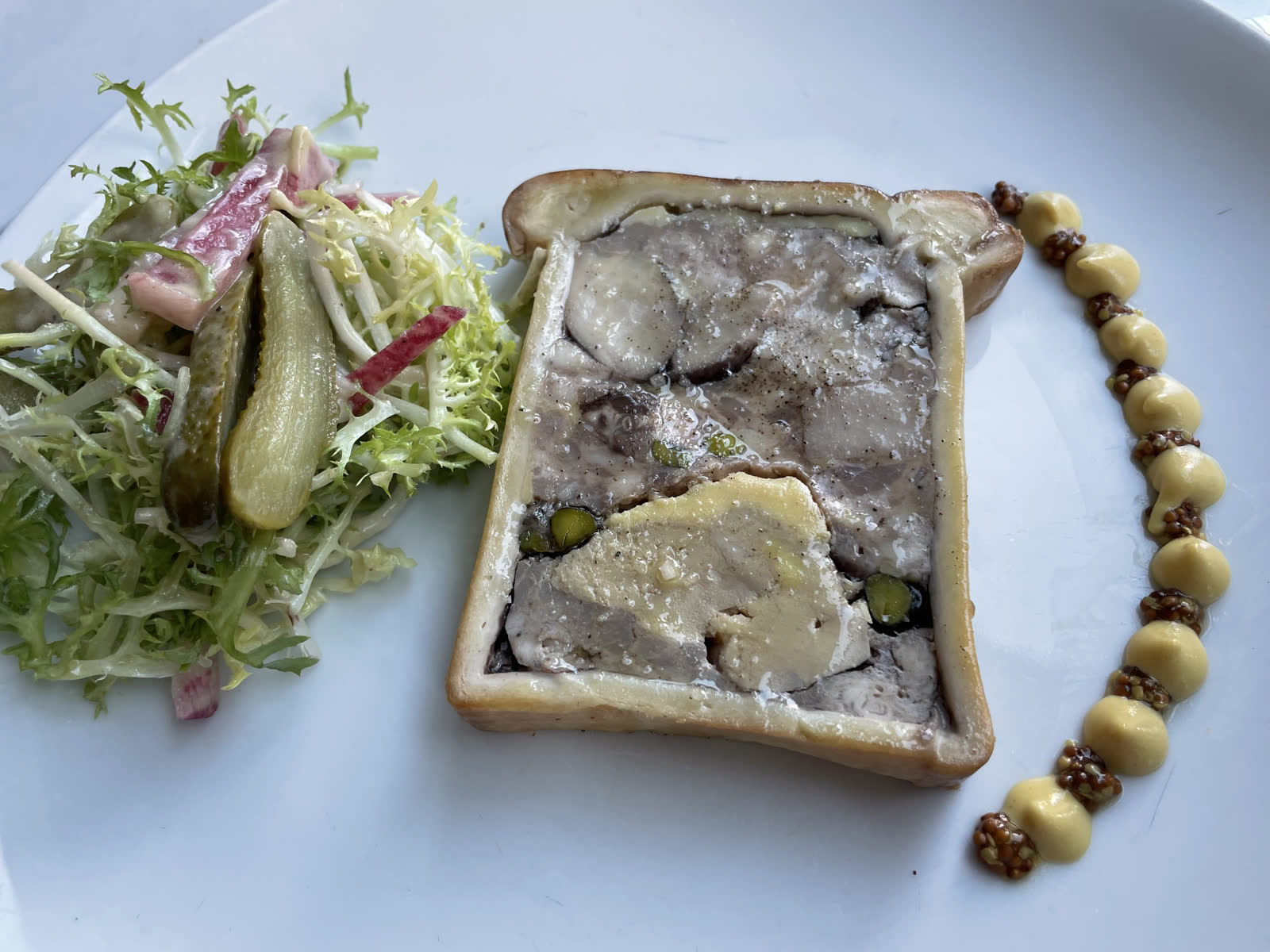
The first trap is vocabulary. Pate is often flattened in English into a spreadable liver preparation, but the French family is wider. The MICHELIN Guide's practical distinction is helpful: pates, terrines, and rillettes are related charcuterie forms, but pate en croute is specifically wrapped in pastry and baked rather than simply packed into a mold or shredded into fat.[3] That wrapper changes everything. The cook is no longer making only a seasoned meat mixture. The cook is building an edible container that must survive moisture, fat, oven heat, cooling, unmolding, refrigeration, slicing, and transport to the plate.
That is why the pastry matters before it tastes like anything. It is structural first. It has to be strong enough to stand upright, sealed well enough to contain steam and juices, and balanced enough not to become a dry wall around a rich interior. Too delicate, and it collapses or goes soggy. Too thick, and the slice becomes a crust exercise with meat trapped inside. The best crust does not call attention to its engineering, but it is engineering all the same.
The forcemeat is the second pressure point. A hot spoonful of seasoned meat can flatter a cook during production; a cold slice will be less forgiving. Salt, fat, spice, alcohol, liver, lean meat, pistachio, poultry, pork, game, or whatever combination the house chooses must taste full after chilling. HOLA Cocina's technical walkthrough emphasizes quality meat, marination, keeping preparations very cold, cooking to a target internal temperature, cooling, and then adding gelatin or aspic after the bake.[4] Those steps sound procedural, but they are where the dish is won or lost.
Cold handling protects texture. If fat smears before the forcemeat is packed, the finished center can feel greasy rather than clear. If the meat is under-seasoned, the pastry makes the problem feel even heavier. If the filling is packed poorly, the slice will show voids. A pate en croute is a rare luxury dish where the guest can see the kitchen's compression work. The cross-section records whether the cook packed with confidence or with anxiety.
Then comes heat, which is less theatrical than it is dangerous. The pastry wants browning and firmness; the filling wants safe, gentle cooking; the eventual slice wants the two to remain attached. Push too hard and the forcemeat shrinks away from the crust. Pull too early and the center lacks the settled density that makes cold charcuterie satisfying. The published technique guidance that points to baking and internal-temperature control is not a footnote.[4] It is the central negotiation: bake enough to cook a meat pie, but not so brutally that tomorrow's slice becomes a ruin.
Aspic is often treated as decoration because it glints. In pate en croute, it is more serious than that. After baking and cooling, meat contracts. The jelly fills the space that heat created, binding the top of the forcemeat back toward the pastry and turning a structural gap into a deliberate layer. It also carries aroma and moisture into a dish that is served cold. Bad aspic tastes like apology. Good aspic makes the slice feel complete.
This is also where the dish becomes fine-dining material rather than deli nostalgia. Fine dining is not defined only by rare ingredients or by plates that look contemporary. It is also defined by accountability. Pate en croute makes a restaurant accountable to time. The kitchen cannot improvise its way out at the pass. The dining room cannot rescue a ragged slice with rhetoric. A service team can frame the dish beautifully, but the geometry has already spoken.
The modern competition circuit shows that chefs understand this. Taste France notes that the Pate-Croute World Championships have been held annually since 2009, with Lyon as the original home and international selections extending to cities including Tokyo, Montreal, and New York.[2] This is not a museum society preserving a lost snack. It is a live technical culture in which chefs are still arguing, by hand, about crust, filling, jelly, seasoning, and cut.
The scale of the 2025 championship makes the point even sharper. The official competition account described the 17th edition as drawing more than 70 candidates through 14 selections, with 4,500 people present, 2,200 tasting boxes, and 9,000 portions served when Thibault Gonzales was named world champion.[1] Those numbers matter because pate en croute is slow food under event pressure. The dish's romance depends on precision, but its contemporary relevance depends on repeatability. A beautiful single slice is one achievement; a competition built around thousands of judged portions says the form still has professional force.
For restaurants, the best use of pate en croute is not as a retro flourish between the amuse-bouche and the fish course. It should clarify the house's values. A rustic version can say that the kitchen respects charcuterie more than ornament. A palace version can say that luxury is discipline held inside pastry. A modern version can season more boldly, cut more cleanly, or change the meat mixture, but it cannot escape the old problem: once the knife passes through, every layer reports the truth.
That is why the dish deserves its current prestige. It compresses many fashionable fine-dining ideas into one unfashionable-looking object. It is low-waste in spirit because trim, fat, stock, skin, bones, and jelly logic can all matter. It is collaborative because pastry and charcuterie have to agree. It is sensory without being loud. It is historical without being inert. It is technical without looking like a diagram.
Most of all, pate en croute slows the restaurant down in a useful way. The cook has to think yesterday for today's guest. The guest has to read a cold slice as an accumulation of hot decisions. The room has to trust that restraint can be more persuasive than spectacle. When it is right, the dish does not shout. It sits on the plate with clean edges, a firm crust, seasoned meat, a line of jelly, and the confidence of something that has already survived all its tests.
Sources
- Championnat du Monde de Pate-Croute, "Who is Thibault Gonzales, spotlight on the 2025 Pate-Croute World Champion" - official competition report on the 2025 winner, candidate pool, selections, attendees, tasting boxes, and portions served.
- Taste France Magazine, "At the Pate-Croute World Championships with Chef Yohan Lastre" - overview of the championship's annual rhythm since 2009, Lyon roots, and international selections.
- MICHELIN Guide, "What's the difference between foie gras and pate?" - guide explainer distinguishing pates, terrines, rillettes, and pate en croute as a pastry-wrapped baked preparation.
- HOLA Cocina, "Como hacer pate en croute" - technical cooking guide covering cold preparation, meat quality, marination, internal temperature, cooling, and gelatin or aspic.
- Wikimedia Commons, "File:Pate en Croute.jpg" - real photograph by Stu Spivack used as the article image.