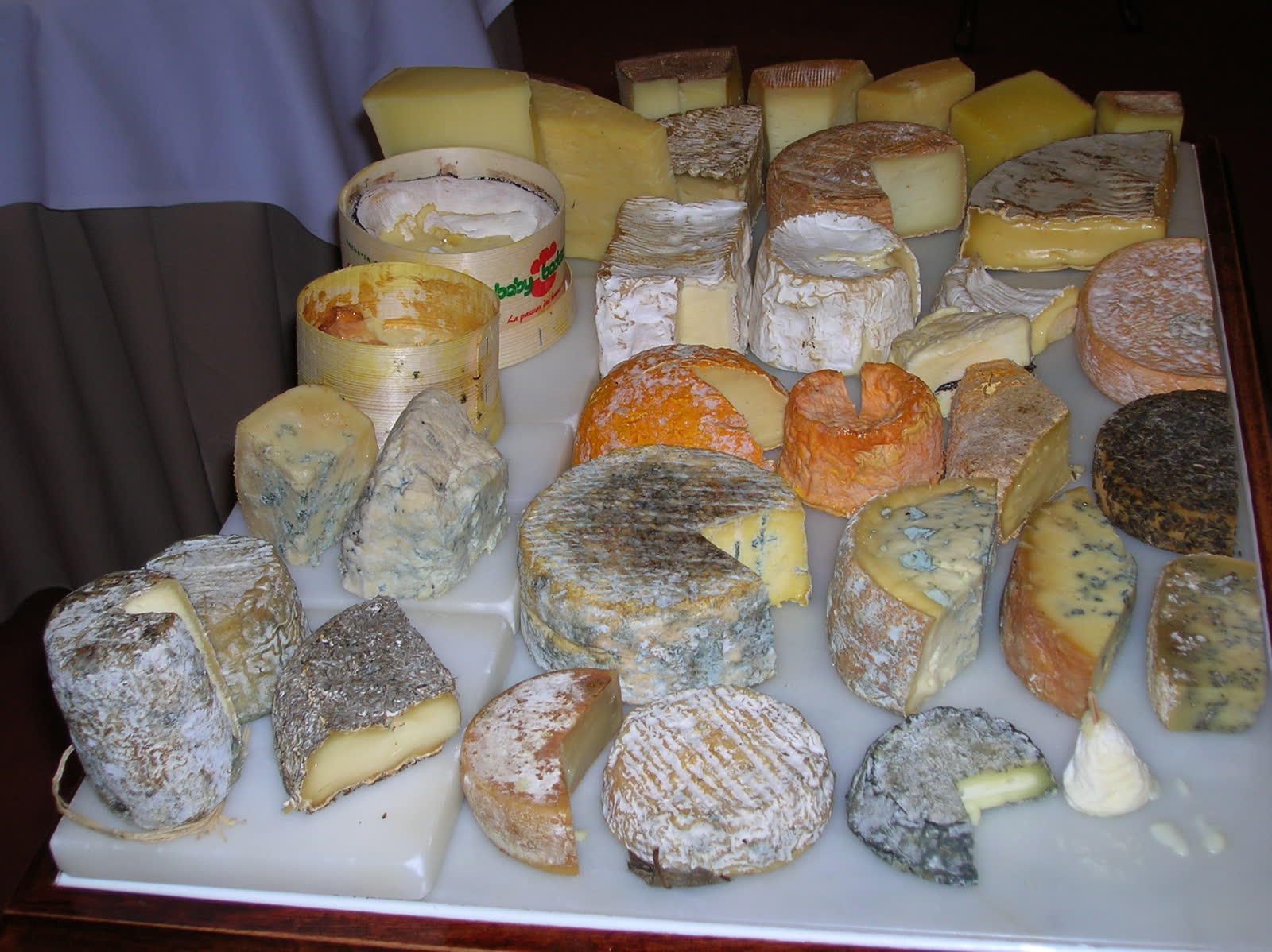
The cheese trolley looks old-fashioned only if you mistake it for furniture. In a serious dining room, it is closer to a live control surface. It brings inventory, temperature, ripeness, knife work, storytelling, portion discipline, and guest hesitation into the same few minutes at the table.
Image context: the cover uses a real restaurant cheese-cart photograph from Wikimedia Commons. The cart is not a plated beauty shot; it shows the actual service problem, with multiple cut and whole cheeses waiting to be read, portioned, and explained in the room.[7]
That is why the trolley still belongs in fine dining. It does something a plated cheese course cannot do as well: it makes choice feel protected. The guest is not abandoned in front of a list of names. A trained person reads appetite, tolerance for funk, wine left in the glass, curiosity, fatigue, and budget. Then the restaurant turns dairy into hospitality instead of homework.
The modern proof is not that every luxury room should bring back a rolling cabinet. The proof is that the rooms still using trolleys have made them more precise, not more sentimental. Restaurant 1890 at the Savoy sells a bar cheese-trolley experience built around five cheeses from a rotating set of twelve British and European varieties, served tableside from a walnut trolley and paired with preserves, honey, garnishes, wines, ports, and alcohol-free drinks.[1] Michelin's note on Gabriel Kreuther in New York still treats an "old-school cheese trolley" as part of the restaurant's night, alongside polished service and Alsatian wine strength.[2] At Steirereck in Vienna, 50 Best describes a whole ecosystem of trolleys: bread, aperitif, tea, cheese, digestifs, and seasonal biscuits.[3]
The lesson is not retro glamour. It is operating design.
The trolley slows the room at the right moment
Cheese arrives when a long meal is in danger of becoming abstract. The savory courses have passed. Dessert may feel inevitable but not yet wanted. The guest is full, but often not finished. A trolley gives the room a pause that is active rather than sleepy.
This pause has practical value. A plated cheese course usually commits the kitchen to a fixed sequence. The trolley lets the dining room adjust. One guest wants a single soft cheese and a last sip of white Burgundy. Another wants three hard cheeses and a pour of Madeira. Someone else wants to know whether the blue is gentle or dangerous. A good server can translate those signals into a plate that feels custom without derailing the kitchen.
That is the difference between abundance and clutter. Desde 1911 in Madrid is described by 50 Best Discovery as finishing its seafood-led menu with either dessert or a cheeseboard from a trolley containing more than 60 iterations.[6] That number sounds theatrical, but it also clarifies the managerial problem. Once the trolley gets large, the restaurant is no longer serving "some cheese." It is running a tiny, mobile cheese counter inside a tasting-menu room.
The counter has to be edited. Too many choices without guidance create anxiety. Too few choices make the trolley feel like decoration. The best version makes the guest feel that there are many paths and that someone competent is steering.
Ripeness is the hidden luxury
The real cost of a cheese trolley is not the cart. It is the condition of the cheese. Whole and cut cheeses are alive with time: soft cheeses relax, washed rinds intensify, blues dry at the edges, hard cheeses lose perfume if cut too far ahead. A restaurant that wheels them into the room is exposing its timing.
The Gorgonzola PDO consortium's practical note on trolleys is useful because it avoids romance. It says dining-room staff must explain history, characteristics, origin, cutting, serving, and tasting order, and it warns that management requires attention: cheeses should not show yellowing from air exposure, and the number offered should stay reasonable to avoid waste.[4] That is the whole system in miniature. Knowledge and freshness are not separate virtues. They reinforce each other.
Restaurant 1890's current offer makes the same point from the guest side. Five cheeses from a rotating collection of twelve is a controlled format.[1] It sounds generous, but it is not endless. The restaurant can manage condition, variety, prep, and explanation because the promise is bounded. A twelve-cheese universe gives range; a five-cheese plate gives shape.
This is where the trolley becomes more modern than it looks. Contemporary tasting menus often sell control: fewer seats, prepaid bookings, short menus, exact pacing, strict allergy policies. The cheese trolley appears to loosen that control, but only because it has moved the control into the dining room. The server becomes the editor.
The guest needs a translator, not a lecture
Cheese has a confidence problem. Many diners know what they like at home but lose certainty when faced with unfamiliar names, milk types, rinds, and intensities. Fine dining can make that worse by turning every choice into a quiz. The trolley works when it lowers the social risk of trying something new.
Tenaya Darlington's first-person Cheese Professor account of driving a cheese cart at Oio in Luxembourg gets this part right. The cart held roughly 10 to 15 cheeses on a given night, and the service became a form of gentle education: asking guests about ash, showing softer cheeses and bolder blues, explaining origin stories, then arranging a plate from soft to hard with accompaniments.[5] Her conclusion is sharper than nostalgia: the cheese cart is not dead, but it needs reinvention and can introduce diners to cheeses they would not choose alone.[5]
That is exactly the hospitality function. The server is not there to recite a dairy encyclopedia. The server is there to make the next bite feel possible. A guest who likes brie may be ready for a ripe triple cream, then maybe a washed rind if the room gives permission without pressure. A guest who says "not too strong" may still enjoy an aged Comte or a sheep's milk cheese with crystalline texture. The art is to hear the limit and find the adjacent pleasure.
The best trolley talk is brief, specific, and responsive. "This one is lactic and chalky." "This one is washed but not aggressive." "This blue is sweeter than it smells." "Take this before that." Those sentences do more work than a long origin speech because they help the guest eat in sequence.
Portioning is part of ethics
A cheese trolley can easily become vulgar. Not because cheese is vulgar, but because the gesture tempts excess. The cart arrives loaded; the guest feels allowed to point; the server wants to delight; the plate becomes too large for the end of the meal.
Good service resists that. It offers abundance without forcing consumption. The portion should respect the rest of the menu, the temperature of the cheeses, the remaining beverage, and the appetite at the table. A beautiful cheese that arrives in a tired slab is no longer generous. It is a failure to read the room.
Waste is the other boundary. The Gorgonzola note's warning about keeping the number of cheeses reasonable is more important than it first appears.[4] Fine dining cannot claim product respect while letting half-exposed wheels dry for theater. The trolley needs a turnover plan: what is cut tonight, what is held whole, what is mature enough to show, what is too tired to sell, and what the staff can confidently describe. A smaller trolley in excellent condition beats a museum of exhausted labels.
This is also why accompaniments matter. Preserves, honey, nuts, bread, and wine are not garnish in the lazy sense. They help portioning make sense. Restaurant 1890's fig and apple preserves, honey, and paired drinks give the cheese course a frame rather than leaving the guest with isolated dairy intensity.[1] The goal is not to sweeten everything. It is to give each cheese a landing place.
What makes it worth keeping
The cheese trolley survives when it does four jobs at once.
First, it gives the guest visible choice at a moment when many tasting menus have eliminated choice almost entirely. Second, it lets the restaurant show product condition in public. Third, it turns staff knowledge into immediate pleasure rather than abstract credentialing. Fourth, it manages the emotional end of dinner: not quite dessert, not quite savory, still social.
That combination is rare. Many tableside rituals are really spectacle with flavor attached. A good cheese trolley is flavor with spectacle disciplined around it. The wheels and wedges are beautiful, but the beauty is perishable. The server's work is to catch them at the right point, cut them cleanly, name them without fuss, and make the guest feel that the plate was chosen with them, not merely for them.
The old trolley deserved to fade whenever it became a dusty parade of status cheeses. The better version deserves attention because it solves a current fine-dining problem: how to restore guest agency without making service feel chaotic. In that sense, the cheese trolley is not a throwback. It is a compact answer to a modern question.
Luxury is not having sixty cheeses roll past you. Luxury is having the right three arrive at the right ripeness, in the right order, with someone nearby who knows why.
Sources
- Gordon Ramsay Restaurants, "Cheese Trolley at Restaurant 1890" - current bar cheese-trolley format, price, five-from-twelve selection, La Fromagerie partnership, tableside service, accompaniments, drinks, and hours.
- MICHELIN Guide, "Gabriel Kreuther - New York" - Michelin restaurant note mentioning the old-school cheese trolley, polished service, and Alsatian wine context.
- The World's 50 Best Restaurants, "Steirereck" - 2025 list profile noting bread, aperitif, tea, cheese, digestif, and seasonal trolleys as part of the restaurant's service identity.
- Consorzio per la Tutela del Formaggio Gorgonzola DOP, "The cheese trolley returns" - trolley tradition, Gorgonzola styles, staff knowledge, cutting order, air exposure, and waste-control guidance.
- Tenaya Darlington, "Cheese on Wheels: What I Learned from Driving a Cheese Cart," The Cheese Professor, February 6, 2023 - first-person account of cart setup, 10-to-15-cheese range, guest education, sequencing, and reinvention argument.
- 50 Best Discovery, "Desde 1911 - Madrid" - restaurant profile describing a seafood-led menu ending with dessert or a cheeseboard from a trolley containing more than 60 iterations.
- Wikimedia Commons, "Cheese Cart in Gordon Ramsay restaurant.JPG" - source page for the article's real restaurant cheese-cart photograph.