Consommé looks too quiet to be dramatic. A shallow bowl of amber liquid, perhaps a few precise cuts of garnish, no tower, no foam, no theatrical pour. That quietness is exactly why it belongs in fine dining. It gives the kitchen almost nowhere to hide. If the stock is weak, the bowl tastes thin. If the clarification is rushed, it looks cloudy. If the seasoning is timid, elegance becomes boredom. If it is too salty, the whole room notices by the second spoonful.
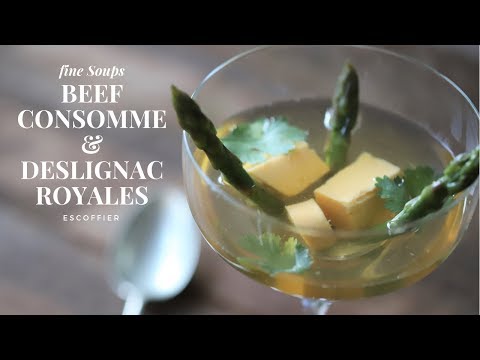
The French Cooking Academy tutorial is useful because it treats consommé as a controlled process rather than as a nostalgic French word.[1] It begins with a broth that already has flavor, then uses the classic egg-white raft to pull suspended particles into a coagulated filter. The New Vintage Kitchen's practical explainer describes the raft as a floating filter made from egg whites, vegetables, shells, and sometimes meat, gelatin, or agar; the important point is that coagulated protein traps what would otherwise cloud the broth.[2] The result should be lucid, not merely strained.
That distinction matters. A fine-dining kitchen can buy luxury, but it cannot buy clarity after service has begun. Consommé asks for patience before the guest ever sits down: a well-made stock, clean skimming, controlled simmering, disciplined aromatics, and enough restraint to let the liquid stay readable. The video gives the process a practical shape; the deeper lesson is that clarity is not a visual flourish. It is a record of decisions.[1][2][3][4]
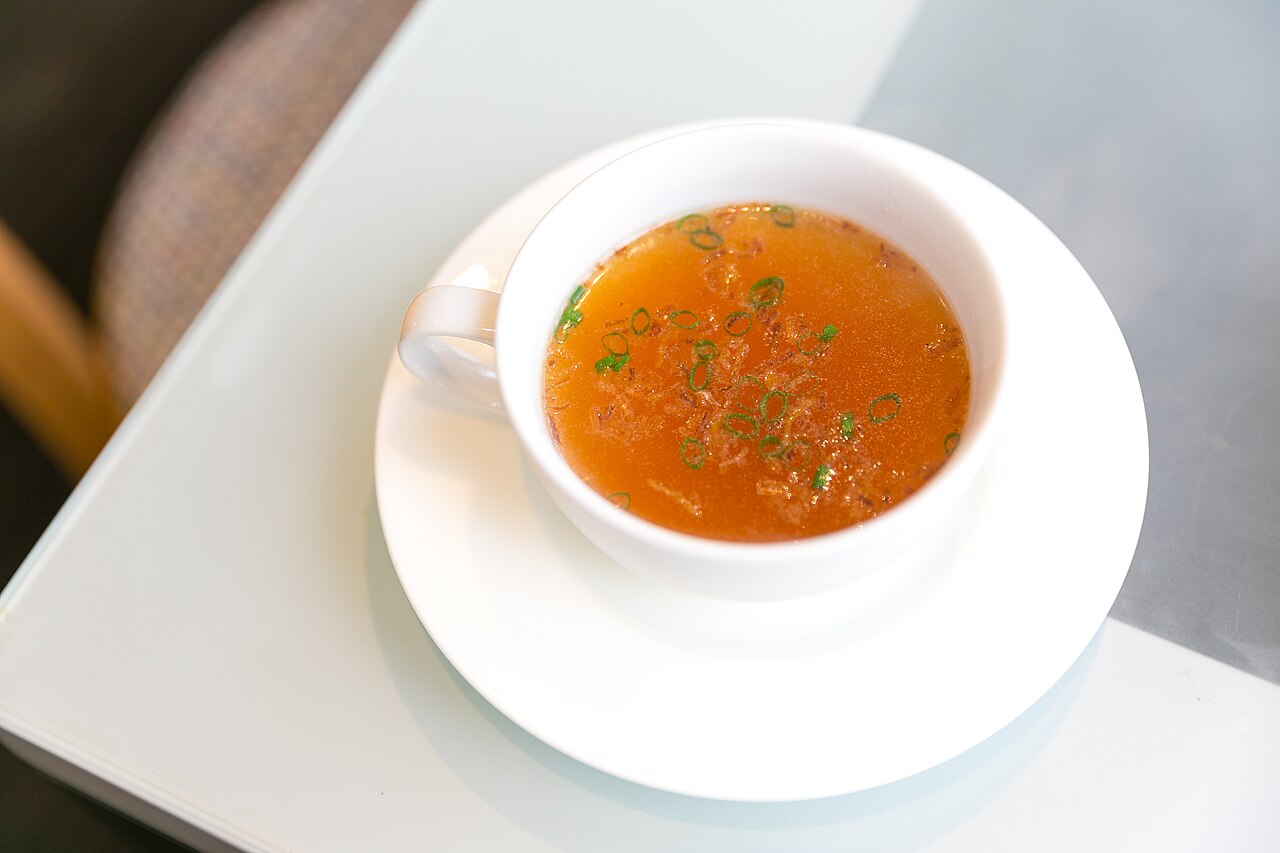
Image context: the cover uses a real photograph of a clear consommé bowl, not a diagram of a raft or a stylized ingredient image. That matters because the finished object is the argument: transparent broth, visible garnish, no visual camouflage, and a service promise that the liquid can stand by itself.[5]
The Raft Is A Filter And A Risk
The central thing to watch is the raft. In a weak explanation, the raft sounds like kitchen folklore: egg whites float up, impurities vanish, soup becomes clear. The actual mechanism is less magical and more demanding. WebCookingClasses describes the classical clearmeat as egg whites, ground meat, mirepoix, and an acidic ingredient such as tomato or wine; as the proteins coagulate, they form a raft that filters the stock while adding some flavor back.[3] Kvalifood's stock-clarification guide makes the same heat lesson visible: once the temperature climbs, egg whites coagulate and trap rising proteins and impurities.[4]
That is why the video is worth watching closely. The danger is not only that the stock might remain cloudy. The danger is that the cook might break the very tool meant to clarify it. Stir too late, boil too hard, or let the raft collapse, and the pot turns from precision into muddy broth.[1][3][4] WebCookingClasses is blunt about the failure mode: a rolling boil breaks up the protein raft and makes the original stock even cloudier.[3]
Fine dining likes visible virtuosity: carving, saucing, flame, tweezers, synchronized delivery. Consommé is the opposite. It asks the cook to make a fragile system, then leave it alone. That is an underrated professional skill. A young cook often wants to fix by touching. Consommé teaches a harder form of control: build the conditions, manage the heat, cut a chimney or opening, baste carefully if needed, and resist the urge to agitate the pot. The final bowl is calm because the cook has been disciplined upstream.[1][4]
Why A Clear Soup Can Feel Expensive
The obvious question is why a diner should care about clarity at all. In a tasting menu, visual transparency can seem less impressive than caviar, truffle, dry-aged meat, or an elaborate pastry. But consommé makes expense legible in a different way. It concentrates flavor, removes noise, and asks the garnish to behave like punctuation rather than decoration.[2][3][4]
The professional-school framing is useful here because it refuses to treat consommé as plain broth. WebCookingClasses calls the recipe less important than the procedure: the final product should be clear, grease-free, and intensely flavored, with the raft working as the filter rather than as a garnish.[3] The point is not poverty of means. It is compression. The kitchen has already spent labor on bones, meat, aromatics, skimming, clarification, and straining; the guest receives a bowl that looks almost effortless.
That effortlessness is a service effect. A consommé course early in a meal can reset the table after richer snacks. It can tell the guest how the kitchen thinks about salt, acid, aroma, and temperature before heavier courses arrive. It can also expose whether the room has confidence. A server does not need to over-explain a clear broth if the bowl is alive. Conversely, no speech can rescue a dull one.
The video's strongest lesson, then, is not a home-cooking promise that anyone can make a perfect consommé on the first try. It is a fine-dining reminder that simple-looking courses often carry the strictest standards. The clearer the food looks, the more visible the mistakes become.[1][3][4]
What To Notice When Watching
Watch how much of the work happens before the final strain.[1] The finished liquid depends on the starting broth, the size and distribution of the clearmeat, the temperature curve, and the cook's patience. If the stock begins as a lazy extraction, the raft cannot invent depth. If the simmer is violent, the clarification can be undone. If the strain is careless, the hard work gets re-clouded at the last step.
Also notice how the process turns waste-looking matter into refinement. The raft is not pretty. It is protein, vegetable, and captured sediment doing a job. The New Vintage Kitchen notes how unappealing the mixture can look before it clarifies the stock, which is precisely why the transformation matters.[2] Fine dining often hides labor behind smooth surfaces; consommé lets you understand the hiding process itself. The table sees the lucid bowl, but the kitchen knows that lucidity came through a temporary mess.
Finally, notice how little garnish the final bowl needs. Kvalifood separates ordinary strained stock, clear stock, and crystal-clear consommé by how much clarification the liquid needs, which helps explain why the finished bowl should not be crowded.[4] That restraint is not a lack of imagination. It protects the liquid's authority. A few cuts of vegetable or herbs can show scale, color, and care. Too much garnish turns the course back into soup and weakens the thing that made consommé demanding in the first place: the broth has to carry the argument.
The Contemporary Lesson
Consommé can sound old-fashioned because the technique belongs to the classical French kitchen, but the modern lesson is not retro. It is about information density. A clear broth tells the diner whether the kitchen can concentrate flavor without heaviness, whether it can use protein chemistry without gimmickry, and whether it can trust restraint in a dining culture that often rewards spectacle.[1][3][4]
That is why the egg-white raft still matters. It is not the only possible clarification method, and modern kitchens have other tools. But the classical raft remains pedagogically sharp because its failure modes are visible. It teaches cooks that precision is not the same as complication. It teaches guests that transparency can be luxurious when the liquid underneath has depth.
The best consommé course does not ask to be admired for difficulty. It simply arrives clear, hot, aromatic, and complete. Then the guest tastes what the eye has already been told: the kitchen had control before it had decoration. In fine dining, that may be one of the cleanest service promises a bowl can make.
Sources
- French Cooking Academy, "How to clarify a Broth and make a consommé at home : Tutorial" - YouTube video demonstrating classic consommé clarification with an egg-white raft.
- Dorothy Reinhold, "Conjuring Clarified Consommé." The New Vintage Kitchen, October 30, 2018 - practical explanation of the raft as a floating filter and the careful ladling and straining process.
- Chef Todd Mohr, "A Consomme Recipe That You'll Never Try." WebCookingClasses, 2012 - culinary-college framing of clearmeat, raft formation, simmer control, and rolling-boil failure.
- Kvalifood, "Clarifying Stock - with an egg raft" - technical note on egg-white coagulation, stock clarity levels, and gentle straining.
- Wikimedia Commons, "File:Consommé soup.jpg" - real 2015 photograph by City Foodsters of a clear consommé bowl at Loup de Mer in Tokyo, used as this article's image.