
Central's 9-minute, 20-second official short from 2010 matters because it catches the restaurant before the now-familiar rhetoric around altitude and biodiversity hardened into global fine-dining shorthand.[1] The film does not yet speak in the polished, current language of the official site, where Central calls itself "a vertical journey through the Peruvian territory" and says its tastings celebrate the country's altitudinal diversity through work done with Mater, local communities, artists, and researchers.[2] Nor does it yet sound like the neat capsule on 50 Best Discovery, which describes an innovative tasting menu built from extensive research into Peru's pantry and structured across elevations from below sea level to the Andes.[3] What the short already shows, however, is the underlying method that makes those later descriptions credible. Central's real luxury is not that it imports geography into the dining room as scenery. It turns geography into staging.
That distinction matters because plenty of restaurants borrow the language of place while leaving the room itself unchanged. Central's current materials suggest a more difficult ambition. The official site describes the project as one that creates maps of biological and cultural diversity and interprets Peruvian territory through immersive tastings.[2] The 50 Best Discovery profile makes the same claim in guest-facing terms, saying the menu explores the country's altitudes through a sequence of more than seventeen courses.[3] The early film gives those statements a working grammar. It moves from shoreline and harvest images to kitchen handling and finally to the composed dining room, as if the restaurant's actual product were not a plate but a carefully edited relay between ecosystems, research, and service.[1]
That is also why the video feels unusually useful in 2026. A Guardian report on Central's rise to the top of the international rankings framed Peru's culinary ascent as the global recognition of a food culture shaped by a rich range of crops, ecosystems, and history.[4] The official short helps explain how a restaurant could convert that scale into an intimate meal without reducing Peru to branding copy. It does so through sequence. The coast, the plants, the hands in the field, the cooks in the kitchen, and the guests in the room are not separate themes. The movie stages them as linked chambers in one argument. Central is not selling the landscape as backdrop. It is building a dining-room cartography.
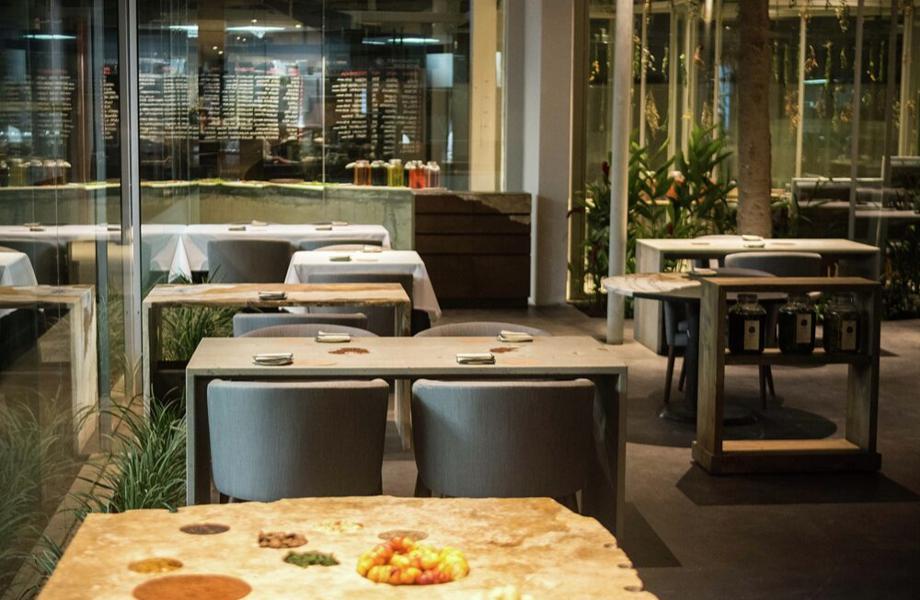
Image context: the cover uses a 50 Best Discovery photograph of Central's dining room rather than a plated dish. That choice fits the article because the video's deepest point is architectural. The film suggests the restaurant's achievement lies in how it receives territory into a room with enough calm, spacing, and legibility to keep all that ecological ambition from collapsing into spectacle.[5]
Around 0:00 to 2:00, the film refuses to let the restaurant begin in the kitchen
The opening passage is full of water, shoreline, vegetation, and people working close to the ground before the film settles into more recognizably culinary images.[1] That structure is not ornamental. It establishes that Central does not want the meal to be read as a purely urban act of refinement. Before we get to the pass, the short insists on distance traveled: ingredients exist inside ecosystems first, and only later inside cuisine.
Seen against the official site, that opening now reads almost like a prototype for the language Central later adopted. The restaurant currently describes Peru as a country understood only by experiencing it in its entirety, then names the sequence of sea depths, Andean peaks, cloud forests, Amazon, and coastal valleys that define its tastings.[2] The 2010 film does not deliver that taxonomy in words, but it already performs it visually. The camera keeps saying that the restaurant's unit of meaning is not the ingredient by itself. It is the ingredient plus terrain, labor, and movement.[1][2]
This is where the Guardian framing is helpful. Its report on Peru's culinary emergence emphasized that the country's cuisine became globally legible because of its crops, ecosystems, and history rather than because of one exportable dish.[4] Central's opening images seem built to solve precisely that translation problem. The restaurant cannot bring the whole territory into Barranco, so it creates a relay of signs that preserves origin without pretending the dining room is the origin itself. That is a stronger and more disciplined approach than simple terroir theater.
Around 2:00 to 5:30, fieldwork becomes research, and research becomes choreography
The middle stretch is where the short gets most revealing. We move through gathering scenes, close observations of plants and materials, and then into kitchen work that feels less like spontaneous inspiration than like sorting, comparison, and transfer.[1] This is where Central stops looking like a chef's travel montage and starts looking like a system. The film implies that field experience is only the first stage. What matters is the conversion process that follows: documenting, selecting, translating, and finally sequencing those findings so they can survive contact with service.
The official site now makes that structure explicit through Mater, the research center tied to Central and led by Malena Martínez, Virgilio Martínez, and Pía León.[2] Mater is described not as a decorative side project but as a platform for exploring and documenting the territory's megadiversity, then translating that knowledge into the experiences at Central and the group's other restaurants.[2] The Discovery profile sharpens the guest-facing outcome: extensive research into Peru's pantry becomes a tasting menu whose courses climb and descend through elevation.[3] The early film matters because it lets you see the hinge between those two statements. Research is not presented as background prestige. It is the hidden labor that allows geography to become dinner without turning vague.
That hidden labor is also why Central's approach feels different from restaurants that merely accumulate exotic ingredients. The movie keeps returning to acts of handling and passage: people carrying, cleaning, arranging, checking, and cooking.[1] These gestures matter because they turn the idea of "Peruvian biodiversity" into a chain of responsibility. One ecosystem does not simply appear on one plate. It has to be interpreted, edited, and paced. In that sense, Central's signature luxury is intellectual hospitality. The restaurant does not only source from diverse landscapes; it builds a route through them that a diner can actually follow.
Around 5:30 to the end, the dining room appears as the map's final legend
By the last third, the video has earned the calmness of the room. We see a polished service environment, plated dishes, and guests receiving a sequence whose force depends on everything that came before.[1] The dining room is not a glamorous interruption to the field material. It is the place where the argument becomes legible. If the early scenes establish territory and the middle scenes establish translation, the late scenes establish reading conditions. Central needs a composed room because composed rooms help guests understand sequence, contrast, and escalation.
That is why the dining-room photograph used here is more than illustration.[5] It clarifies a structural point visible in both the film and the current written materials. The official site says Central tells stories arising from the dialogue among landscapes, people, and the inputs that define them, while also creating maps of biological and cultural diversity.[2] The Discovery profile translates that into the form of the meal itself, with a long tasting progression moving from below sea level to high altitude.[3] Neither claim works if the room behaves like neutral luxury decor. The room has to act as the legend on a map: the place where a complicated set of references becomes readable in order.
This is what the 2010 short already understood. Central's power does not come from dressing nature up as prestige content. It comes from arranging research, ingredient knowledge, and service rhythm so that the diner experiences Peru as a sequence of relations rather than as a pile of rarities.[1][2][3] That is a harder achievement than spectacle, and it may be the real reason Central stayed so influential once the global rankings caught up. Many restaurants can narrate a landscape. Fewer can stage one.
Replay the short with that in mind and the film becomes less promotional and more diagnostic.[1] The coast is there to establish distance, the gathering scenes are there to establish responsibility, the kitchen is there to establish translation, and the room is there to establish legibility. Central's dining room is not the opposite of territory. It is the instrument that lets territory be read.
Sources
- Central Restaurante, "Central Restaurante," YouTube video, published October 12, 2010.
- Central Restaurante official English site, covering the restaurant's "vertical journey" framing, altitudinal diversity, mapping language, and Mater collaboration.
- 50 Best Discovery, "Central - Lima - Restaurant," covering the restaurant's research-led tasting menu and altitude-based course structure.
- The Guardian, "Lima's Central restaurant named world's best in boost for Peruvian cuisine," on Peru's cuisine as a product of crops, ecosystems, and history reaching global recognition.
- 50 Best Discovery image asset used for the lead photo of Central's dining room.