Rio luxury dining can drift toward seduction very quickly. The city is good at atmosphere, and ambitious restaurants often lean into that gift: more spectacle, more lushness, more insistence that pleasure must announce itself loudly. Oteque works in the opposite direction. Its strongest move is restraint. Chef Alberto Landgraf takes a discreet house in Botafogo, a seafood-led tasting menu, and an unusually exposed supplier logic, then reduces the whole thing until flavor has nowhere to hide.[1][3][4]
As of April 26, 2026, Oteque's own site still defines the project in spare but revealing terms. It calls the restaurant Landgraf's "carioca" project, says the team focuses on high-quality ingredients with "an elegant yet casual service," and frames local freshness plus ethical farming as core values.[1] The same page confirms one tasting menu, prepaid reservations only, Tuesday-to-Saturday dinner service from 19:00 to 23:30, and a cancellation policy that converts timely cancellations into transferable vouchers rather than open-ended flexibility.[1] Those details are not administrative filler. They tell you the house is built around one disciplined lane.
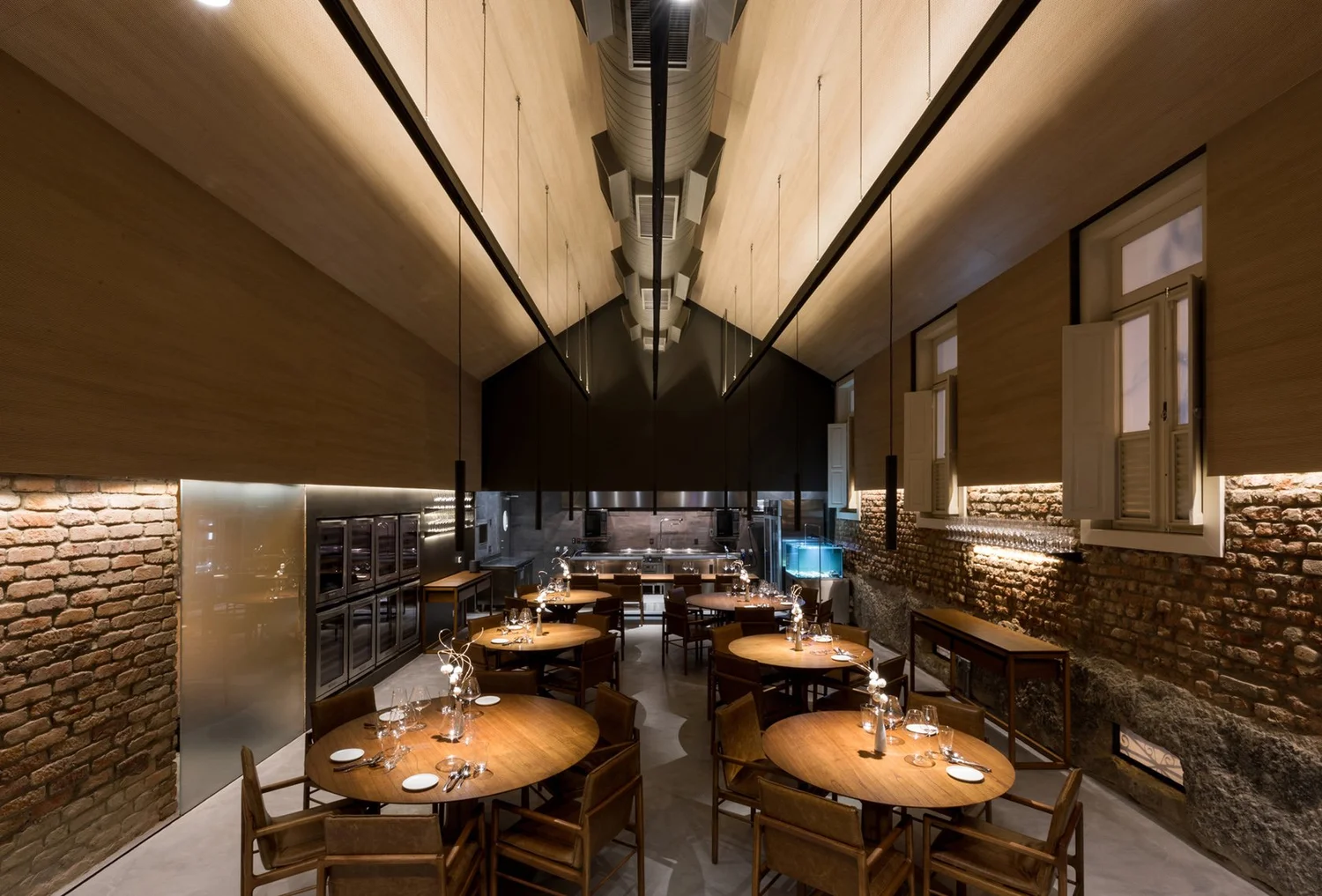
Image context: the lead image uses Oteque's own dining-room photograph because the room is part of the thesis. The long narrow volume, exposed brick, warm wood ceiling, and open kitchen at the back turn attention forward. Before the first course lands, the architecture has already warned you that this is a restaurant trying to sharpen Rio rather than romanticize it.[1]
1. The room lowers the volume on purpose
The 50 Best Latin America profile is useful because it captures the contradiction that gives Oteque its charge. From the street, the front door is described as discreet and unassuming; inside, the restaurant opens into a carefully refurbished 1938 house in Botafogo, mixing modern and minimalist architecture with a far older shell.[4] Michelin's current listing sharpens the same visual logic in service terms: the room carries weathered red-brick walls, a faintly industrial air, six large round tables, and one elongated table set in front of the open kitchen.[3]
That layout matters because it rejects the usual luxury trick of scattering your attention. Oteque does not appear to want guests gazing in five directions at once. The room pulls the eye toward one active point: the kitchen. The house remains cosy rather than monumental, but it never reads as casual in the sloppy sense. It reads edited.[3][4]
This is why the phrase "elegant yet casual" on the official site is more exact than it first looks.[1] Many restaurants use those words as generic reassurance. At Oteque, they describe a real tension. The brick and timber keep the space from hardening into hotel polish; the line of sight to the pass keeps it from relaxing into neighborhood informality. The room does not deny Rio's warmth. It narrows that warmth into concentration.
2. The supplier list makes the style believable
Oteque's most revealing public page may be the plainest one: the partners list.[2] Many serious restaurants talk about quality, ethics, and seasonality. Far fewer publish such a direct map of who helps make those words real. Oteque separates its network into produce, fish & seafood, dairy, meat & poultry, and a notably extensive wine section, then names specific partners across each lane.[2]
That transparency changes how the food should be read. It suggests Landgraf does not want "freshness" treated as a mystical chef trait that appears only at plating. He is willing to show the upstream structure. Produce comes through named growers and distributors such as Cafundo, Manaca, Organicos da Fatima, Sitio do Moinho, and King Funghi; seafood comes through partners such as Amaral Pescados, Vieiras da Ilha, and Frescatto.[2] Even the wine side is presented as a working network rather than a decorative cellar fantasy, with multiple importers and Brazilian sparkling producers visible on the page.[2]
For a seafood-first restaurant, that matters a great deal. Seafood luxury can become vague very quickly because the ingredients already carry prestige. Oteque tries to stop that drift by making procurement legible. The restaurant is not asking you to admire rarity in the abstract. It is asking you to trust a chain.[1][2]
3. One tasting menu, many small daily corrections
The official info page says Oteque serves one tasting menu based on local and fresh ingredients, with the sample menu subject to change according to seasonality and availability.[1] Michelin adds the operational consequence: the proposition centers on a single tasting menu in which some dishes are replaced daily according to what is best and freshest that day.[3] Put together, those two statements explain the house style better than a long manifesto would.
This is not maximalist abundance disguised as choice. It is a one-lane format that keeps editing power in the kitchen. The 50 Best profile describes the menu as a celebration of fish and seafood, balancing texture, acidity, and temperature rather than burying ingredients under technical noise.[4] Its example dishes, like langoustine over embers with kale, shio kombu, and sherry, or oyster with leeks and tucupi sauce, point toward a cuisine that wants flavor to stay transparent even when the technique is sophisticated.[4] Michelin's own examples push in the same direction: langoustines with pirão and aromatic pepper, plus in-house bread served straight from the oven.[3]
That is where Oteque becomes more than a fashionable seafood room. Simplicity here does not seem to mean rustic looseness. It means pressure. Once the house commits to one tasting menu, prepaid entry, and frequent product-led substitutions, every course has to justify why it survived the edit.[1][3]
4. Why Oteque still feels sharp now
Oteque's backstory helps explain why the restaurant still reads so clearly in 2026. The 50 Best insider piece from Oteque's early international rise notes that Landgraf closed his Sao Paulo restaurant Epice in 2016, took time to plan, and reopened in Rio two years later inside a converted 1938 house.[5] The current Latin America ranking page then shows what that reboot has grown into: a restaurant ranked No. 38 in the 2025 list, with a six-seat chef's table, a cocktail bar, and an identity grounded in Landgraf's Brazilian, Japanese, and German background as well as training in Japan and London.[4]
The interesting part is that Oteque does not sell that biography as fusion theater. The menu is technique-led, but the feeling described across the sources is calmer than that. There is a relaxed soundtrack in the background, an open-plan room, and a kitchen that appears to prefer clean edges to conceptual overstatement.[4][5] In a city that could easily tempt a chef into tropical excess, Oteque's discipline is the differentiator.
That is why the restaurant deserves a profile now. Plenty of high-end rooms can source expensive fish. Plenty can design a beautiful house. Plenty can market "seasonality" and "casual elegance." Oteque's edge is that its public evidence lines up unusually well: one direct room, one tasting-menu lane, a visible supplier map, and a seafood vocabulary built around clarity rather than noise.[1][2][3][4] It makes Rio feel edited, not diminished. That is a much harder trick.
Sources
- Oteque, "Info" - official page with the restaurant concept, tasting-menu format, prepaid reservations, cancellation policy, opening hours, and address.
- Oteque, "Partners" - official supplier page listing produce, fish-and-seafood, dairy, and wine partners.
- MICHELIN Guide, "Oteque - Rio de Janeiro - a MICHELIN Guide Restaurant" - current listing covering the discreet facade, red-brick dining room, open-kitchen layout, one-star status, and daily-shifting tasting menu.
- Latin America's 50 Best Restaurants, "Oteque | Latin America's 50 Best Restaurants 2025 | Ranked No. 38" - current profile covering the 2018 opening, 1938 Botafogo house, six-seat chef's table, Landgraf's background, Art of Hospitality award, and representative seafood dishes.
- The World's 50 Best Restaurants, "What to order, insider info and how to book the venues in The World's 50 Best Restaurants 2019 51-120 list" - early international profile covering Landgraf's post-Epice comeback, the converted 1938 house, soundtrack, organic vegetables, and pairing cues.