There is an easy way to misread Masque in 2026. You can walk in looking for the usual signals of global tasting-menu seriousness and conclude that the room is too alive.
Masque does not behave like a pin-drop temple. Its own public language still frames the restaurant as an ingredient-driven 10-course chef's tasting menu, set in Mumbai's former industrial mill area and described as a first of its kind in India.[1][2] Asia's 50 Best Restaurants now ranks it at No. 15 in the region and names it The Best Restaurant in India 2026.[3] Yet the strongest recent description of the house came not from a ranking blurb but from 50 Best's Art of Hospitality Award feature in February 2026, which treated the restaurant's exuberant welcome as the real story.[4] Read together, those sources point toward a clearer claim. Masque works because it has figured out how to turn Mumbai energy into service design rather than trying to sterilize it away.
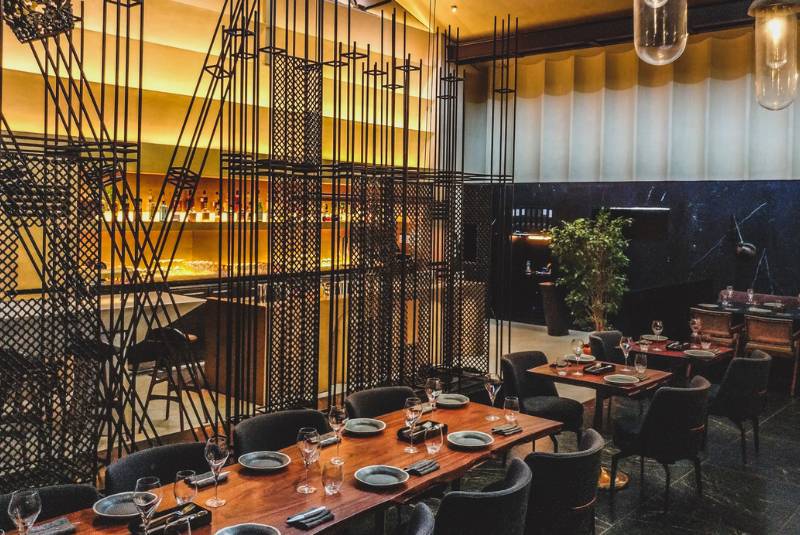
Image context: the lead image uses a real 50 Best Stories photograph of Masque's dining room, with its metal divider and warm light. That choice is deliberate. The article is about operational atmosphere, not just plated technique, and this room shows the argument before the first course lands.[4]
1. The room converts surprise into appetite
Masque's service logic starts before the menu does. The hospitality-award profile describes the old textile-mill site as a cavernous former shed, hidden down a lane off the main road, with the entry still carrying a note of surprise even for prepared guests.[4] The room inside does not flatten that industrial history. It uses it.
The black metal partitions, long tables, bar glow, and wide volume keep the shell legible as a former factory rather than smoothing it into anonymous luxury.[4] That matters because the restaurant's basic trick is not to erase the city's scale and intensity. It is to absorb that intensity and redirect it. Many ambitious tasting rooms aim for reverent quiet. Masque chooses a different conversion. It lets scale remain visible, then answers it with warmth.
That is why the room feels more specific than a generic "industrial-chic" label suggests. The former mill is not just a backdrop for the food. It is the first operational move. Diners arrive with Mumbai still in their system, and the room gives them an environment large enough to accept that energy without becoming chaotic.
2. Warmth here is managed, not improvised
The 50 Best hospitality profile is unusually explicit about the philosophy. Aditi Dugar says that when she and Aditya travel, they often find fine dining defined by unnatural hush, while Masque wants noise, chaos, and energy because those belong to ordinary life in India.[4] Head chef Varun Totlani connects that attitude to a deeper cultural ethic: the guest is treated as if entering a home, not a shrine.[4]
That would be empty branding if the article did not also show how the house supports it. The same feature describes guests being invited into the kitchen for one course, a memory wall filled with gifts and cards, and a polaroid handed over at the end of the meal with the menu.[4] Those gestures do not function as cute extras. They distribute memory across the night. Instead of letting the meal live only in the sequence of dishes, Masque builds repeated points of human recognition into the service flow.
This is why the room can stay lively without losing control. A warm room is only persuasive when the back-end system is clear enough to hold it. The article notes long staff tenure, people who have stayed from the beginning, internal growth across roles, and a leadership style that avoids puppeteering the team.[4] In operational terms, that means ease is being produced by continuity. The friendliness in the dining room is not a mood pasted over pressure. It is pressure that has been organized well enough to become social.
3. The food reinforces the room's collective style
Masque's cooking could have pulled the restaurant in a more didactic direction. The public pages show why it does not.
The official food page says the house is built around local farmers, producers, and foraging trips, while seasonal menus revisit Indian ingredients and techniques through the Masque lens.[2] The same page now publicizes a 10 Course Menu - Rs. 8085, so the restaurant is not hiding its format behind vague luxury language.[2] Asia's 50 Best's current profile then sharpens the picture with example dishes: prickly pear with nagphani and coconut malai, sunchoke with ghassi, smoked pork with Kashmiri chilli and poha, dosa with koji, and burnt ghee with saffron and pear toast.[3]
That list matters because it shows a room that is ingredient-driven without turning solemn about it. The menu's seriousness lies in extraction and transformation, not in performing purity. Local produce, fermentation, grill work, and regional references are all present, but the plates still move with pleasure first.[2][3] In other words, the cooking supports the social temperature of the room. It is exploratory, but not frozen. It invites conversation instead of shutting conversation down.
This is one reason Masque feels more complete than restaurants that treat sourcing alone as moral authority. The ingredient story matters here, but it is tied to hospitality rather than set against it. The guest is meant to feel curiosity and delight together.
4. Masque Lab keeps experimentation from clogging the main room
The smartest operational decision may be the existence of Masque Lab itself. The official food page calls it the restaurant's R&D and test kitchen, opened in 2020 to deepen work on local ingredients and flavor development.[2] Asia's 50 Best adds the useful detail that the lab also works as a 12-seat private dining room where the team can stage more experimental dinners.[3]
That arrangement solves a common fine-dining problem. Once a restaurant becomes famous for innovation, every service risks carrying too much conceptual weight. The dining room can start feeling like a lab with tablecloths. Masque avoids that trap by giving experimentation its own valve. New techniques, aging work, pickling, fermentation, and cross-cultural tests can happen in the lab without forcing the main room to explain every thought at full volume.[2][3]
This separation helps the restaurant preserve generosity. The flagship room gets to stay welcoming and legible, while the research function stays active and ambitious nearby. That is an operational distinction, not a branding one. It is part of why the restaurant can keep moving without becoming heavy.
Why the hospitality award fits
By now the public accolades line up in a neat way. The restaurant's own current pages still present a strong, first-of-its-kind 10-course format in a former mill.[1][2] Asia's 50 Best confirms the regional standing, the menu examples, and Totlani's rise from commis to head chef in 2022.[3] The February 2026 Art of Hospitality feature explains the softer variable that rankings usually flatten: the house has decided that exuberance belongs inside fine dining, and it has built enough structure to make that choice hold.[4]
That is why Masque remains sharp rather than merely fashionable. Plenty of restaurants can source well. Plenty can lecture elegantly about local ingredients. Fewer can hold a large room, a serious tasting menu, an active R&D culture, and a visibly human service style in one coherent rhythm. Masque's luxury is not silence. It is the confidence to let the room breathe, then guide that breath into a meal.
Sources
- Masque official homepage, covering the restaurant's current positioning as an ingredient-driven 10-course tasting menu in Mumbai's former industrial mill area and its claim to be a first of its kind in India.
- Masque official food page, covering Aditi Dugar and Varun Totlani's current roles, local-farmer and foraging language, the 2020 opening of Masque Lab, and the currently advertised 10 Course Menu at Rs. 8085.
- Asia's 50 Best Restaurants 2026, "Masque," covering the No. 15 regional ranking, The Best Restaurant in India 2026 accolade, menu examples, Varun Totlani's promotion to head chef in 2022, and the 12-seat Masque Lab private dining room.
- 50 Best Stories, "Energetic, authentic and now award-winning: Masque's hospitality is the best in Asia" (February 10, 2026), covering the Art of Hospitality Award, the former factory setting, the anti-silence service philosophy, the kitchen course, polaroid ritual, team continuity, and the dining-room photograph used here.