
It is easy to hear the phrase "culinary garden" and imagine that Baan Tepa is selling a mood before it sells a meal. The restaurant's own materials push against that lazy reading. The home page frames the project as "a journey rooted in terroir, reimagining tradition with refined creativity," and it names dishes like "Dong Dang" and "Crab Crab Crab" without apology.[2] The 50 Best Discovery profile sharpens the structure further: Baan Tepa is a hybrid space inside a converted family house, with an open-kitchen dining room, chef's table, workshop, and verdant garden acting together rather than separately.[5] MICHELIN reduces the pitch to its usable core by calling it a polished seven-course Thai tasting menu.[3] Put together, the stronger claim is that Baan Tepa wants to make local Thai ingredients more legible under pressure, not more abstract.
That is why the Gastrofilm short is worth more than a generic chef profile clip.[1] It does not spend six minutes insisting on awards, nor does it confuse sustainability language with moral halo. Chef Chudaree "Tam" Debhakam begins with a direct sensory claim: Thai ingredients are unique in flavor, essence, and aroma, and the restaurant's job is to showcase them creatively while keeping a live link to the garden behind the house.[1] From there, the video keeps returning to a single idea in different forms. The garden is perspective. The kitchen is translation. The drinks program follows the same rules as the food. "Learning space" is not branding wallpaper; it is the operating condition.[1]
That emphasis matters because fine dining often reaches for the language of terroir only after the dishes have become too smooth. Once enough luxury signals pile up, place can turn decorative. Baan Tepa appears to be trying for the opposite effect. The 50 Best Discovery text says Tam traveled Thailand, met farmers, and built the Tepa Garden behind her grandmother's compound around rotational farming, herbs, spices, and heritage vegetables.[5] The video gives that institutional story a more useful texture. You see flowers being picked, herbs being handled, a broth being watched, a dining room opened up to the kitchen, and a cocktail being explained through its plant logic rather than through bar theatrics.[1] The restaurant's argument is not that nature is pretty. It is that ingredients become more exact when the whole house learns how they behave.
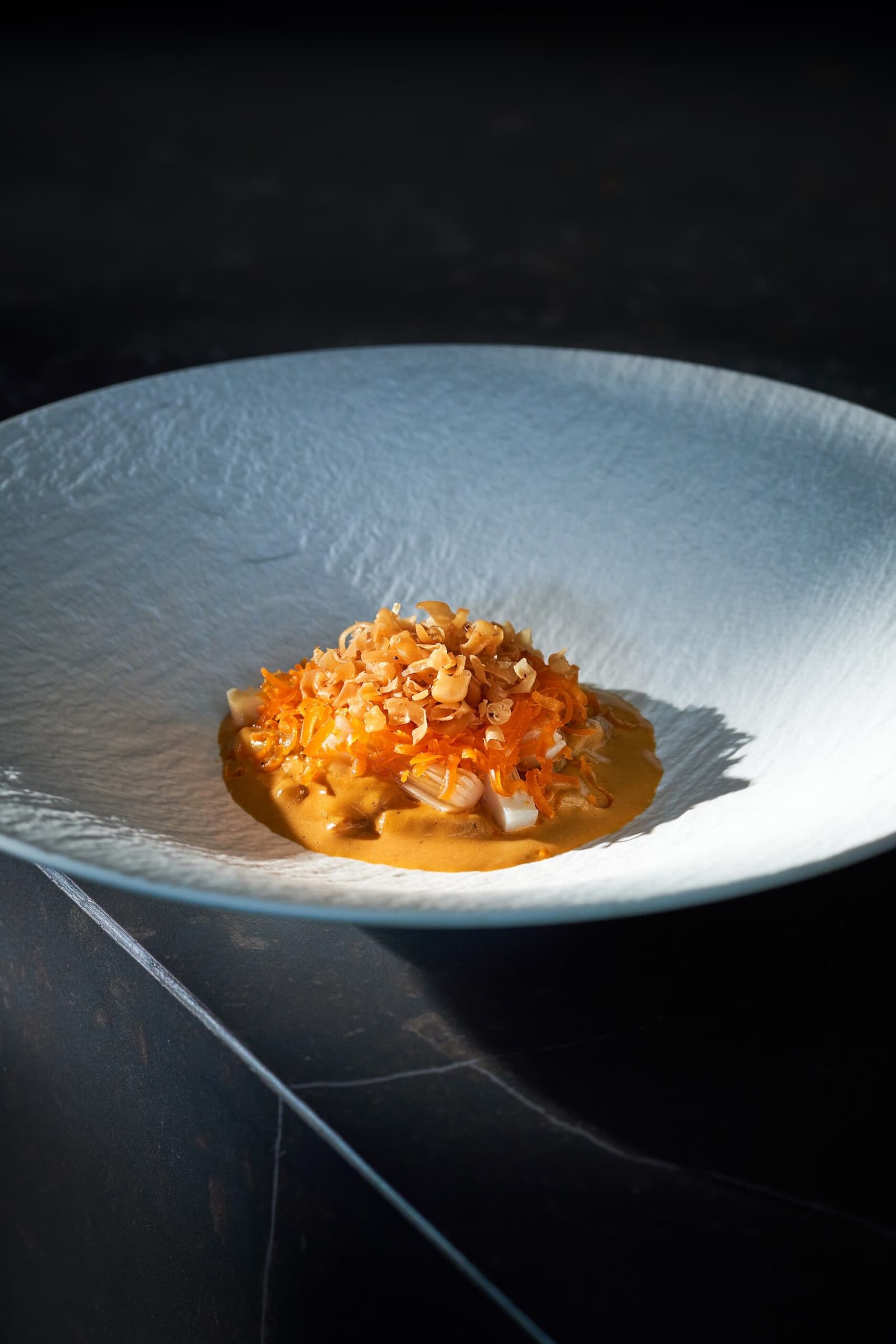
Image context: the lead image uses Baan Tepa's own official photograph of the dish called Dong Dang.[6] It fits this article because the piece is about legibility under refinement. The dark noodle structure, orange sauce, and crisp top garnish read clearly rather than luxuriously blurred. Even before the fork arrives, the plate declares that Baan Tepa wants Thai flavor memory to stay visible.
Around 0:15 to 1:10, the garden is framed as a discipline, not an alibi
The strongest early move in the video is that Tam does not treat Thai ingredients as generic national pride.[1] She speaks about flavor, essence, and aroma in concrete sensory terms, then ties those terms to the garden behind the restaurant.[1] The point is not self-sufficiency fantasy. The point is calibration. She says the garden helps the team see things in perspective and keeps functioning as a place to learn.[1] That line matters because it blocks a common fine-dining shortcut: using a patch of herbs as a charm bracelet for legitimacy.
The 50 Best Discovery profile supports that reading. It describes Tepa Garden as a city plot built around rotational farming and herbs, spices, and heritage vegetables, then says that the garden now anchors food served in the original converted house.[5] "Anchors" is the right verb here. Baan Tepa is not presented as a greenhouse restaurant where every ingredient must emerge from the same soil. It is presented as a restaurant that wants the logic of cultivation to shape how ingredients are chosen, understood, and eventually served.[2][5]
Around 2:00 to 2:30, the video states the article's hardest proposition: sustainability is only useful if it changes outcomes
The next section is where Baan Tepa separates itself from softer farm-to-table rhetoric. Tam says outright that fine dining linked with sustainability can sound pretentious, and she acknowledges that organic and farm-to-table ideas easily become marketing tools.[1] The important turn comes immediately after: if the outcome is better for the next generation, then she is willing to let others call it marketing.[1] That is a sharper position than the usual restaurant pledge language. It treats sustainability as something to be tested by consequence rather than admired by vocabulary.
This is one reason the video's tone works. It keeps showing labor instead of slogan density.[1] You move from garden to kitchen to heat to room. The restaurant on the screen is busy, designed, and polished, but it is not pretending that purity is effortless. The official site's promise of terroir and refined creativity lands better because the film keeps grounding those words in work.[2] Baan Tepa seems to understand that the guest does not need another sermon about virtue. The guest needs evidence that philosophy changes decisions at the stove, in the glass, and on the pass.
Around 4:05 to 5:15, food and drink are shown as one system
The clip becomes most revealing once it starts talking about the room as a total composition.[1] Tam says the philosophy runs through everything the restaurant does and is not limited to food; beverages are created through the same frame.[1] That sounds banal until the visual sequence proves it. The dining room is warm rather than austere. The cocktail is explained through a blend of herbs, spices, and flowers. The open kitchen keeps the restaurant from splitting into two unrelated theaters, one noble and agricultural, the other polished and urban.[1]
This is where Baan Tepa looks more rigorous than many "ingredient-first" restaurants. A lot of places can plate vegetables attractively. Fewer can build a credible bridge between garden language, savory menu, drinks logic, and spatial tone. The official site's spotlight on named dishes like Dong Dang and Crab Crab Crab helps here.[2] Those names suggest that Baan Tepa does not want ingredients dissolved into tasting-menu vagueness. The video confirms the same instinct in motion. The house appears determined to keep flavors identifiable even as they become more refined.[1][2]
By the end, "learning space" feels like the real luxury
The phrase that stays with me is the last one. Tam says the restaurant is a learning space and that the team is learning as it goes while staying mindful of the impact of its daily work.[1] In weaker hands, that line could sound unfinished. At Baan Tepa it sounds exact. The luxury on offer is not omniscience. It is an unusually disciplined openness: a house elegant enough to plate with confidence, but still willing to admit that ingredients, seasons, and techniques keep teaching the cooks how to proceed.
That is why the video works as an annotated viewing subject. It makes Baan Tepa legible at the level that matters most. The restaurant is not asking the diner to choose between Thai tradition and contemporary fine dining, or between creativity and terroir.[1][2][5] It is trying to stage all of those terms inside one working sentence. Garden, broth, flowers, cocktails, named dishes, and the converted house all point back to the same belief: local Thai ingredients deserve refinement that leaves their identity brighter than before. That is a stronger and more difficult ambition than simply looking sustainable on the plate.
Sources
- Gastrofilm, "Savoring Nature's Bounty: Baan Tepa's Sustainable Delights and Botanical Mixology Marvels," YouTube video.
- Baan Tepa, official homepage - project framing, terroir statement, and featured dish names including "Dong Dang" and "Crab Crab Crab."
- MICHELIN Guide, "Baan Tepa - Bangkok - a MICHELIN Guide Restaurant" - official listing describing Chef Chudaree Debhakam's polished seven-course Thai tasting menu.
- MICHELIN Guide, "What Is It Like to Eat at Baan Tepa, a Two-MICHELIN-Star Restaurant in Bangkok? The Inspectors Reveal All."
- 50 Best Discovery, "Baan Tepa - Bangkok" - profile covering the converted house, open-kitchen dining room, chef's table, workshop, Tepa Garden, and seven-course structure.
- Baan Tepa official image asset used for the cover photograph: "Dong Dang."