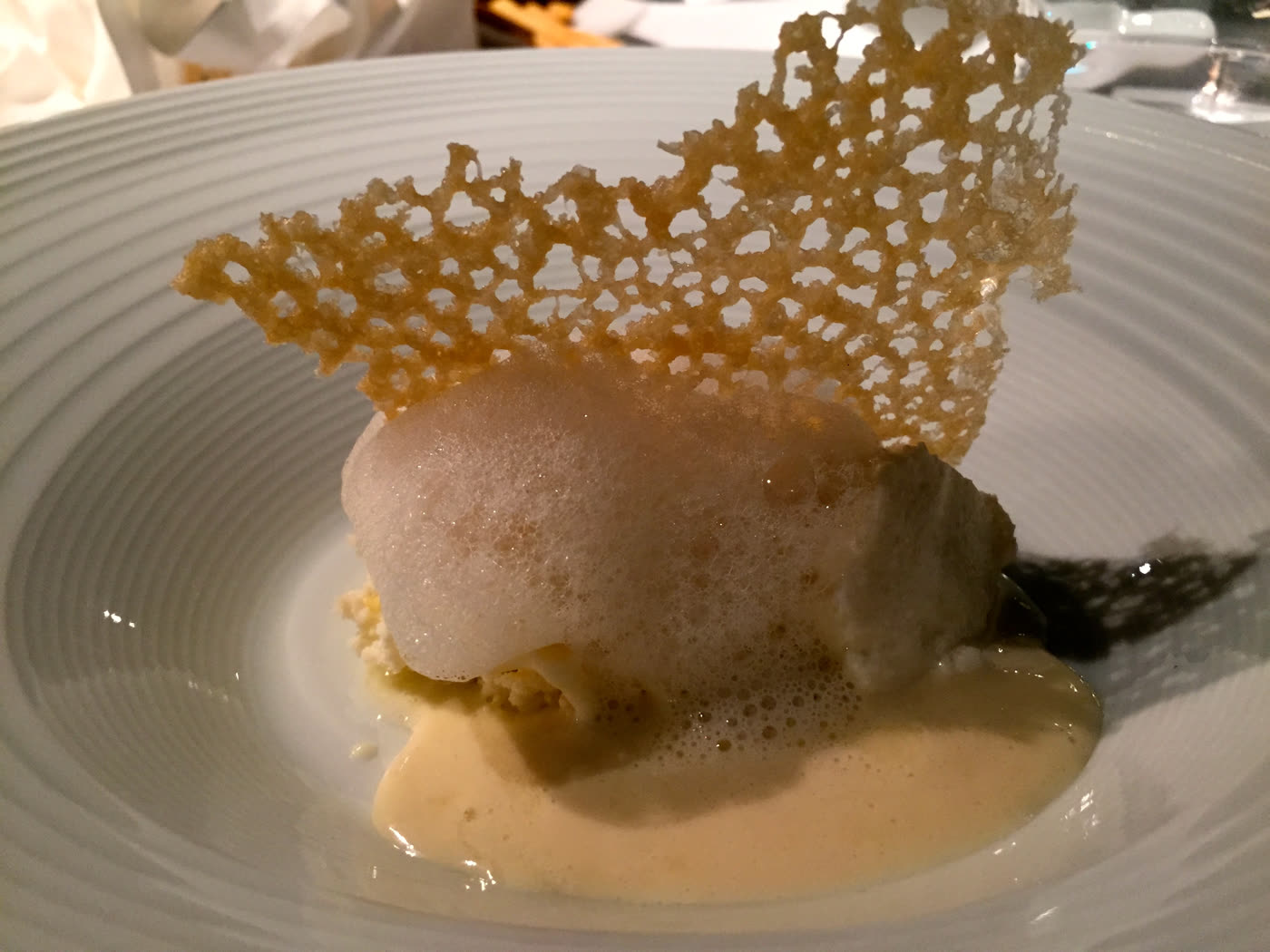
Most signature dishes in fine dining survive as a story people tell after the meal. Five Ages of Parmigiano Reggiano survives as a structure you can still read on the plate. On Osteria Francescana's current menu, it sits in the starters section at EUR90, not hidden away as a retired museum piece or a one-off anniversary revival.[1] That present-tense status matters. Massimo Bottura has spent three decades changing menus, themes, and visual languages, but this dish still functions as one of the clearest entrances into his way of thinking: take one ingredient from Emilia, compress memory and technique into it, then make time itself part of the flavor.[1][2][4]
That is why the dish still matters in 2026. It is not famous merely because Parmigiano Reggiano is famous, and not because diners enjoy eating an icon. It matters because it solves a harder problem than nostalgia. It turns a product that Italian diners already think they know into a sequence of ages, temperatures, and textures that makes familiarity feel unstable again.[3][4] At Osteria Francescana, Bottura often frames cuisine as a cultural act rather than a chain of recipes, and this plate may be the neatest proof. It is a regional ingredient, but staged as argument.[1][2]
Image context: the lead image uses a 2014 archival dining-room photograph from Wikimedia Commons rather than a polished studio asset. That choice fits the article because the dish is easiest to understand when you can see the actual arrangement: a composed set of pale forms on a white plate, all variations of one cheese, each carrying a different density and thermal weight.[7]
Why this one dish still reads the whole restaurant
The official menu tells you something useful before the first bite lands. Osteria Francescana's current tasting menu changes theme, but Five Ages of Parmigiano Reggiano remains available a la carte.[1] That persistence is not accidental. The World's 50 Best still treats it as one of the house's defining signatures, alongside dishes such as Oops! I Dropped the Lemon Tart, and describes it as a textural exploration of the region's best-known cheese.[3] On the broader Best of the Best profile, 50 Best goes further and places the dish inside Bottura's larger project: storytelling through concentrated flavor, with tradition viewed from a deliberate distance rather than repeated dutifully.[4]
That framing is important because the dish is easy to misread as a technical tasting flight. It is not just "Parmesan served five ways." The real move is that Bottura refuses to let Parmigiano stay fixed as table cheese, grated garnish, or background umami. He reorganizes it into stages, so the ingredient stops behaving like a static emblem of Emilia and starts behaving like a timeline. The dish asks you to taste maturation as movement.[4][5][6]
In that sense, it remains one of Osteria Francescana's best gateway plates. You do not need to know the whole Bottura canon to understand what is happening. One famous local product is taken apart, translated across forms, then returned to the diner with more territory inside it than before. That is very close to the restaurant's full operating logic.[2][4]
The real invention was making time a second ingredient
The most useful historical source here is the Identita Golose reconstruction of the dish's evolution, because it shows that the current version was not born complete.[5] Bottura says the first form emerged in the early 1990s, when he was still at Trattoria del Campazzo. The initial idea was three textures and temperatures: a Parmigiano demi-souffle, a sauce, and a wafer.[5] That already treated the cheese as something more elastic than tradition allowed, but it still did not yet treat ageing itself as the central dramatic device.
The decisive turn came after a conversation with Umberto Panini, who pushed Bottura to think harder about what ageing Parmigiano actually means.[5] That is the hinge in the story. Once Bottura began comparing cheeses at different maturation points, the dish stopped being about one ingredient expressed through technique and became about two ingredients working together: Parmigiano Reggiano, and time.[5] In 1998 the plate became Four Ages, and by 2013 it had reached the final Five Ages version that Bottura still considers open to refinement.[5]
That history explains why the dish endures better than many signatures from the same era. Plenty of famous fine-dining plates are remembered for surprise mechanics that later harden into cliche. Here the deeper source of variation is real. A 24-month Parmigiano does not behave like a 40-month cheese. Texture, firmness, aroma, salinity, and the way each component takes heat all shift materially.[5][6] Bottura did not simply add complexity for the sake of spectacle. He found a way to make maturation legible as cooking material.
What the five ages actually do on the plate
Falstaff's published recipe is useful because it maps the current internal logic clearly.[6] The dish is not five random bites. It is a progression built from specific ageing points:
- 24 months for the demi-souffle
- 30 months for the hot Parmesan sauce
- 36 months for the foam
- 40 months for the wafer
- 50 months for the "air," built from rind broth and aged cheese
That sequence moves in two directions at once. One is textural: soft, liquid, foamed, crisp, then almost vaporous.[6] The other is maturational: the younger cheeses deliver sweetness, milkiness, and elasticity, while the older ones move toward concentration, salinity, nuttiness, and a more insistent umami edge.[5][6] The plate therefore does not read like a ladder from mild to strong in any simplistic sense. It cross-cuts age against physical form.
This is why the dish feels lighter than its ingredient list suggests. Parmigiano Reggiano is an intense cheese, and a less disciplined plate built around it would become oppressive fast. Bottura avoids that trap by breaking the product into alternating weights. The warm sauce gives body. The foam opens it back up. The wafer provides fracture. The final air pulls the whole experience toward aroma and disappearance instead of ending in a heavy dairy wall.[5][6]
Identita Golose captures the conceptual flourish behind that last step especially well: Bottura links the cheese cloud to Emilia's fog, the same atmospheric condition that helps shape culatello ageing.[5] That detail matters because it keeps the dish from becoming abstract modernism. Even the air is territorial. The plate is telling you that place does not live only in a raw material. It can also live in weather, patience, and preservation.
Why it still feels current
What keeps Five Ages of Parmigiano Reggiano alive in 2026 is not only fame. It is that the plate still answers a current fine-dining question better than many newer dishes do: how do you make luxury feel more precise, not more overloaded? Bottura's answer is editing. Use one emblematic ingredient, impose strict formal differences, and let the diner feel how much territory can be extracted from a single product when you stop treating it as fixed.[2][4][5]
That answer now looks almost more modern than it did when the dish was born. Contemporary fine dining often claims seriousness through breadth: more producers, more concepts, more references, more supplements, more visible labor. Bottura goes the other way here. He narrows the field to one cheese and asks it to carry history, geography, maturation, and technique without any decorative clutter. The concentration is the luxury.[4][5][6]
That is also why the dish still belongs on the current menu instead of only in retrospectives. It remains legible to first-time diners, but it also still says something exact about Osteria Francescana: the restaurant's best plates are not rebellions against tradition for their own sake. They are acts of compression. Tradition goes in whole, and comes back out sharpened.[1][2][4]
Sources
- Osteria Francescana, "Menu" - official page listing Five Ages of Parmigiano Reggiano on the current a la carte menu at EUR90 and showing the restaurant's current tasting-menu context.
- Osteria Francescana, "Massimo Bottura" - official chef page describing Bottura's Modena upbringing and the restaurant's habit of compressing what it sees, thinks, and feels into cuisine.
- 50 Best Discovery, "Osteria Francescana - Modena" - current profile identifying Five Ages of Parmigiano Reggiano as one of the restaurant's signature creations and describing it as a textural exploration of the region's cheese.
- The World's 50 Best Restaurants, "Best of the Best: Osteria Francescana" - profile linking the dish to Bottura's storytelling method, his treatment of territory and tradition, and the restaurant's long global standing.
- Identita Golose, "Five ages of Parmigiano (they were 3 at first, and then became 6): the story of a dish that made history" - reconstruction of the dish's evolution from the 1990s through the final five-age version, including Bottura's account of Umberto Panini's influence.
- Falstaff, "Five generations of Parmigiano Reggiano" - published recipe outlining the five ageing points and the component logic behind the demi-souffle, sauce, foam, wafer, and air.
- Wikimedia Commons, "Five Ages, Textures and Temperatures of Parmigiano Reggiano at Osteria Francescana" - archival 2014 dining-room photograph used for the article image, with provenance and licensing information.