The easiest way to misread beyond is to treat the wine program as a pleasant extra attached to a handsome Constantia lunch. The restaurant can certainly support that reading: Peter Tempelhoff's food philosophy centers on provenance, the room looks into the estate setting, and the house openly promises an elegant but unpretentious experience at Buitenverwachting.[1] The sharper reading is more structural. At beyond, the drinks matter because the restaurant sits directly on top of one of the Cape's most useful pairing advantages: estate adjacency.
That advantage is visible across the official pages. The home page frames Buitenverwachting as a working farm with heritage and family at its heart, and says the restaurant lets the scenery into the room while keeping the food understated enough for ingredients to stay legible.[1] The menu page, updated on 2026-04-23, turns that idea into a current service ladder: 2 courses for R720, 3 courses for R850, and a 6-course tasting experience for R1435, with a wine pairing add-on at R1225 for the tasting menu.[2] The live wine page then shows the list architecture in unusually plain terms: it begins with Buitenverwachting whites and reds, moves into older vintages, widens into Constantia Valley selections, and continues through dessert wines that include local prestige bottles such as Vin de Constance.[3] Once you place those three documents side by side, the beverage program stops looking like mere cellar decoration. It reads as the mechanism that turns Constantia into sequence.
An outside review helps confirm that the pairing logic is not just a website fantasy. In Eat Out's review of beyond, the writer describes a room with a wall of glass and a sommelier-led pairing that was "often audacious" and still landed its mark against the menu.[4] That is the line worth following. beyond's best luxury signal is not global-bottle flex by itself. It is the ability to keep an ingredient-led menu buoyant by pouring the estate, the valley, and age in the right order.
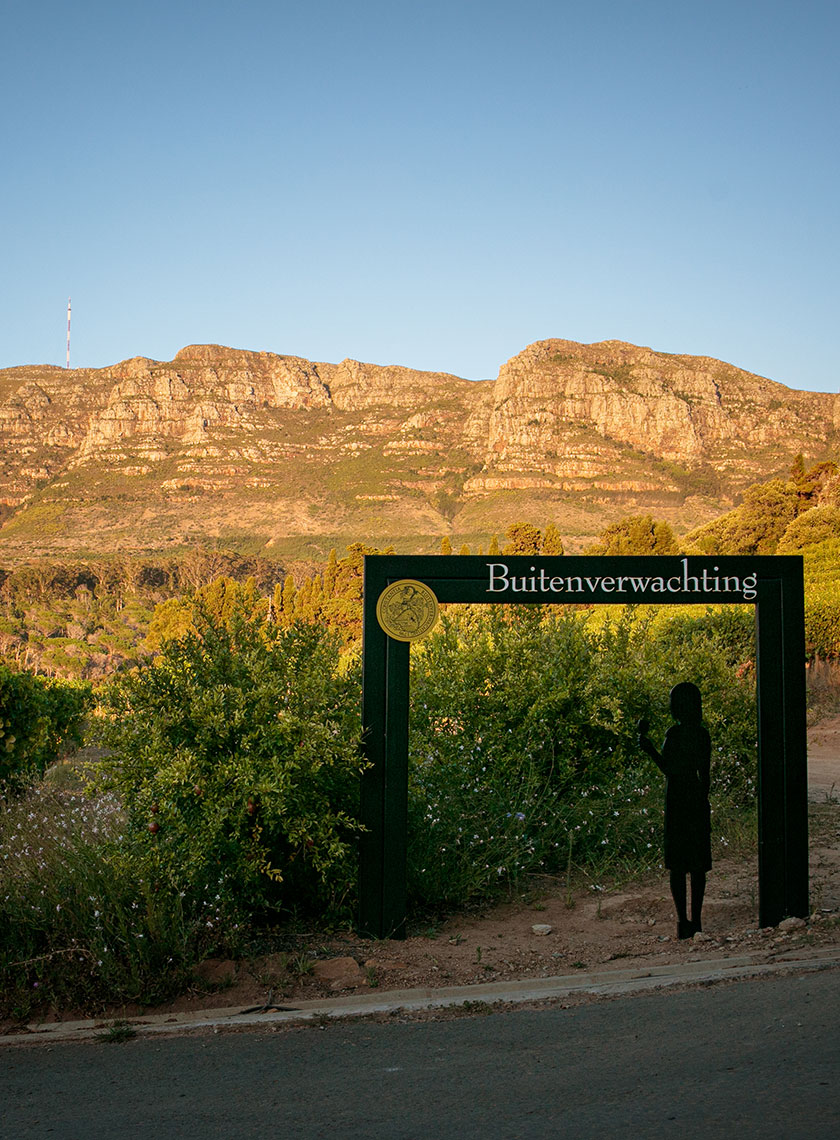
Image context: the lead image uses an official beyond photograph of the Buitenverwachting grounds rather than a plated dish. That choice fits because this article is really about adjacency. The restaurant's drinks logic starts with being physically inside a vineyard estate, where place and bottle can reinforce each other before the first course arrives.[1]
1. The pairing story starts with geography, not prestige
The official home page does more than sell atmosphere. It explains why beyond can behave differently from a city tasting room that has to import its whole liquid identity from elsewhere. Tempelhoff is presented as a chef whose food philosophy centers on provenance, and the property itself is described as a family-run estate whose authenticity lies in feeling like a working farm rather than a polished stage set.[1] The restaurant's interior, the page says, deliberately references that history while staying restrained enough for comfort and enjoyment to remain primary.[1]
That matters because pairing at beyond begins before any sommelier speaks. Guests are already sitting inside the logic of a vineyard estate. The list therefore does not need to invent a local story through back-label rhetoric. It can start with what is underfoot. On the wine page, Buitenverwachting Sauvignon Blanc, Chardonnay, Maximus, 'G', Meifort, and Christine appear as foundational categories rather than token house-pour slots.[3] That is a strong opening move. It means the first pairing question is not "Which famous region proves our seriousness?" It is "How much of this meal should be read through the estate itself before we widen the frame?"
In a beverage program, that is a major distinction. Estate adjacency gives the restaurant permission to make locality feel like structure instead of garnish.
2. Tempelhoff's menu needs lift, salinity, and timing more than brute force
The current menu page is useful because it shows beyond avoiding the heavy-handed idea of wine-led luxury. The food is introduced as "Unpretentious, uncomplicated, elegant," and as a way to celebrate ingredients without unnecessary embellishment.[2] The visible dishes support that claim. Among the items now published are hand-cut beef tartare with shiitake chilli crisp and mushroom garum, pan-roasted Cape fish with green olive romesco and smoke tomato veloute, braised Karoo lamb neck with sweet potato chutney and garlic buchu, and Tulbaghia pappardelle with globe artichoke and leek gremolata.[2]
Those plates do not ask for a list whose main talent is weight. They ask for tension, aromatic clarity, and enough maturity to handle savory depth without making lunch or dinner sag halfway through. Cape fish with olive and smoked tomato wants brightness and edge. Lamb neck with chutney and pan juices wants red fruit, herbal detail, and tannin that can hold shape without clamping down. A vegetable- and pasta-led course wants texture and perfume more than oak theater.[2][3]
That is where the Constantia setting becomes practical. A house anchored in Sauvignon Blanc, Chardonnay, and layered Cape reds can keep the meal moving upward rather than outward.[3] Even the menu's pricing design suggests that drinks are expected to do real compositional work. The pairing is not a minor surcharge beside the six-course tasting; it is one of the central decisions in the meal.[2]
3. The list's smartest move is the jump from estate bottles to older vintages
The live wine page still lays out beyond's intended progression clearly enough to matter.[3] It does not stop at present-release estate bottles. After Buitenverwachting whites and reds, the page opens a separate OLDER VINTAGES section featuring wines such as Chardonnay 2015, Sauvignon Blanc Hussey's Vlei 2009 and 2012, Meifort 2006, Cabernet Franc 2006, and Christine 2003.[3]
That section is the key to the whole beverage story. Older vintages give the restaurant a way to add softness, tertiary aroma, and calm authority without reaching automatically for bigness. Mature Sauvignon or mature Bordeaux-style reds can change the feel of a meal more elegantly than simply escalating extraction or alcohol. They let the program widen in time as well as in flavor.
The next move is just as revealing. The list then broadens into a CONSTANTIA VALLEY set with producers such as Constantia Glen, Klein Constantia, Groot Constantia, and Steenberg appearing across white, red, and sweet-wine positions.[3] That is not random regional patriotism. It is a controlled widening of the lens. The estate remains the center, but the valley becomes the comparative field. If a pairing starts with Buitenverwachting's own line, it can then step sideways into another Constantia expression without breaking the meal's geographic coherence.
Dessert wines complete the argument. The page includes both Buitenverwachting '1769' Muscat de Frontignan and Klein Constantia Vin de Constance vintages.[3] That matters because sweet-wine service here is not an imported prestige flourish. It stays local enough to make the end of the meal feel like a continuation of place rather than a genre change.
4. What the external review adds
Eat Out's review gives the official structure some lived texture. The article describes a room framed by vineyards and mountains, and says sommelier Donovan Ravell offered a pairing for the three-course format that was "often audacious" while still precise against the food.[4] Even allowing for the date and context of a single review, that outside account helps in one important way: it suggests beyond has long understood the pairing as an interpretive act, not a compliance exercise.
That is why the restaurant makes most sense when booked through its drinks logic. If beverages are your primary reason for going, the 6-course tasting experience with the wine pairing looks like the clearest read of the house in 2026.[2] It gives the team room to establish estate identity, introduce age where useful, widen into other Constantia references, and finish with a local sweet-wine register if the menu calls for it.[2][3] The shorter two- and three-course options likely make more sense for a scenic lunch or a first visit built around the room rather than the cellar.[2]
beyond therefore matters as a beverage-pairing story for a reason more specific than "good list, good chef, nice vineyard." It shows what happens when a restaurant uses proximity intelligently. The estate supplies the opening grammar, the older vintages supply temporal depth, the wider valley supplies comparison, and the menu supplies enough restraint for all that liquid information to stay readable.[1][2][3][4] Constantia is not merely served alongside the meal here. It is poured as structure.
Sources
- beyond official home page, covering Peter Tempelhoff's provenance-led food philosophy, the Buitenverwachting setting as a working farm with heritage and family at its heart, and the room's restrained, estate-linked design.
- beyond official menu page, updated on 2026-04-23, covering the current course formats, pricing, tasting-menu pairing add-on, and the ingredient-led dishes now published on the page.
- beyond official wines page, showing the live list architecture across Buitenverwachting whites and reds, older vintages, Constantia Valley wines, and local dessert-wine benchmarks including Vin de Constance.
- Eat Out, "Review: beyond is a place where local produce and ingredients are celebrated" - review covering the vineyard-facing room and a sommelier-guided pairing described as audacious and accurate.