The lazy way to describe CODA is to say that it is the Michelin-starred Berlin restaurant where dessert took over dinner.[1][4] That description is memorable, but it is not quite accurate. CODA is not powerful because it swaps the usual order and puts sweets at center stage. It is powerful because it uses patisserie technique as a whole cooking language. The current Michelin listing still presents the restaurant as a two-star room in Neukolln where Rene Frank's team applies pastry methods across a set menu of 13 to 15 small and larger dishes, avoids refined sugar entirely, and builds drinks directly into the structure of the meal.[1] The official CODA site sharpens that logic from the inside: this is a restaurant concerned with authentic flavor, total attention to detail, and what it calls a holistic journey of tastes in which the glass matters as much as the plate.[2]
That is why CODA still matters in 2026. Plenty of fine-dining restaurants now borrow dessert moves, natural sweeteners, or low-sugar rhetoric. CODA remains more exact than that. It has built a dinner format where sweetness is only one register among many, savory ingredients are freed from their usual habits, and pairings are designed to function almost like sauces in liquid form.[1][2][3][4]
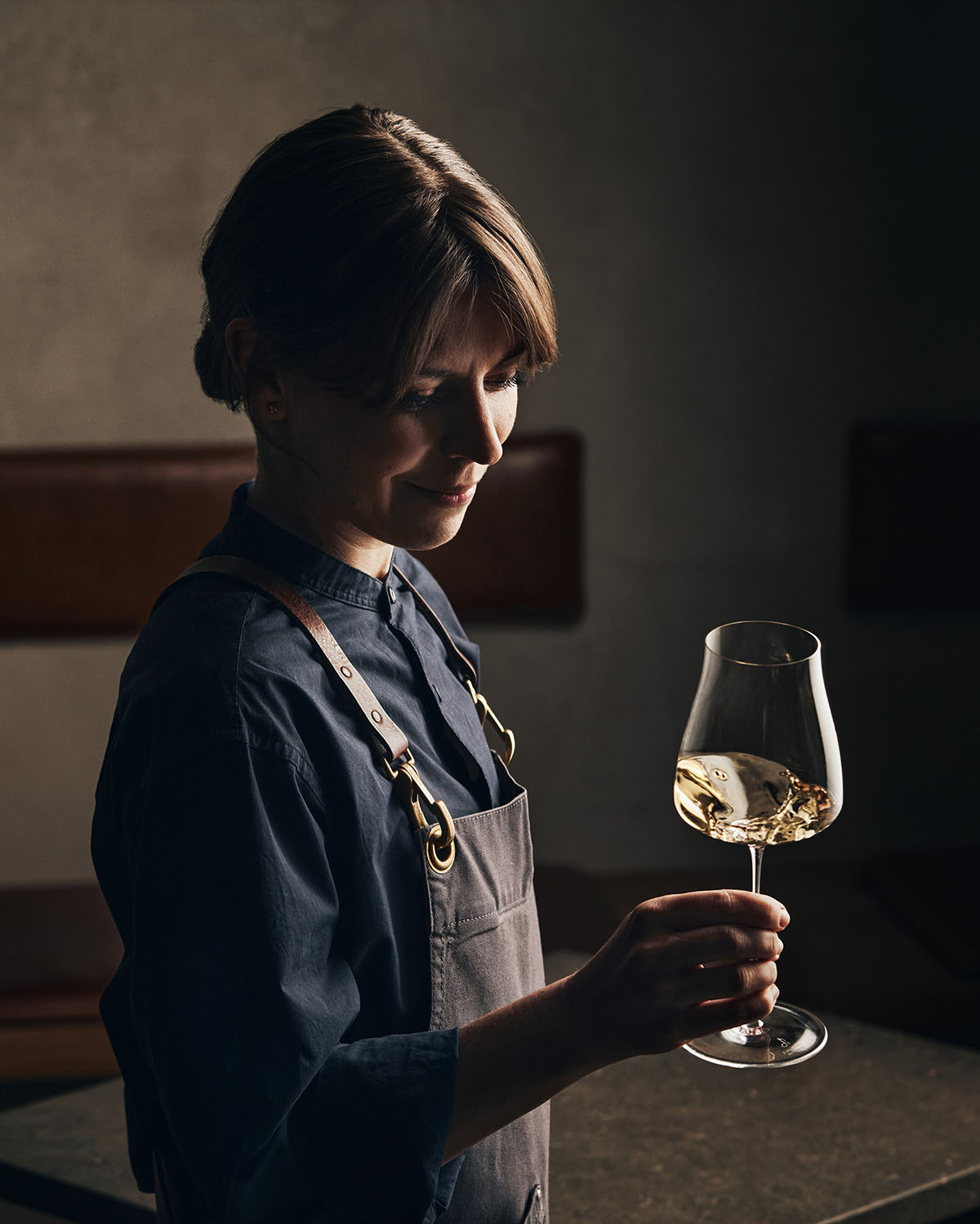
Image context: the lead image uses CODA's official portrait of sommelier Sophia Fenger rather than a polished overhead plate shot. That choice fits the article because CODA's central claim is relational. The meal works when the restaurant can make the drink feel as authored as the dish, and this portrait puts that logic in human terms before the first course arrives.[2]
1. Dessert is the method, not the mood
Michelin's current listing gives the cleanest one-paragraph explanation of why CODA resists the usual labels. The inspectors describe a lively, laid-back room where guests sit at the counter or nearby tables while Frank's team applies patisserie techniques to dishes such as buttercream with plum, walnut, and dulse or grilled peach with pointed pepper and coriander.[1] The point of those examples is not that fruit appears on a tasting menu. Fruit appears everywhere. The point is that CODA takes ingredients and textures associated with pastry, then refuses to let them stay trapped inside the sentimental category of "dessert."
50 Best Discovery pushes the same argument in more guest-facing language. It calls CODA a "dessert dining experience" built from mostly savory ingredients, then immediately undercuts the expectation of sugar overload by stressing natural sweetness from corn, beetroot, and carrots, balanced with umami, salty, sour, and bitter notes.[3] That balance is the key. CODA is not trying to convince diners that dessert deserves more respect in the abstract. It is trying to show that dessert techniques can carry the full burden of a serious meal when the flavor profile is allowed to widen far beyond sweetness.
This is why CODA feels more structural than gimmicky. Many concept restaurants announce a provocation and then spend the rest of the evening proving they can survive it. CODA's sources suggest the opposite sequence. The team began with a technical worldview, then built a format capable of expressing it.[1][3][4] Once you see that, the restaurant stops reading like a novelty and starts reading like a category edit.
2. Removing refined sugar forced the kitchen to invent a new discipline
The Michelin feature on CODA's rise is especially useful because it explains the restaurant's break from pastry convention as a materials problem rather than a branding exercise. When Michelin profiled the restaurant in 2023, it described CODA as the first Michelin-starred dessert restaurant in the world, founded in 2016 as a casual dessert bar before evolving into a more complete tasting-menu dinner experience.[4] In the same piece, Frank describes the deeper frustration behind the project: too much pastry work depends on the same chocolate systems, frozen purees, molds, stabilizers, and inherited recipes. His response was not to reject pastry, but to open it up.[4]
That distinction matters. Plenty of chefs can talk about creativity in broad terms. Frank's version is narrower and harder. Michelin quotes him asking what happens if you stop treating an ingredient according to its default savory identity and begin again from scratch, "like it's a strawberry."[4] That thought experiment is not decorative philosophy. It is what allows CODA to turn pastry from a course type into a research method.
The current restaurant listing shows what that method looks like after years of refinement: refined sugar is completely avoided and the meal still remains luxurious, legible, and complete.[1] 50 Best Discovery fills in the sensory consequence by noting that the dishes stay beautiful and unusual without becoming cloying, while the official site frames the restaurant as a search for natural or authentic flavors rather than processed sweetness.[2][3] Put together, those sources point to the same conclusion. CODA's real discipline is subtraction. Once industrial sugar and familiar pastry crutches lose their central role, the kitchen has to rebuild pleasure through fermentation, salinity, fat, acid, aroma, temperature, and texture.
That is a more serious achievement than simply making dessert less sweet. It means the restaurant has had to invent a palate grammar where pleasure arrives in layers rather than in one obvious sugar hit. The result is a dinner that can feel playful without becoming childish and precise without becoming doctrinaire.[1][3][4]
3. The pairings are not an accessory. They are part of the cooking
The official ABOUT page gives away the deepest part of CODA's structure in one of the clearest sentences on any fine-dining site right now: "Just as sauces in French haute cuisine elevate a dish, CODA's pairing drinks fulfill the same purpose."[2] That is not a sommelier talking point pasted on after the menu was finished. It is a design principle. The page says the bar counter forms a flowing transition between the dining room and the open kitchen, and that drinks act as essential liquid menu components served in a glass.[2]
Michelin's listing independently confirms that the format is built this way. The inspectors note that the menu's dishes are always paired with a drink tailored to the flavors, while an optional wine flight sits alongside the standard pairing structure.[1] Michelin also points to a cellar with German Rieslings, sparkling wines, and sake, while 50 Best Discovery broadens that picture by describing mini cocktails, a wine program focused on German pours, and sakes available by the glass as well as by the bottle.[1][3] The common thread is that CODA does not ask diners to choose between beverage seriousness and conceptual coherence. It wants the two to reinforce each other.
This is where the sommelier portrait becomes editorially useful. A lot of ambitious restaurants say the drinks matter, but the service model still tells you that the real intellectual property lives in the kitchen. CODA appears to have built a different hierarchy. The glass is not there to reset the palate between authored moments. It is one of the authored moments.[1][2] In practical terms, that lets the restaurant make its no-refined-sugar approach feel fuller and more musical. A pairing can add lift, bitterness, salinity, aromatic echo, or cleansing tension without forcing the plate to carry every flavor argument by itself.
In that sense, CODA's most radical move may not be "dessert for dinner" at all. It may be the decision to redistribute authorship more evenly between pastry technique and beverage design.
4. Berlin gives the restaurant room to stay strange
Michelin's long feature begins in the neighborhood for a reason. Neukolln is described there as an edgy, immigrant-shaped, rough-around-the-edges district whose social mix made it unusually suitable for Frank's vision.[4] By the end of the piece, Frank says something even more important: CODA needed Berlin because Berlin let the team do what it wanted, and because the city is diverse and multicultural enough to accept a restaurant that does not fit received categories.[4]
50 Best Discovery complements that with a more atmospheric urban sketch. CODA is presented as a smart, concrete-hued Berlin spot that marches to its own drum rather than trying to impersonate old-world luxury.[3] Michelin's current listing makes the same point from inside the room, calling the atmosphere lively and laid-back while emphasizing the counter view into the kitchen.[1] This is not incidental design. It protects the concept from stiffening into a museum of clever pastry.
That may be the best way to understand CODA now. The restaurant is not asking whether dessert can be taken seriously anymore. That question has already been answered by two Michelin stars, a durable service model, and nearly a decade of refinement.[1][4] The more interesting question is whether a restaurant can keep one part of the meal from being socially pre-assigned to a narrow emotional role. CODA's answer is yes, but only if the kitchen, the bar, and the room all commit to the same argument.
Which is why CODA still feels unusually complete in 2026. It does not rely on a one-line pitch. It relies on a full operating system: pastry techniques applied beyond pastry, sweetness treated as one tool among several, and pairings written with the authority of sauces. Once those pieces lock together, "dessert dining" stops sounding cute. It starts sounding exact.[1][2][3][4]
Sources
- MICHELIN Guide, "CODA Dessert Dining - Berlin - a MICHELIN Guide Restaurant" - current listing covering the restaurant's two-star status, 13-15 dish menu structure, no-refined-sugar policy, tailored drink pairings, wine and sake program, opening days, and service style.
- CODA, "ABOUT" - official page describing the restaurant's attention to authentic flavor, the open kitchen and counter layout, and the statement that pairing drinks function like sauces in French haute cuisine.
- 50 Best Discovery, "CODA - Berlin - Restaurant" - current profile describing the dessert-dining concept, mostly savory ingredients, natural sweetness from corn, beetroot, and carrots, tasting-menu price point, dinner days, and beverage program.
- MICHELIN Guide, "Inside CODA, The First Ever MICHELIN-Starred Dessert Restaurant in the World" - feature covering CODA's 2016 launch as a dessert bar, the 2020 second Michelin star, Rene Frank's critique of pastry defaults, Berlin's fit for the concept, and the restaurant's evolution into a full dinner experience.