The easiest mistake with Aster by Joshua Paris is to treat it as a sequel. Shanghai had a true immersive-dining landmark in Ultraviolet by Paul Pairet: one table, hidden transport, synced sound, projection, scent, wine, and course choreography. When that room closed, the obvious story was loss. Aster is more interesting if you read it as a refusal to replace the lost thing. It takes a chef formed inside maximum-control dining and asks what happens when the voltage is stepped down into a room with a bar, counter seats, ordinary tables, and food that has to hold attention without a full sensory machine around it.[1][2][3]
That is why Aster matters now. The 2026 MICHELIN Guide Shanghai, Jiangsu, Zhejiang release formalized a new map: one three-star restaurant in Shanghai, 12 two-star restaurants, 38 one-star restaurants, and a wider Selected tier where newer rooms can enter the conversation before they become trophy destinations.[2][4] MICHELIN's own Aster listing places the restaurant in that Selected world: European Contemporary, date-night friendly, self-managed bookings, counter dining, and a concise inspector note built around classic European cooking animated by Chinese twists.[1] In other words, this is not the new temple after the old temple. It is a more usable dining room trying to keep ambition close to the plate.
The inheritance is still real. Paris spent years at Ultraviolet, and local coverage has understandably framed Aster through that fact.[3][5][6] But the better question is what he left behind. Ultraviolet's genius was enclosure: the guest surrendered to a complete authored environment. Aster's promise is exposure. The dining room does not hide behind a single-table myth. It lets guests see the bar, the kitchen, the room rhythm, and the point where a European sauce idea bumps into a Shanghai memory.
The room changes the contract
ArchDaily's design record gives the first clue. RooMoo Design Studio built the 2025 interior around the aster flower: a central core, radiating petals, a circular counter, and a room arranged so bar, open kitchen, and dining area feel connected rather than partitioned.[7] That layout is not just pretty hospitality language. It changes the guest contract.
At Ultraviolet, the room could behave like a black box. At Aster, the central counter and visible work surface make the restaurant feel less like a simulation and more like an organism. You can have a drink. You can sit close to the kitchen. You can read the room's mauve and ochre warmth before you read the menu.[1][7] The result is still designed, but it does not demand that every second become a set piece.
This matters because Shanghai fine dining can easily overcorrect toward either imported grandeur or extreme concept. Aster's room seems to be looking for a third lane: polished enough to hold ceremony, loose enough to invite return use. Nomfluence's opening report notices the useful mechanics: a 46-seat dining room, an eight-seat chef's counter looking into the open kitchen, a private room, terrace seating, and a bar installation anchoring the space.[6] That is a very different piece of infrastructure from the one-shot bucket-list room. It lets the restaurant become part of a neighborhood night rather than only the headline of a trip.
The pigeon explains the house style
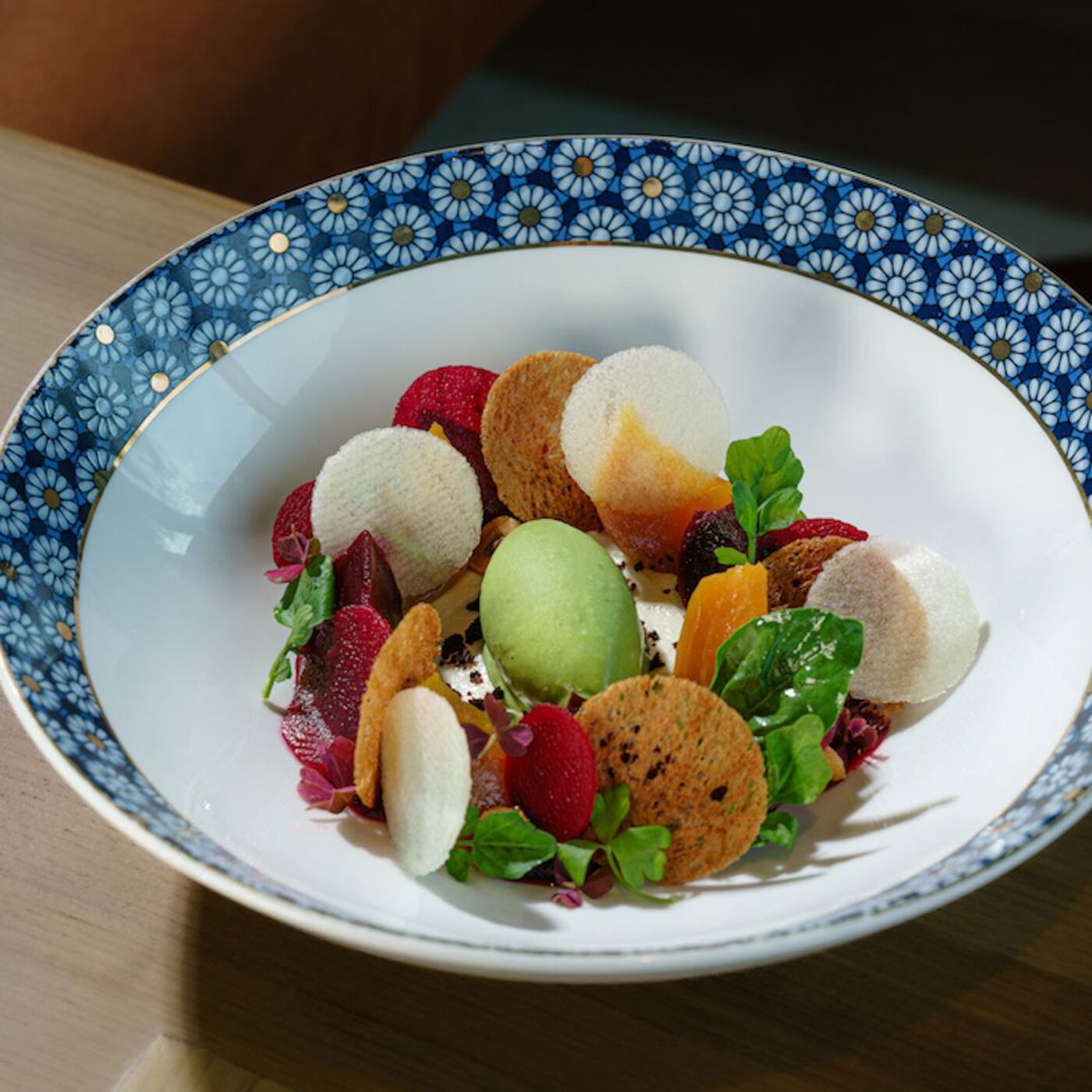
The dish that keeps showing up in coverage is the XL Huzhou pigeon, and it is useful because it contains the restaurant's whole argument in miniature. MICHELIN describes it as a version of Shanghainese drunken pigeon that swaps Huadiao for French vin jaune, producing a rounded aromatic effect.[1] CNA Luxury also lists the XL drunken pigeon among the must-orders, alongside black cod with fennel salad and bouillabaisse sauce, and a beetroot salad with goat cheese labneh, candied walnuts, and green apple.[5]
That is not fusion as a blur. The pigeon works as a grammar test. Drunken poultry is already about aroma, cure, chill, and the way alcohol carries memory into meat. Vin jaune shifts the accent without erasing the format. It brings Jura nuttiness and oxidative depth into a Chinese template that diners in Shanghai can recognize. The pleasure is in the tension: the dish is legible locally, but the sauce-brain behind it is clearly European.
This is where Paris's background becomes useful rather than merely credentialed. CNA notes that he worked under Paul Pairet, Peter Gilmore, and Richard Ekkebus before Aster.[5] Those are not interchangeable lines on a resume. Together they suggest technical range: spectacle and irreverence from the Pairet world, produce and plate clarity from Gilmore, and hotel-polished precision from Ekkebus. Aster's smartest move is not to advertise those influences as a tasting-menu family tree. It lets them show up as decisions: a pigeon cured through one cultural memory and seasoned through another; black cod treated with fennel and bouillabaisse logic; a bar program that keeps cocktails close to dinner instead of exiling them to a prelude.[5][6]
A smaller menu can be a stronger signal
One reason Aster reads fresh is that it is not trying to win by course count. Nomfluence describes the menu as concise and seasonally driven, with dishes including hamachi with fennel seed and kombu, salt-baked beetroot salad, potato gnocchi, the XL drunken pigeon, poulet farci, lamb, and wagyu oyster blade.[6] The same report's price references - for example, CNY 158 for half pigeon, CNY 268 for half poulet farci, CNY 348 for lamb, cocktails from CNY 88, wines by the glass from CNY 68, and bottles from CNY 328 - make the format feel closer to a serious modern bistro than to a sealed tasting-menu purchase.[6]
That structure is important. A tasting menu can protect a chef from guest choice; Aster seems more willing to let guests assemble a night. That is riskier in one sense, because an a la carte or semi-flexible room has more paths through it. But it also makes the restaurant more socially useful. A diner can go for the pigeon and a cocktail, build a fuller dinner around cod or poultry, or use the bar as a way into the room before deciding how deeply to commit.[6]
For a city like Shanghai, that flexibility is not a compromise. It is part of the market intelligence. The combined 2026 MICHELIN release describes Shanghai's dining scene as diverse, inclusive, and increasingly segmented, with clearer market positioning across cuisines and formats.[4] Aster fits that sentence neatly. It is not fighting Taian Table for the same three-star pilgrimage slot. It is fighting for the serious diner who wants technique, atmosphere, and a sense of new-city energy without giving the entire evening to a closed format.
Why the reset works
Aster's strongest case is that it treats post-Ultraviolet history as training, not destiny. It does not seem embarrassed by the lineage; it simply refuses to be trapped by it. The design is immersive, but not hermetic. The food is European Contemporary, but it keeps reaching into Chinese flavor memory. The room is handsome, but the bar and counter keep it practical. The current guide status is modest compared with three-star mythology, but that may be exactly why the restaurant feels alive at this stage.[1][2][6][7]
There is also a useful emotional difference. Ultraviolet asked diners to enter an exceptional machine. Aster asks them to sit in a room that can repeat itself without becoming routine. That sounds less spectacular, but it may be the more durable luxury. New restaurants do not become important only by making bigger claims than the generation before them. Sometimes they matter because they make inherited skill more breathable.
That is the post-Ultraviolet reset Aster makes visible. Shanghai did not need another sealed chamber of wonder. It needed a room where a chef could bring the discipline of spectacle back down to the size of a plate, a drink, a counter seat, and a returnable evening.
Sources
- MICHELIN Guide, "Aster by Joshua Paris - Shanghai" - current listing, address, cuisine category, inspector note, facilities, and source of the article image.
- Rachel Gouk, "Michelin Guide Shanghai 2026: Full List of Starred Restaurants & Bib Gourmands," NOMFLUENCE, April 9, 2026 - Shanghai star counts, Ultraviolet removal note, and Aster's Selected listing context.
- Sophie Steiner, "Chef Josh Paris Plants His Culinary Vision at Aster," Sophie Serves Up, August 4, 2025, updated October 3, 2025 - opening profile and post-Ultraviolet framing.
- Michelin Group, "First Edition of MICHELIN Guide Shanghai | Jiangsu | Zhejiang Released in Taizhou," April 9, 2026 - combined regional guide statistics and Shanghai market context.
- CNA Luxury, "Where to eat and drink in Shanghai 2025" - Aster by Joshua Paris entry covering chef background, dish examples, and location context.
- Rachel Gouk, "New & Hot in Jing'an: Aster by Joshua Paris," NOMFLUENCE, June 10, 2025 - room layout, chef background, menu examples, dish prices, and bar pricing.
- ArchDaily, "Aster by Joshua Paris / RooMoo Design Studio," December 27, 2025 - interior design record, completion year, project area, design concept, and photographer credit.