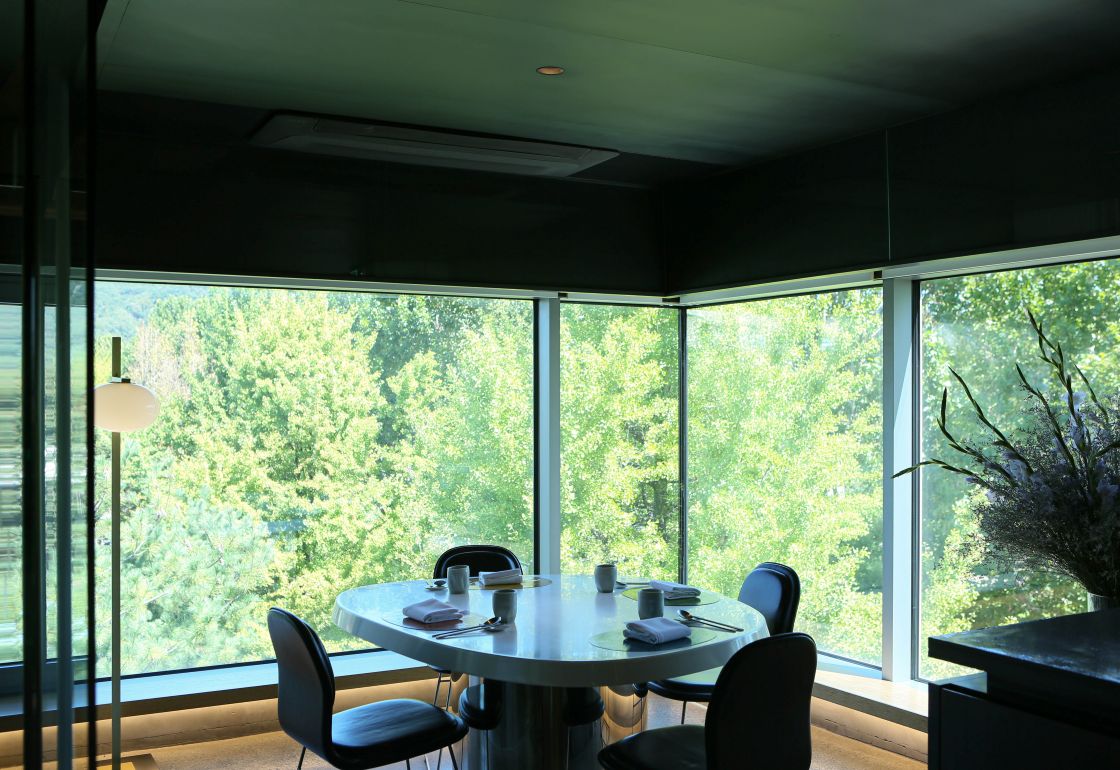
Across the street from the stone wall of Gyeongbokgung Palace, Onjium does something unusually difficult in fine dining. It makes scholarship feel hospitable. As of April 25, 2026, 50 Best Discovery lists the Seoul restaurant at No. 14 on Asia's 50 Best Restaurants 2026, and the writeup is revealingly broader than a standard luxury profile. It does not only talk about a tasting menu. It talks about a Korean cultural centre, in-house fermented pastes, and history-and-culture classes held on site twice a month.[1] The MICHELIN Guide description lands in the same place from another angle: a calm dining room opposite the palace wall, modern technique, seasonal ingredients, and years of research held inside a room that stays quiet rather than theatrical.[2]
That combination is why Onjium feels so specific right now. Plenty of restaurants borrow heritage language. Onjium behaves as though heritage is a daily workload. The plates come out polished and modern, but the restaurant's real luxury lies in how much time has been spent deciding what Korean tradition should mean in the present tense.[1][2][4][5]
Image context: the lead image uses an official Onjium interior photograph published by the MICHELIN Guide because this article is about a restaurant whose force depends on atmosphere, pacing, and disciplined calm. A plated close-up would show technique; the room shows the larger operating system.[3]
1. Onjium reads like an institution before it reads like a brand
The easy version of Onjium is to call it a royal-cuisine restaurant near a palace and leave it there. The stronger reading starts with structure. 50 Best Discovery says Chef Cho Eun-hee trained in the royal cuisine of the Joseon dynasty, that co-founder Park Sung-bae works alongside her, and that the restaurant sits inside a wider Korean cultural centre rather than functioning as a sealed-off commercial dining room.[1] The MICHELIN Guide's recent restaurant page keeps pushing the same idea, describing a team guided by court-cuisine specialization and years of research instead of a house style built purely around novelty or market fashion.[2]
That institutional depth matters because it changes the meaning of refinement. At many ambitious restaurants, refinement is the finished surface: perfect service choreography, polished ceramics, technical accuracy, a coherent room. At Onjium, refinement starts earlier. It begins in classification, study, and editorial judgment. Which part of Korean food history belongs on the table? Which elements should be revived exactly, and which should be translated through contemporary pacing and contemporary palates? Those are research questions before they become menu questions.[2][4][5]
The result is a restaurant that feels less like a shrine to the past than like a working laboratory for cultural continuity. That sounds heavy in theory. In practice, it gives the meal unusual clarity. The room never has to over-explain itself because the restaurant already knows what kind of inheritance it is carrying.[1][2]
2. Royal cuisine here is a grammar, not a costume
Cho's own explanations are useful because they keep the project from collapsing into palace fantasy. In the MICHELIN interview, she says royal court cuisine should be treated as more than food once consumed by noble families. For her, it is a cultural heritage built from the best ingredients across Korea's provinces, and it stays connected to noble, local, and temple cuisines rather than floating above them as a luxury isolate.[4] The 50 Best interview published on April 24, 2026 sharpens the point further: the staff study ancient texts, food, clothing, and design so Korean culture can be understood as a whole instead of as a pile of decorative references.[5]
That is the key distinction. Onjium is not trying to reproduce old dishes as museum objects. It is treating the court tradition as a grammar of balance, order, and attention that can still organize a modern meal.[2][4][5] Once you read the restaurant that way, details that might otherwise sound ceremonial become practical. The proximity to Gyeongbokgung is no longer just scenic prestige. It becomes part of a larger spatial argument about memory, Seoul, and continuity. The light-filled room described by both MICHELIN and 50 Best feels important for the same reason. It is not neutral luxury decor; it is a frame that allows the food's quietness to register.[1][2]
This is also why Onjium resists the usual modern-Korean binary between severe preservation and free-form reinvention. Cho keeps describing tradition as something that has to be carried forward, translated, and made resonant for today's diners.[4][5] That gives the restaurant a rare kind of tension. The past stays visible, but it never hardens into reenactment.
3. Fermented pastes are the engine room
If royal cuisine gives Onjium its long memory, fermentation gives it daily muscle. 50 Best Discovery calls fermented pastes the cornerstone of the cooking, naming doenjang, gochujang, and ganjang as core materials fermented and aged in house.[1] Cho says much the same in the MICHELIN interview, only more bluntly: without mastering the traditional pastes, preserving Korean food in any serious way becomes impossible.[4]
This is where the restaurant's intellectual ambition turns back into flavor. Fermented pastes are not only heritage badges. They are the engine room of structure, depth, and timing. They decide how salt arrives, how sweetness is disciplined, how long flavors linger, and how seasonal ingredients get stitched into something larger than a pretty produce moment.[1][4]
The MICHELIN tofu-hotpot feature makes that logic beautifully concrete.[3] Park Sung-bae describes the dish through the wisdom of "autumn preparing for winter," then connects it to ingredients that mature slowly over time: pickled vegetables, salted seafood, soybean blocks for future paste and sauce. The article's language is domestic and seasonal rather than luxurious, but that is exactly the point. Onjium's idea of grandeur begins with patience. A royal-table lineage reaches the present through storage, preservation, broth, and ferments that keep time inside the food.[3]
That temporal depth is a large part of why the restaurant feels current in 2026 without sounding trend-chasing. The rest of the world is busy rediscovering fermentation, wellness, and seasonality as future-facing restaurant language. Cho's answer, in the 50 Best interview, is that Korean food has been speaking that language for centuries.[5] Onjium's job is to make the old language legible again at a fine-dining level.
4. The room behaves like a classroom without ever becoming pedantic
One of the most striking details in the recent Onjium coverage is how often the reporting leaves the plate and returns to space, study, and mood. The MICHELIN page emphasizes the room's modern architectural calm and notes counter seating that opens the kitchen's focus to the diner.[2] The tofu-hotpot feature describes wide windows framing the seasonal landscape beyond the palace walls and shows an interior that feels restrained, luminous, and deliberately unhurried.[3] 50 Best Discovery adds the crucial operational detail that classes on Korean history and culture are held on site twice a month.[1]
Taken together, those details explain why Onjium does not feel like a conventional chef's-counter flex. It is a restaurant, but it is also a place where thought is part of service. The classes are not a cute extracurricular flourish. They tell you how the staff is being trained to see. In Cho's words, the team studies concepts such as "Thinking Hands" before it handles knives or fire.[4] The 50 Best interview extends that holistic frame into clothing and design, arguing that a cuisine can only be fully understood when garments, tableware, space, demeanor, seasonality, light, and texture are allowed to speak together.[5]
That is an unusually ambitious hospitality brief. It also explains the restaurant's emotional temperature. Onjium does not push drama toward the guest. It organizes conditions under which small differences become readable: the angle of light, the patience inside a sauce, the quiet steadiness of the staff, the way a fermented base can make a dish feel anchored before its garnish even begins to matter.[1][2][3][5]
5. Why Onjium matters now
The timing is part of the story. On April 24, 2026, 50 Best published its Cho Eun-hee interview under the headline "Korean food does not follow trends."[5] A day later, that line still feels like the cleanest summary of Onjium's place in the current restaurant landscape. Much of global fine dining is now trying to prove moral seriousness through provenance, fermentation, plant intelligence, wellness, localism, and craft. Onjium is working in those same territories, but with a deeper archive and a tighter argument. It does not need to invent a sustainability-era language from scratch because the language already exists inside Korean culinary history.[3][4][5]
That is why the restaurant's luxury reads as unusually durable. The point is not palace nostalgia, nor a generic "elevated Korean" label, nor the prestige of a hard reservation. The point is that a small, serene room in Seoul is carrying out a larger act of translation every night. Royal cuisine, noble cuisine, temple cuisine, local ingredients, fermented time, and present-day dining all have to fit on one table without flattening one another.[1][2][4]
Onjium succeeds because it treats that translation as serious work. Research becomes hospitality. Fermentation becomes memory with flavor. The dining room becomes a calm instrument for making old structures audible again. In an era when heritage is often marketed faster than it is understood, that is a rare and substantial achievement.[1][2][3][4][5]
Sources
- 50 Best Discovery, "Onjium" - restaurant profile covering Asia's 50 Best 2026 ranking, the Korean cultural-centre framing, the light-filled room, in-house fermented pastes, and the twice-monthly history-and-culture classes.
- The MICHELIN Guide, "Onjium - Seoul" - restaurant page covering the Gyeongbokgung location, modern architectural calm, counter seating, seasonal ingredients, and research-led contemporary Korean cooking.
- The MICHELIN Guide, "How to Make Tofu Hotpot Like a MICHELIN-Starred Restaurant" - feature on Onjium's tofu hotpot, seasonal framing, patience-and-preservation logic, and the official interior photograph used for the cover image.
- The MICHELIN Guide, "What Drives Me: Cho Eun-hee Of Restaurant Onjium" - interview covering royal court cuisine as cultural heritage, the link between royal, noble, local, and temple cuisines, staff study, paste fermentation, and sourcing philosophy.
- 50 Best Stories, "Cho Eun-hee interview: 'Korean food does not follow trends'" (published April 24, 2026) - interview covering Onjium's holistic study of food, clothing, and design, and why fermentation and balance predate current restaurant trends.