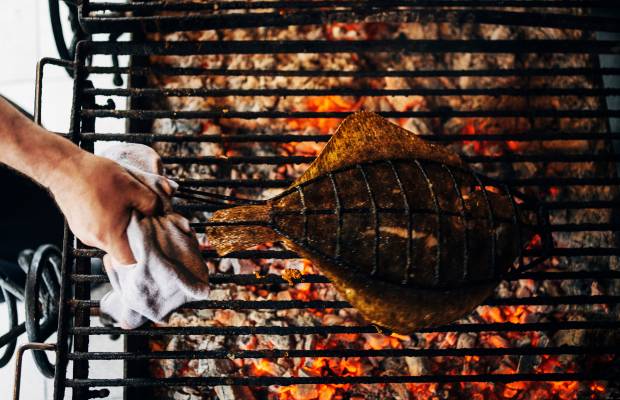
At Elkano, the famous turbot does not arrive as a fillet, a tasting-menu fragment, or a chef's flourish. It arrives as an argument about leaving things intact. The fish is grilled whole, skin on, over embers, then brought to the table with the confidence of a dish that does not need much explanation beyond its own anatomy.[1][2]
That sounds simple until you notice how much has to go right for simplicity to stay convincing. As of April 26, 2026, the current evidence around Elkano still points in the same direction from multiple angles. The MICHELIN Guide's 2026 Spain listing calls the restaurant one of the temples of wood-fired cooking, names the turbot as the house legend, and praises a dining room that runs "like a Swiss watch."[2] 50 Best Discovery still describes Elkano as a family-run seafood grill opened in 1964, known for roasting fish whole, skin and all, with turbot and sole as major players.[3] The World's 50 Best 2025 profile goes even tighter: Elkano became Elkano because Pedro Arregui once put a huge turbot across two grills when it would not fit on one, and chose to roast it whole without removing the skin.[1]
That last detail is the whole story. The skin is not a rustic flourish. It is the method.
Image context: this post uses a 2025 World's 50 Best dish photograph because it captures the dish at the exact point where Elkano's logic is easiest to see. Before carving, before service, before sauce reaches the plate, the fish is still a single body suspended over coals. That is the level at which the restaurant's claim begins.[1]
1. The dish starts as a refusal to break the fish down too early
Many prestigious seafood restaurants build elegance by trimming the animal into neat portions. Elkano's elegance begins with the opposite decision. The 50 Best ranking profile treats Pedro Arregui's large-turbot moment as the foundational act: the fish was too big for one grill, so he used two and cooked it whole, skin on.[1] Foods and Wines from Spain gives the same innovation more technical weight. Instead of filleting turbot, as was customary, Pedro grilled it whole; that choice, together with his treatment of hake heads and other overlooked parts, helped reset Basque fish grilling around completeness rather than disassembly.[4]
That matters because a whole flatfish is not just a larger fillet. Turbot has zones. It carries different textures across the body, more gelatin around the fins and head, and a different relationship between skin, fat, and flesh than a cleaned-up slice ever can.[4] Keeping the fish intact allows the grill cook to work with those zones instead of erasing them. The plate becomes more varied because the fish was allowed to remain one thing longer.
This is why Elkano's turbot feels more serious than "best fish in Spain" hype. The dish is built around structural restraint. The restaurant declines early precision so it can get a better final precision later.
2. The skin is not packaging; it is the pressure system
The easiest mistake is to think the skin is there for drama or tradition alone. At Elkano, the skin behaves like a thermal tool. Foods and Wines from Spain describes Basque parrilleros as cooks who judge fat, salt, grill height, position, and time with unusual accuracy, aiming to crisp the outside while keeping the interior succulent.[4] Read against the Michelin text about total control of the grilling process, that makes the skin look less decorative and more load-bearing.[2]
Turbot is especially suited to that treatment. It is a meaty flatfish, but it is also oily enough to reward high heat if the cook can keep the flesh from drying out. The intact skin helps hold moisture, protects the flesh during the first stage of grilling, and then becomes part of the flavor boundary once the coals have done their work.[1][4] The whole fish can take smoke and radiant heat without collapsing into shredded softness.
Elkano's answer to luxury is hidden there. Plenty of expensive dishes advertise rarity first and execution second. Turbot at Elkano works the other way around. The ingredient matters, but the dish's prestige comes from how clearly the grill makes the fish reveal itself: firm dorsal sections, richer underside bites, gelatin around the collar and bones, and crisped outer surfaces that never turn the dish into a blunt char exercise.[1][2][4]
3. "Agua de Lourdes" keeps the dish from hardening into macho grill theater
If the skin keeps the fish intact, the finishing liquid keeps the dish mobile. Foods and Wines from Spain explains that Pedro Arregui's wife, Mari Jose, replaced the more usual garlicky treatment with a vinegar-and-oil mixture that emulsifies with the fatty juices the turbot releases as it cooks. The restaurant still serves that liquid today under the name agua de Lourdes.[4]
That small detail is what prevents Elkano's turbot from becoming a fire-worship dish. Without the finishing liquid, whole grilled turbot could easily read as masculine grill bravado: big fish, smoke, crust, applause. Agua de Lourdes changes the register. It pulls rendered fat, fish juices, oil, and acidity into a looser emulsion that sharpens rather than smothers. The dish stays elemental, but it also gains movement.[4]
The effect is more important than the romance of the name. Turbot is rich. A whole fish cooked over coals needs a final adjustment that clears the palate and reconnects the different parts of the body. The vinegar-oil finish does that without making the fish taste sauced in the heavy sense. It turns the fish's own runoff into the last stage of seasoning.[4]
That is also why Elkano's turbot remains more compelling than a generic grilled-fish ideal. The restaurant is not just putting excellent seafood over fire. It is solving for the moment after the fire, when rendered richness has to be guided into clarity.
4. The grill is treated as a measurement instrument, not a branding device
The wider Basque grill tradition matters here because Elkano does not present itself as a lone genius act. Michelin places the restaurant inside Getaria's longer gastronomic heritage, and Foods and Wines from Spain frames Basque grilling as a system built on product quality, restraint, and decades of embodied practice.[2][4] A parrillero in this tradition is not showing off smoke. He is calibrating distance.
That idea helps explain why Elkano still feels current in 2026. Around the world, open fire often gets marketed as authenticity in itself. Elkano makes a stricter claim. Fire is only as good as the cook's ability to read a fish, judge its fat, adjust grate height, and stop at the point where the outside is set but the center still feels alive.[2][4] The restaurant's public descriptions keep returning to the same vocabulary for a reason: fresh fish, whole roasting, skin on, little overworking of texture or flavor, total control.[1][2][3]
Even the service language supports that reading. Michelin's note that the dining room runs like a Swiss watch is not just a hospitality compliment.[2] It tells you that the fish's final leg matters. A whole grilled turbot is a live object until the very end: carry it too slowly, carve it poorly, or lose the rhythm of the room, and the dish starts cooling into memory instead of arriving as presence. Elkano's system has to hold from purchase to grill to table.
Why this fish still sets the standard
50 Best Discovery calls Elkano one of the Basque Country's most exclusive seafood restaurants; the 2025 ranking profile calls it a cathedral that chefs make pilgrimages to; Michelin keeps it inside the 2026 guide as a one-star room whose identity stays inseparable from sea, product, and wood fire.[1][2][3] Those are prestige signals, but they are not the main reason the turbot lasts.
The real reason is narrower and harder. Elkano found a way to make a fish taste more like itself by handling it less reductively. Keep it whole. Leave the skin on. Let the grill work across the body's different densities. Finish it with a liquid that gathers the fish's own rendered richness and points it back toward clarity. Then carve and serve with enough precision that the dish still feels alive when it reaches the table.[1][2][4]
That is why the turbot still reads as modern rather than merely famous. It is not a relic dish, and it is not a macho grill signature. It is a lesson in how little intervention can still be a very sophisticated form of intervention.
Sources
- The World's 50 Best Restaurants 2025, "Elkano" - ranking profile covering Pedro Arregui's two-grill turbot origin story, whole skin-on roasting, the restaurant's long legacy, and the 2025 dish photograph used for the lead image.
- The MICHELIN Guide, "Elkano - Getaria" - 2026 Spain guide listing covering Getaria's wood-fire heritage, the restaurant's "culinary landscape," total grilling control, the legendary turbot, and the dining room service note.
- 50 Best Discovery, "Elkano - Getaria - Restaurant" - profile covering the 1964 opening, family-run structure, whole-roasted fish tradition, current 50 Best rankings, and key service information.
- Foods and Wines from Spain, "Spanish Grilled Fish Masters: from Elkano to Etxebarri" - background on Basque parrilla technique, Pedro Arregui's whole-turbot innovation, and the vinegar-oil finishing liquid known as agua de Lourdes.