

The fastest way to misunderstand Ocean is to treat it as one more luxury hotel flagship with Portuguese ingredients and a beautiful view. The official restaurant page certainly gives you the view first: spectacular Atlantic outlook, polished service, casual elegance, and two Michelin stars held since 2011 under chef Hans Neuner and his team.[7] All of that is true. It is also incomplete. Watched closely, the videos around Ocean suggest that the restaurant's real fine-dining argument is not simply excellence in place. It is the way place gets edited into sequence: the room frames the diner toward the water, Neuner frames Portuguese cuisine through routes of travel rather than static nationalism, and the plates compress that wider geography into very exact, often deceptively small acts of composition.[1][2][4][5][7]
That route-based reading matters because Portugal is unusually easy to flatten in fine dining. A restaurant can borrow the language of discovery, Atlantic produce, or national heritage and still serve a meal whose deeper grammar is generic international luxury. Ocean's own materials point in a more demanding direction. The team page says Neuner arrived in the Algarve from Austria in 2007, found in Portuguese cuisine a new gastronomic obsession, and built menus through the regions and influences of Portugal's age of discovery, a path that led to the restaurant's first Michelin star in 2009 and the second in 2011.[4] The newer story page extends that logic even more explicitly: over five years and five menus, Neuner has traveled through routes tied to Portugal's Era dos Descobrimentos, following voyages toward India, South America and Brazil, and Asia and the Far East.[5] Taken together, those statements define Ocean less as a museum of Portuguese classics than as a restaurant trying to plate Portuguese cuisine as a network of encounters.
That is why Video Collection is the right mode here. No single clip can carry the whole thesis. The official dining-room film explains the emotional register of the house.[1] The longer #FOODMISSION profile explains how Neuner narrates Portugal through movement and ingredients rather than through clichés about tradition.[2][4][5] The kitchen-prep video on sea bass, wild Algarve juniper, leek, and caviar shows how that larger historical and geographic framing is forced to cash out at plate level, where temperature, smoke, salinity, garnish, and restraint have to do the real persuasive work.[3]
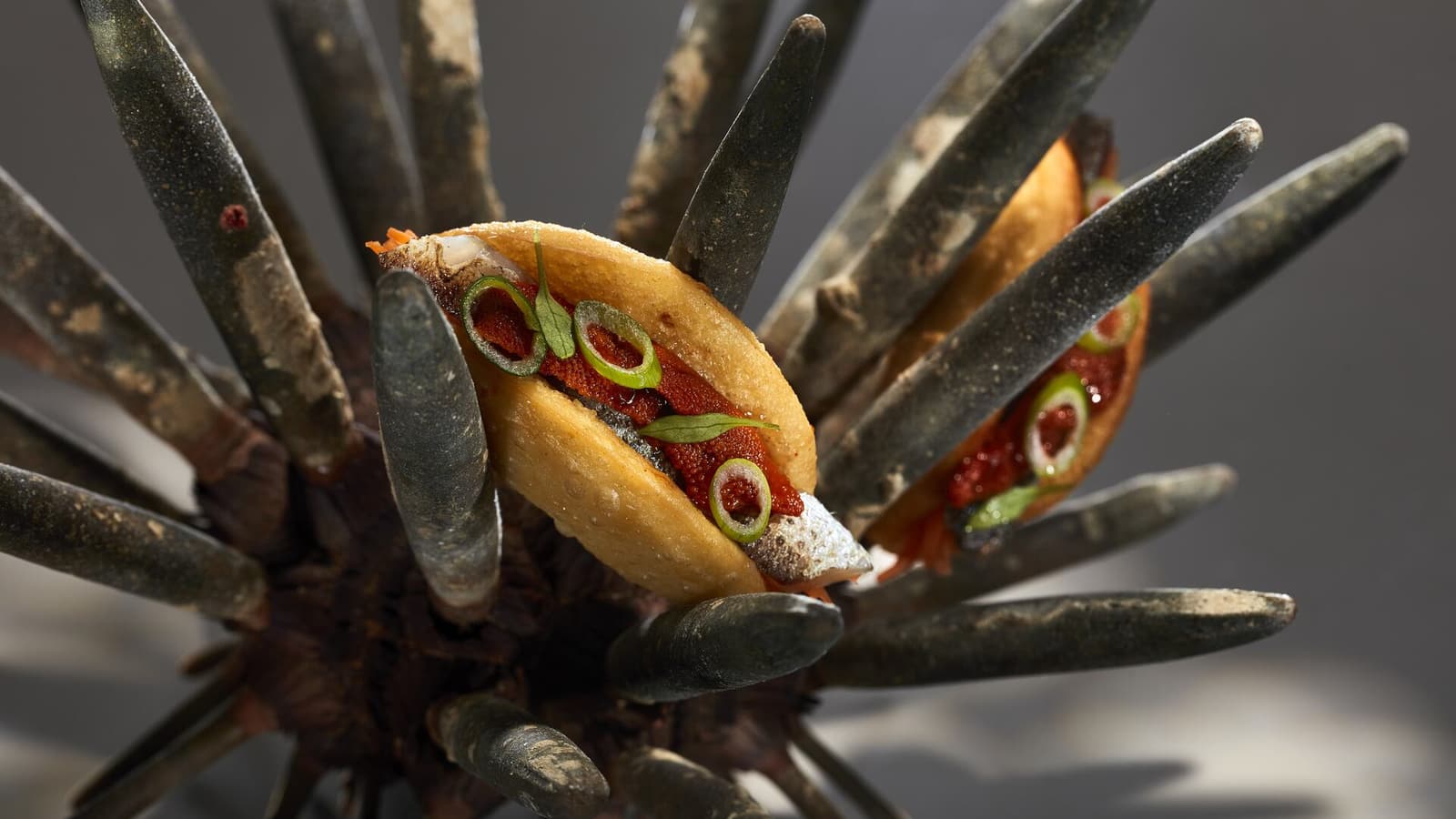
Image context: the cover uses an official Ocean food photograph published by Vila Vita Parc. A real photographic image is the right lead here because this article's claim is that Ocean's identity lives in controlled physical staging, not in abstract branding language. Even a small bite is treated as marine theater under pressure.[8]
Video 1: the official room film shows that Ocean's first move is calibration, not grandeur
The short "Ocean - The Art Of Dining" film is polished resort media, but it is still useful because it establishes the house tempo with surprising accuracy.[1] Ocean is not presented as a temple of intimidation. The visual language is smoother than that: water, light, quiet surfaces, choreographed service, and a room that wants to feel precise without turning rigid.[1][7] That atmosphere matters because it tells you how the restaurant wants its technical ambition to be perceived. The luxury is real, but the room is arranged to read as controlled ease rather than pressure.
That is more important than it sounds. In high-end dining, room tone is not decoration around the meal; it is one of the meal's arguments. Ocean's official page describes "sublime food, seamless service and an atmosphere of casual elegance" while foregrounding the Atlantic view.[7] The video makes that description legible. You can see why the house needs exactly this level of composure. If the room tilted further toward grand ceremony, the historical and geographic ideas around the menu might harden into self-importance. If it tilted further toward beach-resort looseness, the labor and precision of the kitchen would lose force. The film therefore works as more than promotion. It shows Ocean's first act of editing: the restaurant narrows luxury into a calmer bandwidth so that the menu can carry conceptual weight without becoming heavy-handed.[1][7]
The official clip also helps explain why Ocean travels so well in the international fine-dining imagination. Awards and rankings do not only reward food; they reward a total environment that can convert local identity into a globally legible experience. Portugal Global's 2025 news item naming Ocean "Restaurant of the Year" in the Algarve is part of that wider recognition system.[6] The room film makes clear why the place functions so effectively within it. Ocean has built a setting where locality is visible, but never provincial; polished, but not anonymous.[1][6][7]
Video 2: the Hans Neuner profile makes the menu read like a route map
The #FOODMISSION 2024 video is where Ocean stops looking like a beautiful room attached to a strong kitchen and starts reading like a more specific intellectual project.[2] Neuner comes across there not as a chef performing heritage for effect, but as someone trying to explain Portuguese cuisine through movement: ingredients, routes, encounters, and returns. That matters because it matches the official written material closely enough to feel like a stable house position rather than a one-off interview line.[2][4][5]
The team page gives the backbone of that position. Neuner is described as arriving in the Algarve in 2007, finding in Portuguese cuisine a new gastronomic passion, and pursuing the flavors and ingredients he encountered through the regions touched by Portugal's age of discovery.[4] The "A Journey Around the World" story makes the structure even plainer: over five menus, he has followed routes linked to India, South America and Brazil, and Asia and the Far East in order to trace the roots of Portuguese gastronomy through the stories embedded in food.[5] Once you read those pages and then watch the video, Ocean's menu stops looking like a generic "modern Portuguese" tasting sequence. It becomes a route map in which Portuguese cuisine is not defined by isolation but by what arrived, departed, fused, and was made local over time.[2][4][5]
This is the point where Ocean separates itself from a lot of internationally fluent fine dining. Many restaurants can say they are seasonal, local, or technically exact. Fewer can explain what national cuisine means without retreating into folklore or drifting into borderless prestige cooking. Neuner's version is stronger because it treats Portuguese identity as historically mixed yet still structured. The sea is not scenery here. It is the transport mechanism behind the menu's imagination.[2][4][5] That is also why the room from the first video matters so much. Once the restaurant places the diner in front of the Atlantic, the historical routes described in the second video stop sounding like an abstract narrative overlay. They acquire physical direction.
Video 3: the sea-bass clip shows where Ocean either proves itself or fails
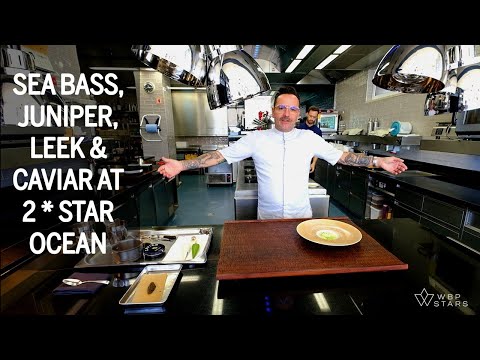
The most valuable clip in the set may be the shortest and most concentrated one: the wbpstars video of Neuner preparing sea bass, wild Algarve juniper, leek and caviar.[3] If the first video gives Ocean a room and the second gives it a theory, the third gives it a test. Fine dining finally has to survive contact with a single plate. Historical language, Atlantic rhetoric, and Portuguese route-mapping only matter if they can be reduced to a few bites without collapsing into ornament or overstatement.
What makes this dish persuasive is not the presence of caviar or the elegance of the plating. It is the way local and imported signals are ranked. Sea bass and wild Algarve juniper immediately anchor the plate to regional material.[3] Leek brings sweetness and structure. Caviar introduces a luxury note, but in the logic of the dish it reads less like a trophy and more like a salinity amplifier, another way to tune the marine register already established by the fish.[3] That hierarchy matters. Ocean is at its best when luxury ingredients sharpen the Atlantic argument instead of replacing it.
The same is true of the video's handling of fire and finish. You can feel why a restaurant with Ocean's ambitions would obsess over this level of detail. A route-based cuisine has to avoid two symmetrical failures: becoming so narrative that the food turns literary, or becoming so technically polished that the story disappears. The sea-bass clip sits in the narrow band between those outcomes.[3] Smoke, juniper, gloss, and garnish all remain subordinate to clarity. The plate looks expensive, but the more serious achievement is editorial. Ocean trims the dish until the diner is left with a controlled sequence of coast, herb, sweetness, and roe rather than a blur of premium signifiers.[3][5]
What the collection reveals when watched together
Seen in sequence, these three videos make a stronger claim than any one of them could alone. Ocean's fine-dining identity does not live in just one place: not only in the view, not only in chef biography, and not only in plate craft. It lives in the way those three layers lock together. The Atlantic-facing room creates the sensory frame.[1][7] Neuner's route-based account of Portuguese cuisine creates the intellectual frame.[2][4][5] The sea-bass preparation shows the point at which both frames must become edible or else be exposed as rhetoric.[3]
That is why Ocean is worth taking seriously now. Its distinction is not that it makes Portuguese food luxurious. Plenty of restaurants can do that. Its distinction is that it treats Portuguese fine dining as a problem of translation: how to move from sea, history, and travel into a meal without losing pressure, and without dissolving into generic cosmopolitan polish. The recent external recognition noted by Portugal Global matters for exactly that reason.[6] Ocean is not merely visible. It has become legible. Watch these three videos carefully and the restaurant's real achievement comes into focus: Portugal arrives here not as a flag pinned to a menu, but as a route tightened into room, service, and plate.[1][2][3][4][5][6][7]
Sources
- Vila Vita Parc, "Ocean - The Art Of Dining," YouTube video, published July 12, 2017.
- The Best Chef, "#FOODMISSION 2024 - Hans Neuner, Ocean Restaurant, Algarve, Portugal," YouTube video, published May 24, 2024.
- wbpstarscom, "Hans Neuner prepares SEA BASS, WILD ALGARVE JUNIPER, LEEK AND CAVIAR at 2 * star Ocean (Portugal)," YouTube video, published October 26, 2025.
- Ocean Restaurant, "Team" - official chef biography and restaurant positioning.
- Ocean Restaurant, "A Journey Around the World" - official story on the menu's discovery-route framework, published May 28, 2025.
- AICEP Portugal Global, "Ocean elected 'Restaurant of the Year', Algarve, Portugal," published February 2025.
- Vila Vita Parc, "Ocean Restaurant" - official restaurant page on the Atlantic-facing room, service style, and Michelin status.
- Vila Vita Parc official Ocean photograph used as this article's lead image.