
The most useful way to watch 50 Best's 4-minute visit to Le Du is not as an awards reel for the restaurant that topped Asia's 50 Best Restaurants 2023.[1][5] The video is too short for that, and chef Thitid "Ton" Tassanakajohn is too precise in it for that reading to hold. What the clip really offers is a compressed explanation of how Le Du keeps modern fine dining from drifting into generic luxury. The room may use contemporary plating and non-Thai technique, but the restaurant keeps dragging the diner back to Thai geography: season, local produce, river prawn, shrimp paste, late-night street food memory, and a countrywide supply chain that has to stay legible on the plate.[1][2][4][5]
That distinction matters because "modern Thai" can mean two very different things in high-end dining. One version uses Thai flavors as a mood board while the deeper logic of the meal stays French, Japanese, or globally interchangeable. Le Du's own materials point in the other direction. The official site says the restaurant's name comes from the Thai word ฤดู, meaning season, and the suppliers page makes the sourcing claim explicit: the kitchen has spent years searching across Thailand for farmers, fisheries, and local producers worth building menus around.[2][4] The short 50 Best article on Le Du sharpens the same point by describing chef Ton's project as a seasonal Thai restaurant built from Thai ingredients, even when French-European technique is part of the method.[5]
That is why this video is worth embedding now. In just a few minutes it sketches the whole house grammar: ingredient sovereignty first, modern method second; a seasonal menu that changes around one anchor dish; and a signature river-prawn course that behaves less like a trophy plate than like a map of Thailand compressed into one bowl of rice, paste, head sauce, and memory.[1][5]
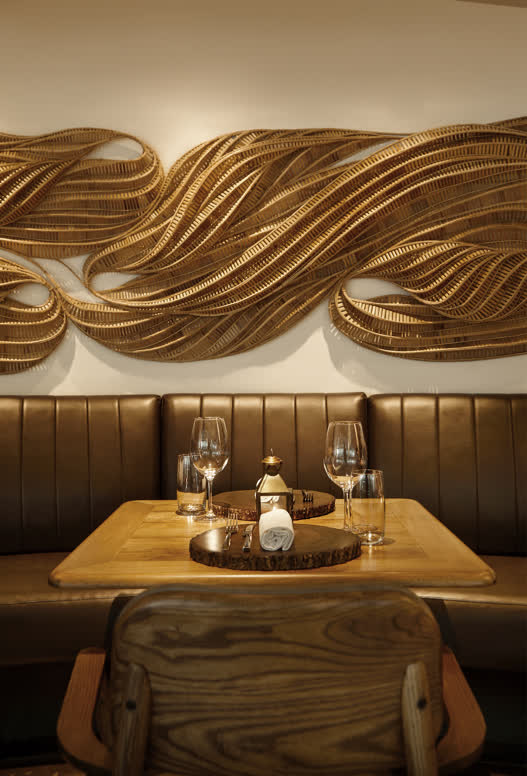
Image context: the cover uses an official Le Du interior photograph from the restaurant's website. A real room photograph is the right lead image here because the argument of the article is about how Thai produce and seasonal structure get translated into an actual dining sequence in Bangkok, not into an abstract chef manifesto.[6]
Around 1:05, chef Ton defines the restaurant by ingredient sovereignty, not by technique purity
The key statement arrives a little after the first minute, when Ton says Le Du wanted to do something "pure Thai" in terms of ingredients and flavors, while relying on modern cooking techniques that are not themselves Thai.[1] That line is the best single explanation of the restaurant's position because it refuses two easy traps at once. It does not pretend classical European method is absent, and it does not let that method become the real author of the meal. Technique is admitted openly, but the authority of the dish stays with Thailand.
This is also consistent with the official biography page. Le Du's team page stresses Ton's formal training in the United States and his time in kitchens such as Eleven Madison Park, The Modern, and Jean-Georges, then frames his project as returning home to elevate Thai cuisine and give it standing among the world's leading cuisines.[3] The point, then, is not national purity in the narrow sense. The point is control over what gets centered. Imported technique can be useful; imported hierarchy is the thing the restaurant is trying to reject.
That is why the video feels more serious than a standard chef-profile short. When Ton says that more than a decade ago not many people valued Thai ingredients and Thai produce as highly as they should have, he is not making a nostalgic claim.[1] He is describing the old prestige ladder that many ambitious Asian restaurants had to negotiate. Le Du's answer was to reverse that ladder: keep the technical sophistication, but stop treating Thai produce as raw material waiting for foreign validation.[1][3][5]
Around 1:54, "season" stops being branding and becomes the restaurant's operating system
The next crucial turn comes when Ton explains that Le Du means season in Thai and that the menu changes seasonally except for one signature dish that always remains on the card.[1][2] This is the moment where the restaurant's name stops reading like a tasteful label and starts functioning as structure. Seasonality is not there to make the menu sound contemporary. It is what decides the movement of the meal.
The suppliers page gives that claim real weight. It is not written like polished marketing copy; it is blunt about the restaurant's long effort to find farmers, fisheries, and local suppliers across the country.[4] That matters because seasonality in fine dining often stays at the level of garnish language. A menu says "seasonal," but the real architecture of the meal still depends on year-round luxury staples and a fixed international palate. Le Du's source material suggests a different ambition. The changing menu is supposed to follow what Thailand can offer at its best, while the signature dish holds the room's identity steady.[1][2][4]
That combination is unusually intelligent. A fully fluid tasting menu can become hard for diners to remember and hard for a restaurant to symbolize. A fully fixed menu can turn "seasonal" into empty rhetoric. Le Du solves that tension by letting one plate behave like a house thesis while the rest of the meal rotates around it.[1][5] The video explains this in seconds, but the underlying design logic is strong: identity should remain stable even while ingredients move.
Around 2:02, the signature prawn dish turns the country into one plate
The video's most revealing passage is the description of the signature course. Ton explains that the dish uses a river prawn from southern Thailand, rice from the north, shrimp paste from the east, and a sauce drawn from the prawn head, infused in this season's version with tom yum reference.[1] The companion 50 Best article names the plate more precisely as Le Du's signature khao kluk kapi: butterflied Tapi river prawn, grilled and served with a risotto-like rice mixture built from northern Thai rice and shrimp paste.[5]
That description matters because it shows what Le Du means by modern Thai cuisine. The restaurant is not simply plating a regional classic more elegantly. It is composing a national argument out of distinct local materials, then tightening that argument with sauce work and sequencing. South, north, and east arrive together, not as a sampler but as a single course with internal logic.[1][5] Fine dining here is doing what it does best when it is at its best: compressing distance without flattening difference.
The late-night street-food reference in the same segment sharpens the point further. Ton says this menu's prawn dish took inspiration from the kind of late supper one eats on the street in Thailand after going out or working late.[1] That is a critical detail. It means the restaurant's luxury move is not to escape ordinary food memory; it is to condense that memory into a more exacting form. The plate gets more technical, but it does not sever its social source. That is why the dish reads as more than a signature. It is a method statement.
By the end, the award means proof and permission, not just prestige
The video closes by turning from one restaurant to a wider Thai horizon. Ton says becoming the first Thai chef to lead the No. 1 restaurant in Asia means a great deal because it proves Thai cuisine is equally worthy of respect and can open the door for younger chefs in Thailand.[1] In another context, that kind of closing line could feel ceremonial. Here it lands because the earlier parts of the video have already shown the mechanism behind it.
Le Du's official materials make the same ambition visible from a different angle. The team page frames Ton's return to Thailand as an effort to give Thai cuisine standing on the world stage, and the 50 Best written profile presents Le Du's rise as part of a broader shift in how Thai fine dining is being read across Asia.[3][5] Once you put those sources beside the video, the ending stops sounding like personal triumph alone. The award becomes evidence that a particular argument about Thai ingredients, technique, and prestige has become harder to dismiss.
That is what makes this clip worth watching as more than promotional content. It is short, polished, and designed for broad circulation.[1] But inside that format it still manages to show a serious fine-dining idea at work. Le Du is not trying to make Thai cuisine legible by diluting it into global sameness. It is doing the opposite. It is using fine-dining control to make Thai seasonality, Thai produce, and Thai food memory travel farther without losing their shape.[1][2][4][5]
Sources
- 50 Best, "Inside Asia's Best Restaurant - Le Du in Bangkok," YouTube, published February 1, 2024.
- Le Du, official homepage - on the restaurant name deriving from the Thai word for season and the emphasis on seasonal produce.
- Le Du, "Team" - chef Ton's training background and the restaurant's stated ambition for Thai cuisine.
- Le Du, "Suppliers" - on the restaurant's sourcing across Thai farmers, fisheries, and local producers.
- Giulia Sgarbi, "A new era for Thai cuisine: how Le Du became The Best Restaurant in Asia 2023," 50 Best Stories, March 28, 2023.
- Le Du, official atmosphere photograph used as this article's lead image.