The lazy description of NUTA would be "Italian-Polish-Asian fusion in Warsaw." The better description is more musical: Andrea Camastra has built a restaurant that behaves like a composed improvisation. The official site gives the theme in one compact phrase, calling NUTA "Polish cuisine with Italian accents and a subtle Asian twist," and says the restaurant has been awarded a Michelin star for the fourth time in a row.[1] Michelin's current listing keeps the same triangle in view from the outside: Camastra comes from Puglia, lives in Poland, and has a passion for Asian cuisine; all three feed the tasting menus.[2]
That triangle matters because it does not read like a branding exercise. NUTA is not trying to make Warsaw cosmopolitan by scattering global references across plates. It is trying to make Camastra's actual biography edible. Puglia gives him memory of fish, vegetables, southern Italian generosity, and sharp product instinct. Poland gives him the country he chose, the traditions he keeps reworking, and a dining public increasingly confident that fine dining does not have to sound French to sound serious. Asian influence gives him another register of structure, umami, precision, and restraint.[1][2][4]
The result is a restaurant profile built less around one signature dish than around a method. NUTA works when those influences stop announcing themselves separately and begin to behave like one score.
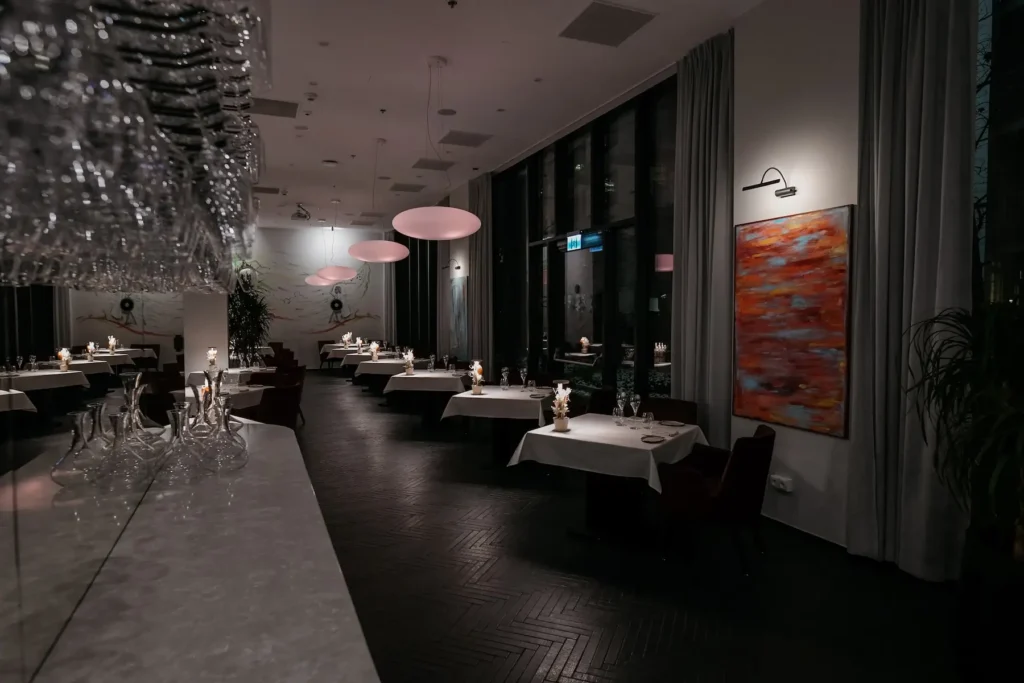
Image context: the lead image uses a real dining-room photograph credited on The Best Chef's Andrea Camastra profile. It shows NUTA as a room of controlled atmosphere rather than a neutral container: white cloth, glass, dark floor, tall windows, and colored light make the musical metaphor visible before the menu begins.[5]
Why the room matters
NUTA sits at Plac Trzech Krzyzy 10/14 in Warsaw, inside the Ethos address near one of the city's main central squares.[1][4][5] That location could easily push the restaurant toward stiff prestige. Instead, the public descriptions suggest a more elastic room. In Your Pocket notes the jazz-inspired murals, soundtrack, and three wine-pairing moods: Polish, Funky, and Jazzy.[3] Warsaw Visit similarly frames the dinner through Virtuoso and Maestro menus plus pairing sets, with the Polish pairing sitting beside more unconventional or classical wine paths.[4]
Those names might sound decorative, but they explain how the restaurant wants to be read. A menu called Maestro or Virtuoso is not only saying "luxury." It is saying that timing, pitch, variation, and control matter. A Polish pairing is not just a patriotic add-on; it can pull the meal back toward the country whose food memory Camastra keeps interrogating. A Funky pairing creates room for surprise. A Jazzy pairing implies a more polished, perhaps more classical, route through the same food.[3][4]
This makes NUTA more interesting than a standard tasting room with a long beverage list. The pairings appear to be part of the restaurant's grammar. They let the same kitchen idea play in different keys.
Camastra uses science as a way back to memory
Camastra's science language could be a trap. Molecular gastronomy became a global restaurant shorthand years ago, and many kitchens used it to make food look clever while losing contact with pleasure. The useful thing about Camastra is that the sources describe the opposite direction. Lavazza's profile says he uses scientific technique and "note-by-note" thinking to dig into Polish tradition rather than to escape it.[4] The examples are telling: rosol, gulasz, bread and lard, mizeria, and oscypek are not luxury objects by default. They are foods loaded with domestic recognition, countryside memory, street-fair habits, and Sunday-table emotion.[4]
That is why the chemistry matters. It is not there to make dinner futuristic. It is there to concentrate memory until the familiar becomes newly legible. Lavazza describes Camastra's Senses-era reinterpretations of Polish staples as tiny forms that released recognizable flavors, and then places NUTA as the next chapter: Polish cuisine, Italian accents, and a subtle Asian touch inside the Ethos building.[4] Read beside the official NUTA site, the point sharpens. The kitchen is inspired by beauty, art, and science, but its stated goal is the search for new and perfect flavors, not the display of technique for its own sake.[1]
That distinction is the house's best defense. If a dish only proves that a laboratory can alter texture, it ages fast. If it lets a diner taste broth, lard, cheese, fish, or stew with more voltage than memory normally permits, it has a reason to exist.
Why Warsaw is not just the backdrop
NUTA's current importance also depends on Warsaw. The official site says the restaurant won its Michelin star in June 2023 after only 13 months of operation, and Michelin still lists it in the 2026 guide.[1][2] That kind of recognition matters in a city where the modern fine-dining scene is still defining its international vocabulary. NUTA does not answer that pressure by pretending to be a borderless luxury room. It answers by making Warsaw the meeting point for an Italian chef's adopted Polish language.
The Best Chef profile reinforces that biographical structure. It identifies Camastra as an Italian chef from Puglia, links him to NUTA in Warsaw, and describes him as blending traditional and contemporary techniques into sensory cuisine rooted in local produce and southern Italian culinary heritage.[5] That combination is important because it keeps both sides alive. He is not performing Polishness from outside and he is not abandoning his southern Italian foundation. The restaurant's tension comes from holding both claims at once.
In Your Pocket's summary catches the same working balance in more diner-facing language: Puglian roots, a life in Poland, and Asian flavors feed tasting menus where unlikely combinations are handled with confidence and precision.[3] That is the real why-now. Warsaw does not need another imported luxury template. It needs restaurants that can make the city's own dining identity feel porous, serious, and specific at the same time.
The profile in one plate-less sentence
NUTA is most persuasive when it is understood as a system of translation: Polish dishes remembered through Italian appetite, adjusted by Asian structure, sharpened by chemistry, and staged in a room that thinks in musical terms.[1][3][4] That system gives the restaurant a clearer identity than "fusion" allows.
There is risk in this kind of authorship. A chef-led concept with strong metaphors can overcompose itself. It can become too eager to explain. It can make every plate carry more symbolism than a diner wants over dinner. But the sources point to a restaurant aware of those risks. The official language stays concise. The outside guide language keeps returning to precision, confidence, and the balance of influences.[1][2][3]
That is why NUTA belongs in the current fine-dining conversation. It shows one useful future for Central European high-end cooking: not a retreat into heritage purity, not a copy of Nordic austerity, not a generic global tasting menu, but a room where a chef's migration, technique, and adopted city can become one coherent score.
Sources
- NUTA official site, covering the restaurant's Polish cuisine with Italian accents and Asian twist, Michelin-star continuity, opening recognition, Andrea Camastra profile, working hours, and Warsaw address.
- MICHELIN Guide, "NUTA - Warsaw," current 2026 listing for the one-star restaurant and inspector framing of Camastra's Puglian, Polish, and Asian influences.
- In Your Pocket, "NUTA," Warsaw venue guide covering Puglian roots, Polish life, Asian flavours, tasting-menu confidence, the on-site lab, and Polish/Funky/Jazzy pairing language.
- Lavazza, "Andrea Camastra: Polish cuisine and high-tech instruments," profile covering Camastra's scientific method, Polish tradition, Senses, and NUTA's Virtuoso and Maestro menus.
- The Best Chef Awards, "Andrea Camastra," profile covering Camastra's Puglian identity, NUTA location, awards biography, and the Natalia Poniatowska restaurant photograph used as the article image.