The most useful way to read Nuema in 2026 is not as a patriotic showcase with good plating.[1][2] It is as a restaurant that keeps asking a harder question: how do you make Ecuadorian biodiversity feel authored rather than merely abundant?[1][2][3] The answer, judging from the restaurant's own pages and the current 50 Best record, is that Nuema refuses to let the meal split into two halves. Savory cooking does not carry the national argument alone, and pastry does not arrive as a soft decorative landing. Alejandro Chamorro and Pía Salazar are building one tasting-menu language in which endemic products, angular form, seasonality, and dessert all keep pushing the same territorial claim.[1][2][3][5][6]
The official house statement is unusually direct. Nuema says it was born in Quito in 2014 as the project of Chamorro and Salazar, with the purpose of expressing the biodiversity of Ecuador through a contemporary and avant-garde perspective.[1] The tasting-menu page then sharpens the method: the restaurant believes the tasting menu is the best way to express the vast Ecuadorian territory without limiting creativity, and says the sequence changes according to what the season offers at its best so that the idea of locality actually makes sense.[2] That is a serious distinction. Plenty of ambitious restaurants talk about locality as a moral glow. Nuema talks about locality as an editing problem.
The 2025 Latin America's 50 Best profile fills in what that editing looks like on the plate.[3] It describes a menu where nepia appears as a fermented cassava-and-chilli paste, mashua stands in for Andean depth, and river shrimp from Manabí carry the coast into the room.[3] The same profile also refuses to treat dessert as a separate cute annex. It points straight to Salazar's long-standing dish of wafers, rice pudding, and nougat with salted and dehydrated crunchy peas, honey ice cream, and apples, and reminds readers that she was named The World's Best Pastry Chef 2023.[3][5] That is the real opening move for a restaurant profile here. Nuema's strength is not that Ecuador appears in the meal. Its strength is that Ecuador keeps appearing all the way to the end of the meal.
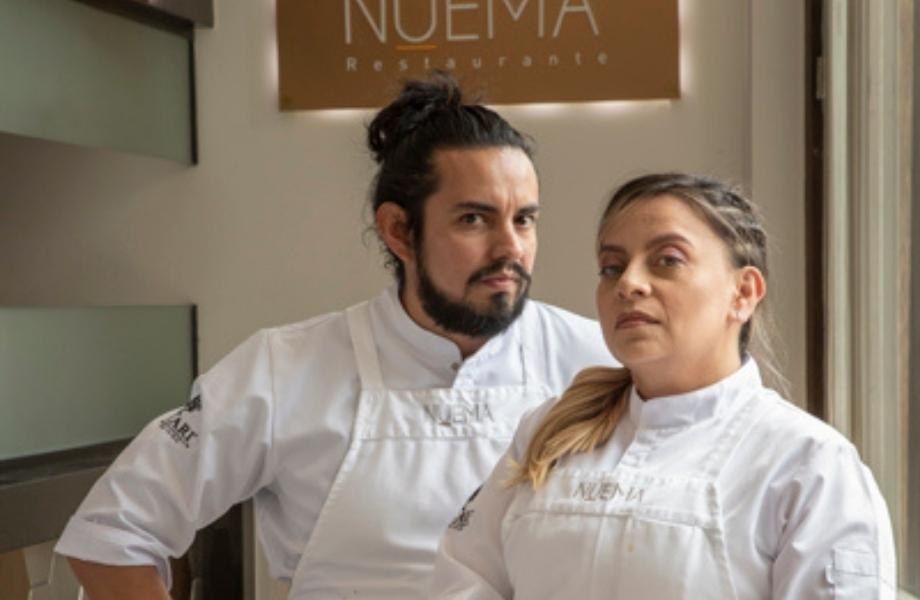
Image context: the lead image now uses a single 50 Best Discovery photograph of Alejandro Chamorro and Pía Salazar at Nuema, rather than a collage-style dish image.[3] That choice fits the article because the restaurant's main proposition is formal and authored at once. It wants territory to arrive as sequence, spacing, controlled shape, and the shared discipline of two cooks working inside one Quito room.[3][5][6]
1. The tasting menu is a territorial grammar, not a medal shelf
Nuema's own tasting-menu statement is brief, but it does a lot of work.[2] It does not say the menu exists to display as many rare products as possible, nor that Ecuadorian cuisine becomes important simply by being native. It says the format exists to express everything the country's territory contains without limiting creativity, while adapting philosophy to products so that locality makes sense.[2] That is a much more demanding standard than patriotic ingredient listing. It implies that a product matters only when the kitchen knows what form, rhythm, and sequence make that product legible.
The 50 Best profile suggests the house can meet that standard because it keeps biodiversity tied to a strong visual and structural discipline.[3] The dishes are described as angular, unusually shaped, brightly colored, and profound in flavor.[3] Chamorro's separate Chefs' Choice Award 2025 page makes the same point in more political language, describing him as an ingredient-driven storyteller who travels through Ecuadorian communities and landscapes to build a menu that can hold Indigenous food heritage and modern technique at once.[6] Read together, the sources make Nuema feel less like a single-restaurant success story and more like a carefully compressed map. The menu is trying to translate distance, altitude, coast, fermentation, and regional memory into a sequence that still feels exact inside one room.
That is why the restaurant's current status matters, but not in the obvious way. Yes, Nuema is No. 10 on Latin America's 50 Best Restaurants 2025 and holds the title of The Best Restaurant in Ecuador 2025.[3] Those are useful signals, but the stronger point is that the restaurant seems to have found a format that can carry Ecuador without flattening it into national-brand rhetoric.
2. Pastry changes the meaning of the entire meal
Nuema becomes more interesting the moment you stop treating dessert as the reward after the serious courses. Salazar's 2023 50 Best profile is valuable here because it shows how the house's pastry language was built.[5] She describes carrying a commitment to local produce and seasonality into Nuema, and says the restaurant's product-based tasting-menu structure initially left her with vegetables to work with for desserts.[5] Instead of reading that as a limitation, she turned it into style. The profile describes early desserts built from radish and turnip, later work that pairs a local fruit with a vegetable, and compositions such as Coconut, Yeast and Black Garlic or Cacao, Mucilago and Mashua, each meant to tell a story rather than merely provide sweetness.[5]
This matters because it changes the burden on the rest of the kitchen. If the savory side is mapping coast, Andes, or Amazon, and the pastry side is doing something entirely French, generic, or chocolate-only, the territorial argument collapses right at the finish line. Nuema avoids that collapse.[3][5] Salazar's work keeps root vegetables, herbs, fermentation, fruit memory, and regional reference active in the final stretch of the meal.[5] The current 50 Best profile makes the effect visible in one sentence: guests come for endemic Ecuadorian extravaganza with delicate desserts.[3] The two parts belong together. Delicacy is not an escape from the country's rougher textures; it is another way of reading them.
That also explains why Salazar's global recognition does not feel ornamental.[3][5] Her award is not there to make the restaurant look more complete on paper. It proves that the last courses are carrying real authorship and real conceptual weight. At Nuema, pastry is not a coda. It is one of the main engines of the house style.
3. Separate recognitions for Chamorro and Salazar make the restaurant feel fully authored
The strongest evidence that Nuema is more than a one-chef narrative lies in the fact that both halves of the house now have major external recognition of their own. Chamorro's Estrella Damm Chefs' Choice Award 2025 page describes him as the definitive champion of Ecuadorian cuisine, traces his route through Astrid y Gastón and Noma, and says he opened Nuema in 2014 with Salazar as a family-centered exploration of Ecuador's diversity and culinary heritage.[6] The same text stresses his fieldwork across the country's communities and landscapes, and names local ingredients such as neapia, mashuas, and Pacific mangrove black clams as part of that mission.[6]
Salazar's 2023 pastry profile gives the matching perspective from the sweet side.[5] She is not presented as the restaurant's elegant finisher. She is presented as a cook whose identity was shaped by local produce, seasonality, memory, and the decision to push vegetables into dessert without apology.[5] Once those two biographies are held together, Nuema stops reading like a restaurant with a strong savory chef and a gifted pastry department. It reads like a restaurant where both leaders are trying to solve the same Ecuadorian problem by different means.
That is why the family detail from the Discovery and Chefs' Choice material matters more than it first appears. Nuema is named after the couple's three children, and the restaurant keeps being described as intimate, family-centered, and rooted in Quito rather than as a placeless luxury export.[4][6] In fine dining, that can easily slide into sentimental branding. Here it lands differently. The family framing helps explain why the restaurant keeps resisting split identity. The meal does not want one part of the house to speak locally while another part speaks generic cosmopolitan refinement. It wants the whole table to sound like one home grammar pushed to a very high technical level.
That is what makes Nuema worth publishing in a fine-dining feed now. The restaurant is not important because Ecuador finally has a high-ranking standard-bearer. It is important because it has built a tasting-menu structure in which biodiversity, seasonality, savory craft, and pastry all reinforce one another instead of competing for narrative control.[1][2][3][5][6] The result is a restaurant that makes locality feel less like a slogan and more like a complete authorial system.
Sources
- Nuema official About page, covering the restaurant's Quito 2014 origin and its stated mission to express Ecuadorian biodiversity through a contemporary and avant-garde perspective.
- Nuema official Tasting Menu page, covering the restaurant's view that the tasting menu is the best format for expressing Ecuadorian territory, seasonality, creativity, and locality.
- Latin America's 50 Best Restaurants 2025 profile for Nuema, covering its No. 10 ranking, The Best Restaurant in Ecuador 2025 title, endemic ingredients, and the role of Pía Salazar's desserts.
- 50 Best Discovery profile for Nuema, covering the restaurant's first entry into Latin America's 50 Best list, its Quito location, and the broader establishment profile.
- 50 Best Stories, "Eating vegetables for dessert: exploring the bold cuisine of Pía Salazar" (August 3, 2023), covering Salazar's local-produce philosophy, vegetable-led desserts, and Nuema's product-driven tasting-menu method.
- Latin America's 50 Best Restaurants, Estrella Damm Chefs' Choice Award 2025 page for Alejandro Chamorro, covering his Astrid y Gastón and Noma background, Ecuador-focused fieldwork, and Nuema's family-centered mission.