The most useful thing about FREA right now is that the homepage no longer lets you romanticize it. The first line a visitor sees is stark: the restaurant is permanently closed, while catering and events continue.[1] That closure notice sharpens the restaurant's legacy instead of blurring it. FREA mattered because it was never only a pleasant vegan dining room in Berlin-Mitte. It was a sourcing system that tried to pull fine dining closer to production, waste handling, and supplier logistics than most polished restaurants are willing to do.[1][3][5]
The homepage still carries the core thesis in unusually concrete language. FREA says it produced everything itself, from house-made sourdough bread in its own bakery to the chocolate used for dessert.[1] It says regional producers and suppliers understood the philosophy well enough to help the team avoid plastic packaging.[1] And it says food scraps were processed within 24 hours in an on-site composting machine, turned into a soil substitute, and sent back to suppliers.[1][3][5] Plenty of restaurants talk about sustainability as tone. FREA described it as a loop.
The surviving menu PDF helps explain why the loop mattered. This was not an austere, sermonizing card built to make guests admire restraint from a distance. The meal still opened with FREA Bakery bread, miso butter, and broth, then moved through dishes such as Romana XO, sweet potato with mushroom ceviche and leche de tigre, croqueta with smoked-paprika bechamel, flauta with mushroom-chocolate mole, and tonnarelli with green asparagus, cauliflower-miso cream, wild garlic oil, olives, and black lemon powder.[2] The experience prices were published cleanly at 75 euro, 85 euro, and 95 euro, with wine, mixed, and alcohol-free pairings layered on top.[2] In other words, the restaurant was not asking guests to pay for moral cleanliness alone. It was asking them to taste how a house-made system could still feel lush.
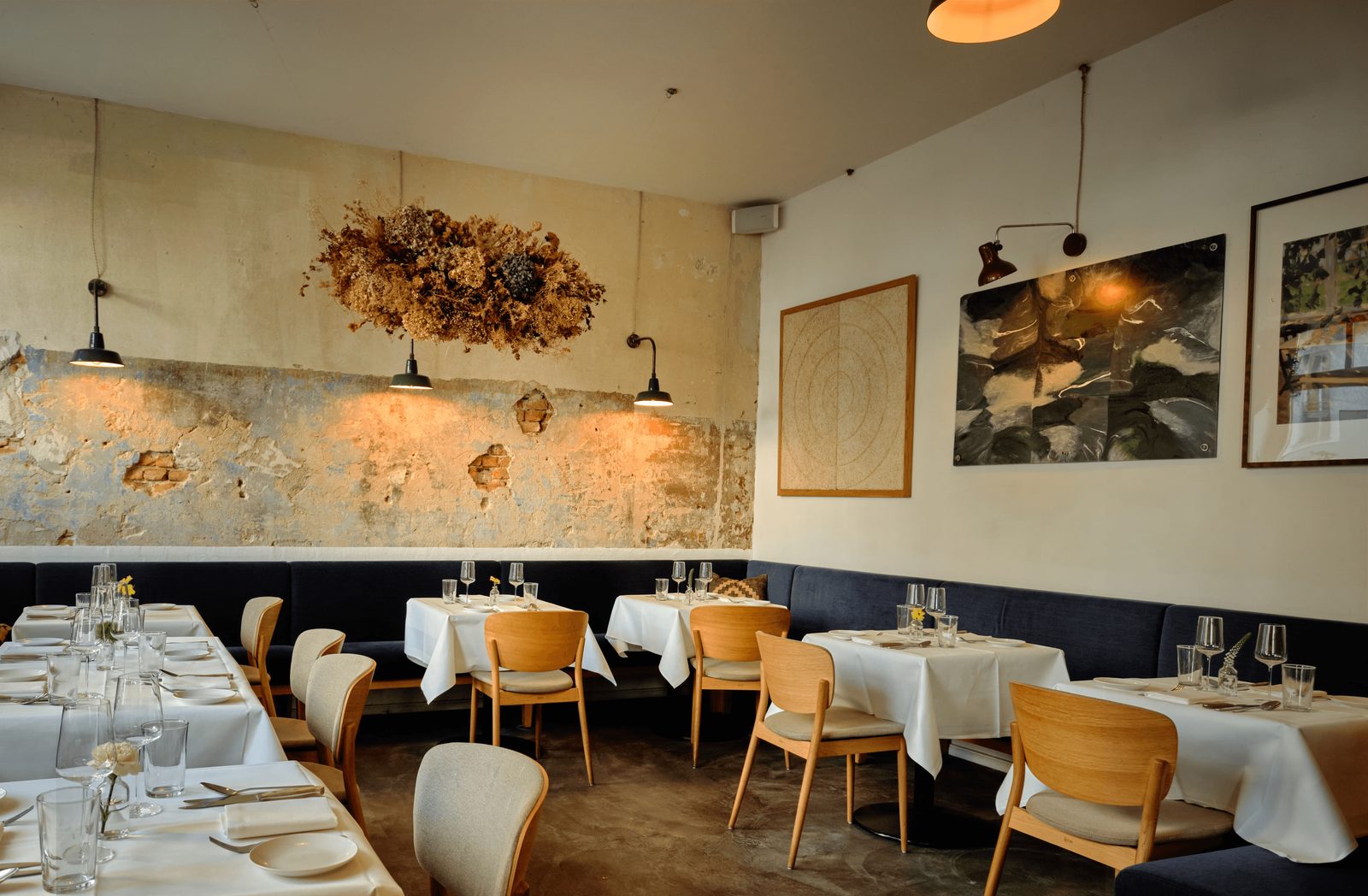
Image context: I chose an official dining-room photograph rather than a plate close-up because this article is about where a supply chain becomes legible. FREA's white tablecloths and softened, worn walls matter as stage design, but the stronger point is that the room looked calm because bread, prep, fermentation, packaging decisions, and waste handling had already been absorbed into the structure behind it.[1][2]
1. The bakery was not a side project; it was the front end of the restaurant's argument
Many fine-dining rooms buy in bread from specialists and treat that choice as sensible focus. FREA built the opposite case. Both the homepage and Berlin sustainability profile stress the role of its own bakery, and the menu itself makes FREA Bakery bread the first named element of the dining experience.[1][2][3] That detail matters because bread is one of the easiest places for a restaurant to hide inconsistency. It arrives early, it carries enormous emotional weight, and it quietly signals whether the kitchen wants to own texture and fermentation from the start or only once the official courses begin.
At FREA, bread appears to have been treated as the beginning of authorship, not as an accessory. The same outside profile that describes the restaurant as Berlin's first vegan zero-waste restaurant also notes that the bakery worked under the same principles and sold sourdough breads, croissants, and a daytime food menu of its own.[3] That extends the sourcing report beyond dinner service. The house was trying to keep grain, fermentation, and daily production inside the same ethical and sensory grammar rather than outsourcing them to a fashionable supplier and calling the result local enough.
That helps explain why the menu's other dishes read the way they do.[2] Once a restaurant decides to own bread, homemade cider, kombucha, syrups, miso butter, and parts of the dessert program, the dining room stops behaving like a place that merely plates ingredients. It starts behaving like a small manufacturing ecosystem.
2. The strongest zero-waste signal was abundance, not hair-shirt discipline
FREA's menu is revealing on this point because it does not read like a punishment menu.[2] There is plenty of richness and seduction in it: ajo blanco, smoked-paprika bechamel, cashew milk chantilly, salted caramel, pistachio mousse, and the dark theatricality of a mushroom-chocolate mole.[2] The pairings reinforce the same point. The house was not telling guests to admire sacrifice from afar. It was building a pleasure-forward meal and then insisting that pleasure did not have to depend on disposable excess.[2]
That distinction is crucial in fine dining. Sustainability claims are easy to respect and hard to crave. FREA seems to have understood that the idea would only travel if the food still looked like dinner people would actively want. Michelin's current restaurant listing described the kitchen as modern, creative, and entirely vegan, and the sustainability article in the same guide framed the operation around full flavor rather than virtuous denial.[4][5] The outside Berlin profile makes the same point in plainer terms, highlighting creative plant-based cooking, house-made products from bread to chocolate, and a dining format that still felt like a real night out.[3]
So the zero-waste achievement was not just technical. It was rhetorical. FREA made a case that no-waste dining had to look generous enough to compete with conventional luxury on appetite, not only on conscience.
3. The compost machine changed the scale of the sourcing story
The most memorable sentence on FREA's homepage remains the one about scraps becoming a soil substitute within 24 hours and going back to suppliers.[1] Nachhaltig Berlin repeats the same mechanism and treats it as the signature point of pride.[3] Michelin's sustainability article, as surfaced on FREA's own press page and in search results, echoes the model: handmade production, hardly any waste, and compost returning to producers as part of the loop.[5]
This is where the restaurant moved beyond familiar farm-to-table theater. Many serious restaurants can tell you who grows the vegetables. FREA tried to tell a more circular story: what left the kitchen also had a path back.[1][3][5] That does not mean the operation achieved a magical closed system. The wine list alone shows how selective the loop remained, moving through Germany, France, Italy, Spain, Austria, Georgia, and beyond.[2] The point is subtler and more believable than total purity. FREA seems to have concentrated its most demanding sourcing discipline on the areas it could actually control: bread, pantry items, house-made drinks, dessert components, supplier packaging, and organic waste processing.[1][2][3]
That is a more serious fine-dining lesson than generic localism. A restaurant does not become convincing by claiming that every item traveled the shortest possible distance. It becomes convincing when it knows which parts of the chain it can genuinely redesign, then redesigns them all the way.
4. Closure makes the case study cleaner, not smaller
Now that the restaurant itself is closed, the temptation is to turn FREA into a mood board: Berlin cool, vegan, green star, nice room, sad ending. The documents left on the site resist that flattening. They leave behind a sharper record of method: the bakery-first opening move, the fully published three-tier dinner experiences, the house-made beverages, the chocolate in dessert, the avoidance of plastic packaging, and the compost return line that tried to bind suppliers into the same system as service.[1][2][3][4][5]
That is why FREA still matters in a fine-dining feed in 2026. Its strongest contribution was to make sourcing visible as infrastructure instead of branding. The tables were elegant, but elegance was not the point. The point was that the room read as the final, polished surface of a much tighter production chain than most luxury restaurants ever show. Even after the closure note, that argument still tastes fresh.[1][2][3][5]
Sources
- FREA official homepage, including the current closure notice, the continuing catering-and-events note, and the restaurant's sourcing statement on in-house bread, dessert chocolate, plastic-packaging avoidance, and the 24-hour compost return loop.
- FREA official menu PDF, including the published 75/85/95 euro experience formats, pairing prices, FREA Bakery bread, and the current dish language around Romana XO, sweet potato, croqueta, flauta, tonnarelli, and desserts.
- nachhaltig.berlin profile for FREA, covering the restaurant's zero-waste concept, in-house bakery, self-made products from bread to chocolate, 24-hour composting machine, and Green Star framing.
- MICHELIN Guide restaurant listing for FREA in Berlin, covering the Green Star recognition and the plant-based, seasonal, three-to-five-course format.
- MICHELIN Guide sustainability feature, "FREA in Berlin - Zero Waste. Full Taste," covering the founders, chef Lorenzo Mele's description of organic seasonal handmade cooking, and the compost-return logic.