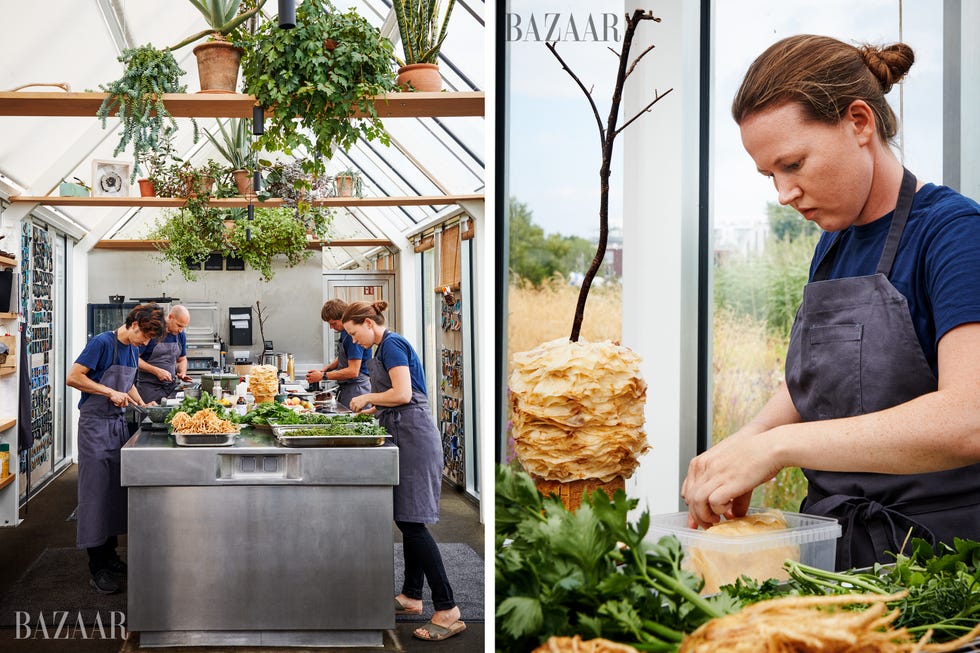
Noma's celeriac shawarma is easy to remember as a stunt: a root vegetable dressed up like a kebab. That reading is too small. The dish mattered because it solved a harder fine-dining problem: how to make a plant-based main course feel as ritualized, labor-heavy, aromatic, and table-commanding as meat without pretending the vegetable was meat.
The dish emerged in the reopened Noma 2.0 era, after the restaurant moved in 2018 to its Refshalevej compound and divided its cooking year into sharper seasons: seafood, vegetable, and game/forest.[2][3] In that structure, a vegetable menu could not survive as a polite series of delicate greens. It needed weight. It needed a moment when the room understood that the main course had arrived. Celeriac, sliced into hundreds of thin layers, seasoned with truffle, browned butter, linseed, smoke, apple, greens, and currants, became that moment.[1][2]
The cover image is important because it catches the dish at the fabrication stage, not the glamour stage. The stack is not yet carved for the guest. It stands in the kitchen like a small piece of edible engineering, surrounded by cooks, herbs, trays, notebooks, and glasshouse light.[1] That is the point: the luxury here is not a rare protein. It is time, repetition, testing, and the willingness to make a humble root carry the room.
The joke is not the dish
Calling the dish "shawarma" gives it an immediate comic charge. A diner expects rotating meat, late-night fat, shaved edges, and sauce soaking into bread. Noma gives celeriac. But the dish works because the joke is only the door. Once the conceit is understood, the eating logic has to hold on its own.
Harper's Bazaar's process account, told through René Redzepi and Mette Brink Søberg, describes a long development path rather than a one-off visual gag. The team had been working on the idea of a vegetable shawarma for years, trying different terrines of vegetables, seaweeds, and fruits before finding that root vegetables behaved best under the technique and that celeriac was the strongest candidate.[1] That matters because celeriac has the right paradox for the job. Raw, it is rough, knobbly, and celery-scented. Cooked patiently, it can become sweet, nutty, dense, and absorbent without losing all structure.
The genius of the dish is that it borrows the shawarma format's best properties rather than its literal flavor. Shawarma is not only meat; it is stacked layers, rendered fat, browned edges, vertical cooking, aromatic drip, and the drama of carving. Noma translated those qualities into a root-vegetable grammar. Thin slicing created strata. Truffle juice, browned butter, truffle puree, celery puree, and linseed fudge gave fat and umami. Slow grilling over light coals supplied caramelization and smoke. Douglas fir on the coals added a Nordic aromatic register instead of Middle Eastern spice imitation.[1]
That is why the dish avoids the usual weakness of luxury vegetarian mains. It does not arrive as a substitute steak, a sculptural salad, or a pious statement about restraint. It arrives as a process you can see.
Celeriac earns the center
The most revealing detail in the process notes is not the truffle. It is the selection of celeriac after repeated tests.[1] Truffle can make almost anything feel expensive. Celeriac has to do more stubborn work. It has to take seasoning, hold a stack, brown without collapsing, slice cleanly enough for service, and still taste like itself.
That is where the dish becomes more than clever presentation. Many vegetable-centered tasting menus rely on smallness: bright leaves, fragile herbs, compressed fruits, precise broths, and acid snaps. Noma's shawarma goes the other way. It makes a vegetable big. It lets the root become architectural. Hundreds of slices are not a garnish; they are the body of the course.[1][2]
The surrounding plate keeps that body from becoming heavy in a dull way. Harper's Bazaar describes foraged herbs wrapped in steamed greens, currants brushed with elderflower oil, and a caramelized apple wedge served alongside the celeriac.[1] The World's 50 Best account adds white currants, grilled apple, steamed greens, truffle, and the table-carving gesture.[2] These details matter because they show the dish using contrast rather than imitation. The celeriac provides dark, smoky richness; the greens and currants cut it; the apple gives cooked sweetness and acidity; truffle deepens the illusion of meatiness without requiring the dish to taste like lamb.
This is the difference between a plant main course and a plant argument. A plant main course can be satisfying. A plant argument changes what a diner thinks the category can do.
The table carving is the old luxury hiding inside the new one
The dish's most powerful move may be service choreography. 50 Best describes the celeriac "meat" being carved at the table.[2] That one detail pulls the dish back toward older restaurant theater: carving trolleys, roasts, pressed ducks, flambés, whole fish, and all the moments when luxury announces itself by making time stop around a server's hands.
Vegetable tasting menus often struggle with that kind of authority. They can be exquisite, but they rarely seize the room in the way a roast, a whole bird, or a large fish does. Noma's celeriac shawarma understood that the main course is not just a flavor slot. It is a social event in miniature. Something arrives. Someone cuts. The table watches. Portions are made from a larger whole.
That gesture changes the emotional scale of the vegetable. The guest is not asked to admire a tiny plated composition that has already been decided in the kitchen. The guest sees a larger object give itself up slice by slice. It is theatrical, but the theater is tied to labor and transformation rather than mere reveal.
This is why the dish still feels useful to think with in 2026, even as Noma itself has moved into a more itinerant phase. The restaurant's current reservation page foregrounds LA Season 2026 and access to "upcoming seasons at home and abroad," while still listing the Copenhagen address and booking infrastructure.[4] The old fixed-room logic has loosened, but the celeriac shawarma remains a compact lesson in how Noma made a dish travel through memory: strong silhouette, strong process, strong service gesture, and a method that chefs could argue with.
Seasonality as pressure, not decoration
Noma's official page for Noma 2.0: Vegetable, Forest, Ocean describes the book as a deep dive into the test kitchen after the 2018 move, with 200 dishes, detailed photography, and comprehensive descriptions rather than a conventional recipe-first cookbook.[3] That framing fits the shawarma. The dish is not only a recipe. It is an answer to the reopened restaurant's seasonal discipline.
The 50 Best profile of Noma 2.0 describes three tasting-menu seasons: Fish, Vegetable, and Game and Forest, with the restaurant's style shaped by an on-site biodynamic farm and a year divided by ingredient availability.[5] A vegetable season built that way creates a creative constraint. If plants are not a side category, they need their own forms of abundance, climax, and depth. The shawarma answers by giving the vegetable season a center of gravity.
Wallpaper's cookbook feature makes this explicit through Søberg. It says each season needs an iconic dish, and identifies celeriac shawarma as her first such mark on the menu: rich with umami, built around the plant kingdom, and designed to challenge the perception of luxury.[6] That last phrase is the real issue. Luxury is not only price or rarity. It is what a room is trained to pay attention to.
Noma redirected that attention from the animal to the work. The root was common. The preparation was not. The dish made labor visible enough to be felt but not so visible that dinner became a technical lecture.
What other kitchens should steal
The celeriac shawarma is not worth copying as a visual meme. A restaurant that simply stacks another root vegetable on a spit will probably make a weaker joke. The transferable lesson is structural.
First, a plant main needs a convincing body. That does not always mean size, but it does mean the diner should understand what carries the course. In the Noma dish, the body is layered celeriac, not sauce or garnish.[1][2]
Second, the cooking method must create a before-and-after. Raw celeriac becoming smoky, caramelized, truffled, sliceable, and almost roast-like gives the guest a transformation to believe in.[1] Without that transformation, the table-side ritual would feel hollow.
Third, the dish needs a counterweight. Apple, currants, herbs, greens, elderflower oil, and sour-sweet freshness prevent the main object from becoming a dense umami block.[1][2] This is where many ambitious vegetable dishes fail: they chase depth and forget relief.
Finally, the service gesture should belong to the ingredient. The carving works because the stack was built to be carved. It is not a random flourish pasted onto a plated vegetable. The technique, object, and room behavior all point in the same direction.
That is the dish's lasting force. Noma's celeriac shawarma did not ask vegetables to be humble, virtuous, or decorative. It asked one ugly root to stand upright, absorb weeks and years of testing, take on smoke and fat, be carved in public, and still taste unmistakably of the plant world. For fine dining, that was the more radical move: not making vegetables look like meat, but giving them meat's old ceremonial power and letting them keep their own flavor.
Sources
- Alison S. Cohn, "Noma's Chefs On How Their Celery Root Shwarma Gets Made," Harper's Bazaar (October 4, 2022) - process account from René Redzepi and Mette Brink Søberg, with Ditte Isager photographs including the image used here.
- Laura Price, "Three ground-breaking dishes that made Noma the highest new entry to The World's 50 Best Restaurants," The World's 50 Best Restaurants (July 2, 2019) - 2018/2019 Noma 2.0 context and celeriac-shawarma description.
- Noma, "Noma 2.0: Vegetable, Forest, Ocean" - official book page describing the post-2018 test-kitchen record, 200 dishes, photography, descriptions, and recipe access.
- Noma, "Reservations" - current official reservations page listing LA Season 2026, booking policy, Copenhagen address, and season/reservation infrastructure.
- 50 Best Discovery, "Noma - Copenhagen" - restaurant profile covering Noma 2.0, seasonal tasting menus, biodynamic farm, accolade history, and location.
- Jeni Porter, "René Redzepi, Mette Søberg and Junichi Takahashi on Noma's new cookbook," Wallpaper (updated October 25, 2022) - cookbook context, Noma 2.0 documentation, and Søberg's account of celeriac shawarma as an iconic vegetable-season dish.