The most useful way to read El Chato is not as a restaurant that finally made Colombian cuisine fashionable abroad. That is too neat, and it makes the place sound like a trophy cabinet. Its stronger story is more physical: a Bogotá kitchen learning how to make Colombian biodiversity workable in service, one producer relationship and one seasonal adjustment at a time.
The 2025 Latin America's 50 Best profile is direct about this. El Chato is described as a contemporary Colombian bistro led by chef Álvaro Clavijo, built around producers, global technique, local ingredients, and a relaxed dining experience rather than a temple-like room.[1] It also says Clavijo keeps exploring Colombia for new produce, works seasonality into both the a la carte and tasting menus, and uses native products in the cocktail program as well as the food.[1] That is the operating system. The glamour comes later.
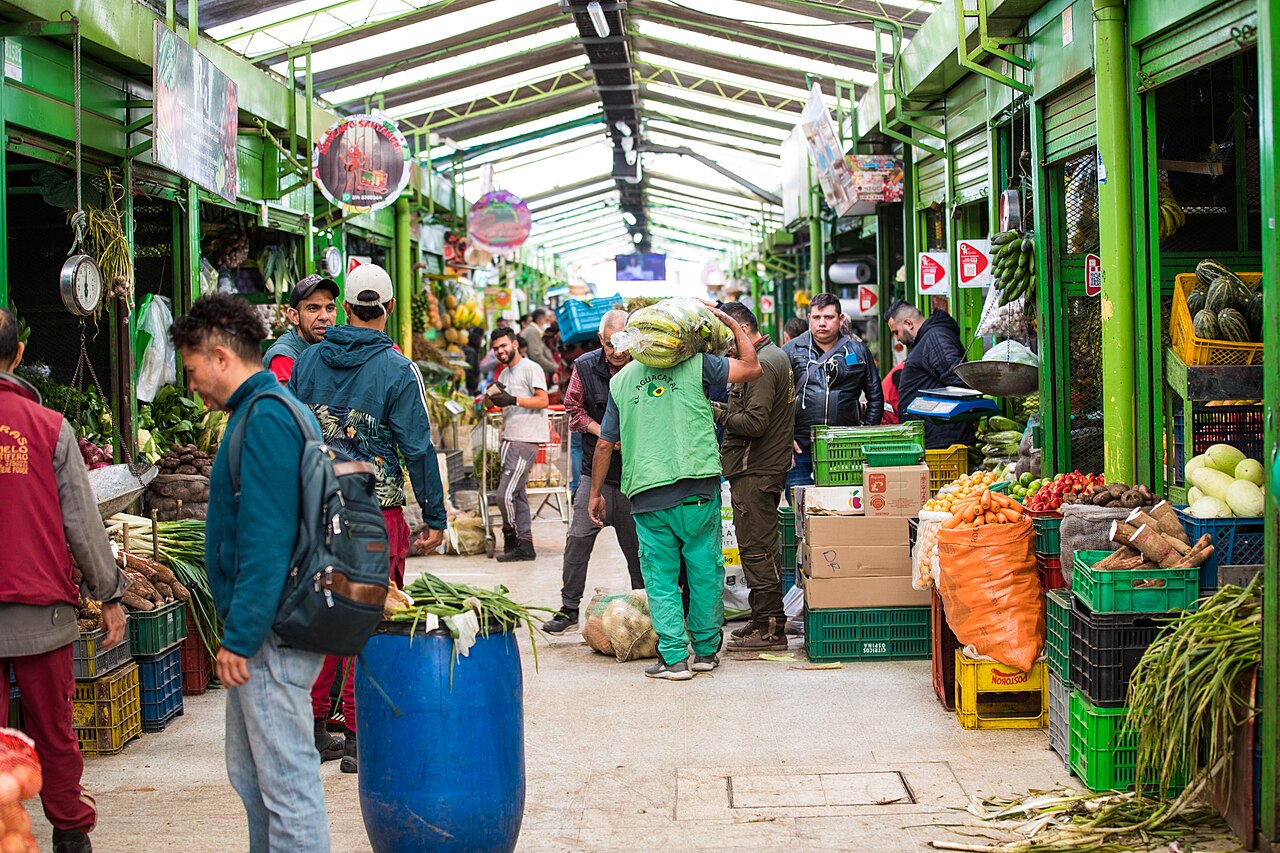
The cover image is deliberately a market photograph, not a plated course. Paloquemao's aisle of roots, greens, fruit, squash, vendors, and shoppers makes the article's point faster than a tweezered garnish could: El Chato's luxury depends on Colombian abundance becoming legible without being tidied into a generic global tasting menu.[6]
The pantry is the real proposition
El Chato opened in 2017 and, by 2025, was named No. 1 on Latin America's 50 Best Restaurants list, the first Colombian restaurant to take that position.[2] The ranking matters here less as a verdict than as a timestamp. It marks a moment when Bogotá's contemporary dining scene could be read outside Colombia without being filtered only through older assumptions about rusticity, spectacle, or borrowed European technique.
The restaurant's 2025 list profile gives the clearest sourcing frame. It describes El Chato as a contemporary Colombian bistro that pays homage to the producers it works with, applies global techniques to local ingredients, and keeps the atmosphere relaxed rather than temple-like.[1] It also says Clavijo routinely explores Colombia for new produce, uses both a la carte and tasting menu formats, and cooks with ingredients such as heart of palm, rambutan, coconut, seaweed, yacon, mushroom garum, sea snail, golden berry, and physalis.[1] Read as a list, those ingredients are colorful. Read as logistics, they are demanding.
The demand is not simply buying unusual produce. A restaurant that claims Colombia as a pantry has to avoid two traps. The first is postcard cooking, where each ingredient becomes a flag. The second is anonymous luxury, where local products are polished until they could be from anywhere. El Chato's sourcing story works because it stays in between. The kitchen uses modern technique, but the dishes keep naming the pressure of origin: harvest, grower, fruit, tuber, fermentation, coastal or Andean memory, and the fact that Colombia is not one flavor zone.
Small producers set the menu clock
The 50 Best news account of El Chato's 2025 win is unusually useful because it treats producer relationships as menu infrastructure, not public-relations garnish. It reports that the restaurant works with local ingredients and small-scale producers, and that Clavijo's relationships with farmers are close enough that the menu adapts to seasonal harvests.[2] It gives examples that sound like El Chato's house grammar: crab with aged corn tamales and pusandao, or beef tartare with Andean yacon tubers and mushroom garum, depending on the time of year.[2]
That phrase, "depending on the time of year," is where the sourcing report becomes concrete. Seasonality in fine dining often sounds romantic, as if ingredients simply wander into the kitchen at peak ripeness. In practice it is a discipline of disappointment. Some products arrive short. Some are perfect for only a few days. Some must be fermented, aged, pickled, juiced, dried, or turned into a sauce base before they can survive the gap between harvest and service. A menu built on small producers has to be confident enough to change without looking improvised.
El Chato appears to turn that instability into part of the pleasure. 50 Best notes that the restaurant has a production center working on fruit fermentation and broader research.[2] That matters because fruit is not only dessert color or cocktail brightness. In a Colombian context, fruit can be acid system, aroma library, sugar source, fermentation starter, preservation route, and cultural signal. A kitchen that learns to ferment fruit is not just chasing novelty. It is building a way to hold Colombian seasons longer and translate them into sauces, drinks, marinades, and pairings.
Biodiversity needs editing
Colombia's biodiversity is so large that it can become a useless generality. The Colombian Ministry of Foreign Affairs says the country holds close to 14% of the planet's biodiversity while representing only 0.7% of the world's continental surface area.[5] A 2022 Scientific Reports study makes the food implication sharper: researchers catalogued 3,805 edible plant species in Colombia, with species-rich genera including Inga, Passiflora, Solanum, Pouteria, Annona, and Bactris.[4]
Those numbers are not automatically cuisine. They are possibility, plus risk. The same study emphasizes that many species remain neglected or underused, and that geography matters: edible plant diversity varies by bioregion and department.[4] For a restaurant, this means abundance has to be edited. A kitchen cannot simply declare "biodiversity" and put twenty unfamiliar things on the plate. It has to decide which ingredient has enough flavor, stability, supply, cultural route, and service logic to carry a dish.
That is why El Chato's producer network is central rather than decorative. If a farmer can grow something for the restaurant, or if the kitchen can introduce a producer to an ingredient that becomes viable, sourcing becomes creative work.[1] The dish begins before the cook touches the product. It begins with whether the ingredient can be grown, gathered, transported, paid for fairly enough to continue, and used in a form that rewards both diner and producer.
The room keeps it from becoming a lecture
There is another reason El Chato's sourcing approach travels well: the restaurant does not appear to confuse seriousness with stiffness. The Latin America's 50 Best profile emphasizes a friendly, welcoming atmosphere and a relaxed, approachable dining experience.[1] 50 Best Discovery describes a ground-floor dining room with shareable plates and a first-floor tasting menu space looking into the open kitchen, with a "spice library" of colorful ingredients lining the walls.[3]
That split matters. El Chato is ambitious enough for a tasting menu, but the bistro frame keeps Colombian ingredients from being presented like museum specimens. The a la carte and shared-plate mode gives the room a different temperature: less reverent, more hungry. It also matches the sourcing thesis. Markets, farms, and regional products are social systems. A restaurant trying to honor them should not make every bite feel like an exam.
Even the non-alcoholic pairings reinforce the ingredient report. 50 Best Discovery notes that they lean into botanical flavors and local ingredients such as huacatay, paico, and lulo.[3] That is important because drinks can either flatten a menu into prestige wine language or extend the kitchen's pantry argument. At El Chato, the beverage side seems to keep the same question alive: what can Colombian plants do when treated with enough technical care?
What the money buys
A sourcing-led restaurant can still fail if the diner feels preached at, or if the ingredient hunt becomes more interesting than dinner. El Chato's strongest claim is that it turns research into appetite. It does not ask a guest to admire biodiversity abstractly. It gives that biodiversity form: a gourd with mussel and oregano, aged corn with crab, yacon against beef, fruit fermentations, native cocktails, botanical juices, a room in Chapinero Alto that wants to be warm before it wants to be grand.[1][2][3]
That is the modernity here. The restaurant is not modern because Clavijo trained in Paris, Barcelona, New York, and Copenhagen, though those experiences clearly sharpened the technique.[1][2] It is modern because the kitchen treats Colombian abundance as a set of constraints that can be organized rather than a vague identity claim. Small producers decide the menu clock. Research decides what can be repeated. Fermentation decides what can be carried forward. Service decides how much explanation the room can hold before pleasure thins out.
El Chato's rise therefore feels less like Colombia finally imitating the global fine-dining center and more like Bogotá making a better bargain with its own pantry. The market remains visible, but not raw. The farmer remains visible, but not sentimentalized. Biodiversity remains visible, but edited into dinner. That is why the restaurant's ingredient story has force beyond ranking season: it shows how a country with too many possible flavors can become precise without becoming small.
Sources
- Latin America's 50 Best Restaurants 2025, "El Chato" - list profile covering the No. 1 ranking, producer homage, local ingredients, relaxed service style, menu examples, cocktails, and small-producer relationships.
- Louella Berryman, "El Chato is The Best Restaurant in Latin America 2025," The World's 50 Best Restaurants (December 2, 2025) - award context, 2017 opening, small-scale producers, seasonal harvests, dish examples, and fruit-fermentation research.
- 50 Best Discovery, "El Chato - Bogotá" - venue profile covering Chapinero Alto, seasonal and unusual Colombian ingredients, dining-room formats, spice library, pairing details, and price context.
- Camilla Pironon et al., "Understanding the diversity and biogeography of Colombian edible plants," Scientific Reports 12, 7835 (2022) - open-access study cataloguing Colombian edible plant diversity and underused species.
- Colombian Ministry of Foreign Affairs, "Biodiversity" - official page summarizing Colombia's share of global biodiversity and land area.
- Mussi Katz, "Market in Bogotá.jpg," Wikimedia Commons - 2022 CC0 photograph of Paloquemao Fruit Market in Bogotá used as the article image.