The useful way to read NOA Chef's Hall is not as "Estonia has a Michelin star now" and stop there. The more interesting claim is operational: the restaurant turns geography into sequence. First the guest sees Tallinn Bay through glass. Then the evening tightens into an aperitif lounge, an open kitchen, smoke, fire, a chef's-counter moment, and a tasting menu that asks for full attention rather than casual luxury.[1][2][3]
That sequence matters because Tallinn's fine-dining scene could easily be flattened by recognition language. Visit Estonia notes that Estonia was the first Baltic country in the Michelin Guide and that NOA Chef's Hall remains one of the country's highest-ranked fine-dining destinations, with one Michelin star in the 2025 guide.[3] Michelin's own listing gives the more useful service clue: guests begin with an aperitif in a lounge overlooking Tallinn Bay before moving into a room where the on-view kitchen and open fire become the heart of the restaurant.[2] In other words, the bay is not just a pretty backdrop. It is the first act.
The official site speaks in similarly immersive terms. NOA Chef's Hall presents itself as a mysterious Michelin-starred restaurant, promises an experience that demands full attention, and names the leadership structure: executive chef Tõnis Siigur, head chef Roman Sidorov, and head sommelier Marko Mägi.[1] That team framing is important because this is not a loose scenic restaurant with an expensive menu attached. It is a choreographed room where front-of-house, wine, furniture, lighting, and kitchen visibility all have to keep the same tempo.[1][5]
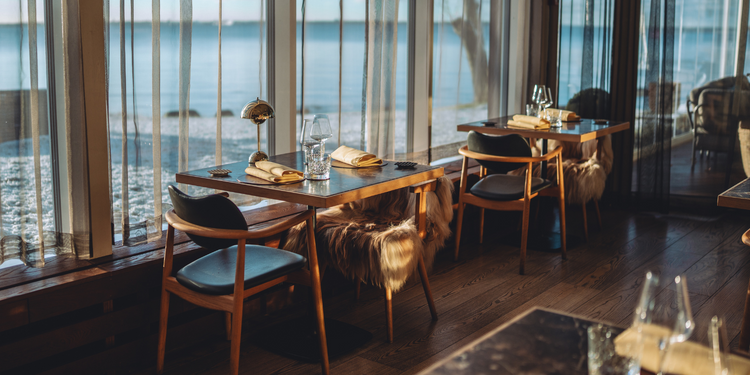
Image context: I used Ro Collection's real dining-room photograph because the article turns on service architecture. The bay-facing tables, dark floor, low light, and restrained chairs show the restaurant's basic contract before a single course arrives: the room has to stay calm enough for the food theater to feel intentional rather than noisy.[5]
The evening starts wide, then narrows
The strongest service move is the change in aperture. A bay view is wide, slow, and atmospheric. A tasting menu is narrow, timed, and demanding. NOA Chef's Hall uses the lounge as the hinge between those two states. Michelin describes the start in the romantic lounge with a view over Tallinn Bay, then the transition to the main room, where the open kitchen takes center stage.[2] Visit Estonia repeats the same basic progression and adds the Gulf of Finland to the sightline.[3]
That order solves a common fine-dining problem. A waterfront restaurant can become lazy if the view does too much of the emotional work. A theatrical kitchen can become exhausting if it asks for attention too early. NOA Chef's Hall appears to split the load: first orientation, then concentration. The water opens the guest up; the kitchen then closes the frame.
The current official menu reinforces that tightening. The restaurant lists an 8-course degustation menu at 169 euros, with a sequence that moves from small opening bites into white asparagus with Nordic béarnaise, hamachi crudo, turbot with grilled cabbage, onion with lamb rillette, an artisan sorbet, quail and truffle, olive with rhubarb and elderflower, and petits fours.[1] The menu is not local-only, and it does not pretend to be. King crab, hamachi, turbot, truffle, lardo, wasabi, amontillado, and sea buckthorn sit in the same script.[1] The kitchen's job is not purity. It is controlled movement between Baltic setting, global luxury, smoke, acid, fat, and texture.
Fire is the visible production system
Michelin's phrase "the open fire used to great effect" is easy to pass over, but it explains the restaurant better than a list of ingredients would.[2] Fire gives the room a production logic readers can picture. It also gives the meal a way to connect imported luxury to place. Canadian lobster or hamachi may travel a long way; smoke, char, heat, and timing have to happen in the room, in front of the guest.[2]
Ro Collection's design case study catches the same point from the furniture side. It describes NOA Chef's Hall as a coastline restaurant shaped by fire, smoke, raw materiality, minimalist architecture, and attention to detail, then notes that guests move through a ritualized journey beginning with canapés in the lounge and continuing into a tasting sequence prepared before them.[5] The source is a design partner, so it should not be treated like an anonymous review. But it is useful evidence for how the room is meant to function. The chairs, leather, dark wood, and quiet visual field are not decoration in isolation. They are support structures for a meal that wants the kitchen to be watched without turning the dining room into a circus.[5]
This is why the chef's-counter invitation in Michelin's listing matters.[2] A single course at the counter changes the guest's relation to the kitchen without forcing the whole meal into counter dining. The dining room keeps its bay-facing calm; the counter gives one controlled point of contact. That is a smart compromise for a restaurant with spectacle in its grammar. It offers proximity, then gives the table back.
Pairings are part of pacing, not an afterthought
The official pricing makes the pacing structure visible. Alongside the 169 euro menu, NOA Chef's Hall lists a Sommelier Selection at 125 euros, a Cellar Selection at 230 euros, and a Tea Pairing at 90 euros.[1] Those lanes are more useful than a generic "wine pairing available" note. They let the restaurant sort guests into different energy levels without changing the food sequence itself.
The standard wine lane moves broadly: sparkling sake from Fukushima, Txakolina, Tavel, Luxembourg Moselle, and Gaillac appear in the current list.[1] The cellar lane reads more classical and deeper, including Prüm Riesling Kabinett, Château Simone, Barolo, and Tokaji Aszú.[1] The tea lane is not filler either: kombucha from Estonia, oolong from Taiwan, Lapsang from Wuyishan, sparkling tea from Copenhagen, and Bai Mu Dan from Fujian all appear on the page.[1] That matters for service because it gives the room a non-alcoholic structure with its own pacing rather than a consolation flight.
The guest guidebook rules are also part of the operation. Allergies or intolerances must be communicated at least 48 hours ahead; the restaurant says it cannot provide a vegan menu or accommodate restrictions related to milk protein or celiac disease, though it can adapt the menu to be gluten- and lactose-free if necessary. It also sets a smart-elegant dress code and does not allow small children, babies, or pets.[1] Those policies may sound severe in isolation. Inside this restaurant's format, they are boundary-setting. A room built around synchronized pacing, open fire, counter movement, and a fixed menu has less slack than a large à la carte dining room.
Sustainability appears as supplier discipline, not rustic theater
NOA Chef's Hall is not a Michelin Green Star restaurant, and the article should not imply that it is. But sustainability language does appear in the surrounding evidence. The 360 Eat Guide calls the restaurant a pioneer of sustainable gastronomy and describes a glass-walled dining room where creative tasting menus blend locally foraged produce with premium ingredients, seasonal sourcing, small farmers, trusted suppliers, waste reduction, and sustainable practices.[4] Michelin similarly notes preserved, locally foraged produce alongside luxury ingredients.[2]
The important point is balance. NOA Chef's Hall does not seem to be selling austerity or pure localism. It is selling a controlled luxury room that still wants a Baltic and seasonal signal running through it.[1][2][4] That combination is more convincing than a fake purity claim would be. The menu can include truffle and hamachi; the room can still use spruce tip, mountain ash, sea buckthorn, alder, local foraging, and supplier discipline to keep the meal from becoming placeless.[1][2][4]
Why the operation works
NOA Chef's Hall works, at least on paper, because each piece has a job. Tallinn Bay supplies scale. The aperitif lounge slows the guest down. The open kitchen and fire create visible craft. The chef's-counter course gives contact without overexposing the whole meal. The pairing tiers let different diners choose intensity. The guidebook rules protect the fixed-menu choreography.[1][2][3][5]
That is a service-operations story, not merely a recognition story. Michelin stars can make restaurants sound interchangeable from a distance: one star here, two stars there, a list of luxury ingredients everywhere. NOA Chef's Hall becomes more specific when you read the evening as a route through space. It begins wide at the water, narrows into the lounge, sharpens at the fire, pauses at the counter, and then returns the guest to a calm table looking back out at the bay. The food matters, but the path is what makes the room legible.[1][2][3][5]
Sources
- NOA Chef's Hall official site, covering the current 8-course degustation menu, 169 euro menu price, pairing prices, team roles, guest guidebook, address, and booking language.
- MICHELIN Guide, "NOA Chef's Hall - Tallinn," covering the one-star listing, Tallinn Bay lounge opening, on-view kitchen, open-fire cooking, 7-course inspector framing, chef's-counter moment, hours, and location.
- Visit Estonia, "The best restaurants in Estonia according to the MICHELIN Guide," updated May 11, 2026, covering Estonia's 2025 Michelin context and NOA Chef's Hall's bay-facing lounge, Gulf of Finland view, fire, and one-star status.
- 360 Eat Guide, "NOA Chef's Hall," covering the glass-walled dining room, Roman Sidorov, seasonal sourcing, locally foraged produce, small farmers, trusted suppliers, and sustainability framing.
- Ro Collection, "Restaurant Noa Chef's Hall," design case study and source page for the dining-room photograph, covering coastline setting, fire, smoke, raw materiality, minimalist architecture, lounge canapés, tasting sequence, and furniture role.