Penang is a dangerous place to open a tasting-menu restaurant because the city already knows how to eat. George Town does not need a chef to explain appetite. It has kopitiam mornings, hawker queues, Nyonya memory, Tamil Muslim kitchens, Chinese clan-house streets, wet markets, fish stalls, and the everyday confidence of people who will cross town for one bowl but reject ceremony that feels pointless.
That is why Gēn is interesting. It does not try to beat Penang at volume, speed, or street-level abundance. It changes the tempo. The restaurant sits at Unit 6, 8 Gat Lebuh Gereja, in George Town, and its own language is built around "Our Malaysian Story": memory, culture, experience, local flavour, and the idea of making the intangible tangible through food.[1] That can sound like ordinary restaurant poetry until you set it against the city outside. In Penang, memory is not scarce. The harder work is editing it without making it smaller.
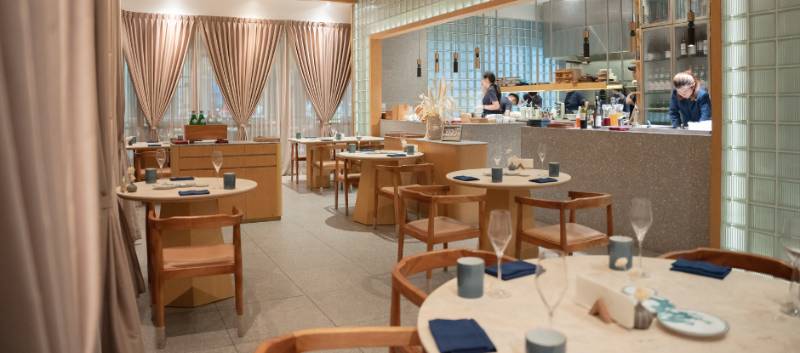
Gēn's best move is to make Malaysian memory sit down. The room in the 50 Best photograph is pale, curtain-softened, and open to the kitchen rather than grand. It does not mimic the old shophouse street outside, and it does not erase it either.[5] It creates a pause where ingredients that might normally arrive as market habit, family shorthand, or quick craving can be studied for a few hours.
A Quiet Room In A Loud Food City
The phrase "modern Malaysian" can become lazy very quickly. It may mean little more than familiar flavours arranged with tweezers. Gēn avoids that trap when it treats locality as supply, memory, and service rhythm at the same time.
The current menu page is unusually useful because it shows the restaurant's discipline in ingredient pairings rather than in abstract mission language. Lunch is listed at RM398++ per person and dinner at RM498++ per person, with a six-glass bespoke pairing at RM288++ and a five-glass zero-alcohol pairing at RM148++.[2] The courses move through coral grouper with cekur and green peppercorn, ming prawn with gingerflower and rose, mussel with chestnut and pine needle, corn-fed chicken with chicken liver and chamomile, flower crab with white corn and beechey bamboo, threadfin with pandan embrio rice and eucheuma, and a dessert register that can include buah kulim, buah keluak, gula apong, birdnest, starfruit, and barley.[2]
That list matters because it does not read like a tourist board inventory. It has fish, shellfish, aromatics, bitterness, rice, forest notes, Chinese-Malaysian echoes, and local sweetness, but the pairings are tight enough to stay edible before they become explanatory. Penang's food culture is famous for density; Gēn's counter-move is concentration.
Michelin's current listing frames the restaurant as innovative and farm-to-table, and says the tasting menu is driven by local seasonal produce, especially fish, while connecting the name Gēn to roots and childhood memory.[3] The useful word there is not "innovative." It is "driven." A tasting menu in this city earns its place only if ingredients are not decorative citations. They have to push the meal forward.
Market Trust Is The Hidden Luxury
The Star's 2025 profile gives the article's most important scene because it starts before the dining room. Johnson Wong recalls arriving in Penang without speaking Hokkien well enough to navigate market relationships easily; he says some sellers would not talk to him or would not offer their best produce.[4] That detail makes Gēn feel more grounded than a simple "chef returns to local ingredients" story. Locality is not a pantry door that opens automatically. It is earned through language, repetition, and trust.
The same profile reports Wong's ingredient-first method: the menu begins by sourcing, with emphasis on local northern Malaysian ingredients, while staying broadly Malaysian when the right product sits outside the immediate region.[4] That is a smarter position than forced hyperlocal purity. Penang is a port city, a migration city, a trading city. A rigid circle on a map would misunderstand it. Gēn's better boundary is cultural and practical: Malaysian product, Penang pressure, and enough market knowledge to know when a course should be regional, national, or simply delicious.
This is also why the restaurant's generosity matters. Wong tells The Star that he wants guests to feel full rather than leave for mamak food afterward, and the profile notes that almost every ingredient appears in at least two ways.[4] That is not a throwaway hospitality line. It is a local test. In a city where good food is plentiful and relatively informal, fine dining cannot afford to feel precious in the weak sense. It has to be refined without making the guest feel rationed.
The Menu Works Best As Remembrance, Not Nostalgia
Gēn's official about page says the restaurant translates relinquished memories, cultures, and experiences into something guests can take part in.[1] The danger in that kind of project is nostalgia. Nostalgia often softens food until it becomes flattering and harmless. Gēn seems more interesting when it treats memory as material that still needs technique.
Take the current sequence as a clue. Coral grouper with cekur and green peppercorn is not a family photograph; it is fish forced into a sharper aromatic register.[2] Threadfin with pandan embrio rice and eucheuma lets rice and seaweed carry place without becoming a lecture on coastline.[2] Buah kulim with buah keluak and gula apong places forest funk, black-nut depth, and palm sweetness in one dessert-like pressure field.[2] These are memory cues, but they are not allowed to remain only cues. They have to become structure.
The operations team matters here too. Gēn's own page places head of operations Sherrie Hoo inside the restaurant's evolution, including non-alcoholic beverage R&D and a zero-waste philosophy using local Malaysian produce.[1] The current menu's zero-alcohol pairing makes that visible in commercial form.[2] This is the right direction for a restaurant built from herbs, fish, fruit, rice, fermentation, and bittersweet local materials. Wine can be useful, but it should not be the only serious way to read the meal.
Why Gēn Belongs To George Town
Gēn's 2026 regional signal is modest but real. Asia's 50 Best Restaurants placed it at No. 89 in the 51-100 list as a re-entry, describing seasonal tasting menus built from nostalgic Malaysian flavours and modern technique, with a relaxed pace and dishes such as corn-fed chicken with chicken liver and chamomile, and flower crab with white corn and beechey bamboo.[5] That ranking does not make the restaurant important by itself. It confirms that the restaurant's quieter argument is legible outside Penang.
The more interesting question is what kind of fine dining the city lets Gēn become. George Town does not need a luxury room that pretends to stand above everyday food. It needs, if anything, a room that can listen to everyday food without copying its form. Gēn's pale dining room, open kitchen, produce-first menu, and generous pacing suggest one answer: slow the city down, keep the ingredients local enough to carry memory, and let technique organize the feeling without trying to domesticate the whole place.
That is why Gēn works as a neighborhood lens rather than just a restaurant profile. It shows one possible future for Penang fine dining: not replacing hawker brilliance, not embalming heritage, and not importing luxury codes as proof of seriousness. The restaurant's promise is smaller and better. It gives Malaysian memory a room where it can breathe, recombine, and arrive at the table with enough quiet around it to be tasted.
Sources
- Gēn, "About" - official restaurant philosophy, Johnson Wong biography, team roles, George Town address, hours, and "Our Malaysian Story" framing.
- Gēn, "Menu" - current lunch and dinner prices, dish sequence, pairing prices, market-availability note, and Zero Foodprint Asia contribution statement.
- MICHELIN Guide, "Gēn - George Town" - current listing describing the restaurant as innovative, farm-to-table, rooted in childhood memory, driven by local seasonal produce, and supported by organic and biodynamic wines.
- Abirami Durai, "Penang restaurant Gen is a loving ode to local Malaysian ingredients," The Star, November 13, 2025 - profile covering Johnson Wong's market relationships, ingredient-first approach, menu-change rhythm, open kitchen, dinner price, and guest-satiety philosophy.
- Rachael Hogg, "Asia's 50 Best Restaurants 2026: the 51-100 list revealed," 50 Best Stories, March 12, 2026 - Gēn at No. 89, re-entry status, Johnson Wong context, menu examples, relaxed pacing note, and source page for the dining-room photograph.