The wrong way to read Kvitnes Gard is as remote-restaurant romance: northern light, long roads, serious chef, big silence, a meal made special by distance. The better reading starts lower to the ground. Kvitnes is an ingredient system before it is a dining room. Its own philosophy page says the journey of a meal does not begin in the kitchen, but years earlier, with compost, nutritious soil, feed, weather, harvesting, and slaughter.[1] That is not soft sustainability language. It is a sourcing contract.
This makes Ingredient / sourcing report the useful mode. The restaurant's argument is not simply that northern Norway is beautiful, or that a chef can plate Arctic austerity with enough skill. The sharper claim is that Kvitnes asks the guest to understand sourcing as time. Soil takes time. Animals take time. Short seasons take time. A farm tour takes time. Even getting there takes time. The meal becomes convincing because the operation keeps those clocks visible instead of hiding them behind fine-dining polish.[1][2][4]
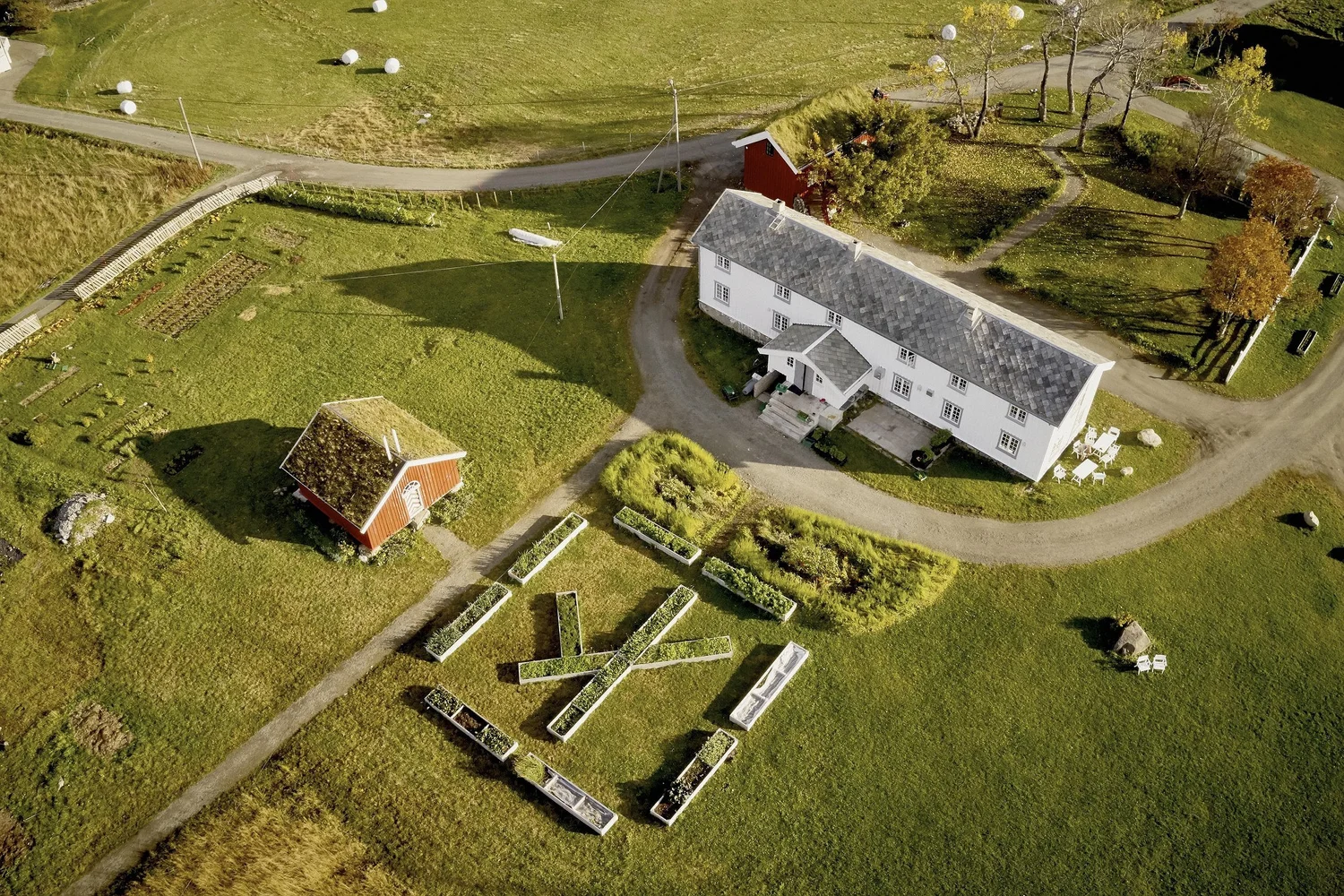
Image context: I used the restaurant's real aerial farm photograph rather than a close-up plate because the article's claim begins outside the dining room. The white house, garden beds, red outbuildings, roads, and surrounding fields show the practical question Kvitnes has to answer every season: how much of dinner can be grown, raised, gathered, preserved, cooked, served, and explained from this place?[5]
The pantry starts before the pass
Kvitnes describes its philosophy as living and delivering in harmony with nature, following "one rhythm" - the rhythm of nature.[1] That line could be generic if the page stopped there. It does not. It immediately specifies the work underneath: compost, soil, feed, weather, gentle harvesting, and slaughter.[1] The important word is not "nature." It is preparation.
In many tasting-menu restaurants, sourcing is presented as a list of supplier names or a seasonal flourish printed above the courses. At Kvitnes, the sourcing story is heavier because the official experience page tells guests they will see where they are and what time of year it is. Each season and micro-season has its own ingredients and flavors; old traditional techniques are combined with modern methods; and guests who book accommodation are told to arrive in the early afternoon, join a tour, and see how ingredients are produced before tasting the work from the fields, barn, cellar, and kitchen.[2]
That order changes the emotional logic of dinner. The farm tour is not an optional pastoral preface. It is part of the evidence. If a guest has already seen beds, animals, weather exposure, storage, and work spaces, a dish built from the farm's produce has less need to announce itself as local. The place has already argued its case.
Self-sufficiency is a constraint, not a slogan
The most useful outside source here is 360 Eat Guide, because it writes about the operation in material terms. It describes Kvitnes as a northern Norwegian restaurant where farming and cooking are inseparable, led by Halvar Ellingsen, working from organic land with vegetables, herbs, animals raised on the farm, and ingredients from nearby lakes, forests, and fields.[3] It also notes firewood cooking, compost returned to the soil, and careful use of the whole animal.[3]
Then the chef's own quoted answer sharpens the numbers. In 360 Eat Guide's interview section, Ellingsen says the goal was a responsible food system where the team knows exactly where everything comes from, and that since June 2022 they had not bought vegetables, herbs, flowers, or salads. He also says the farm raises its own meat, including wild sheep, cows, pigs, chickens, goats, and quails.[3] That is the kind of sourcing claim worth slowing down over. It is not "we love farmers." It is a partial withdrawal from normal restaurant procurement.
That withdrawal carries risk. A restaurant that buys everything can smooth over bad weather, weak harvests, staff shortages, and menu gaps by calling better distributors. A restaurant that tries to live from its own beds and animals must accept thinner choice and more planning. The reward is not purity. The reward is legibility. When Kvitnes says everything is interconnected and that if one thing is displaced everything is displaced, the sentence reads like operational truth rather than mood copy.[1]
The chef profile explains the tolerance for overlooked things
Ellingsen's background helps explain why the farm project does not read like a lifestyle retreat. Kvitnes' chef page says he had worked at several of Norway's best restaurants, naming Bagatelle, Palace Grill, Ylajali, and Arakataka; it also notes that he had been Norwegian champion and part of the national culinary team.[4] In other words, he did not arrive at the farm because he lacked access to conventional restaurant ambition. He arrived after proving he could operate inside it.
The same page gives the more important biographical clue: Ellingsen was born and raised in a family that gathered, butchered, and fished, and he learned to see potential in raw materials that are overlooked and unused.[4] That line gives the Kvitnes pantry its personality. A farm restaurant can become precious if it treats every carrot like a moral object. Kvitnes sounds more interesting because the chef's stated instinct is not only reverence but usefulness: gathering, butchering, fishing, finding value in the ignored part, and letting scarcity become technique.
That also keeps the restaurant from collapsing into generic Nordic minimalism. The point is not to make the plate look sparse and call it nature. The point is to build a pantry where preservation, animal care, waste avoidance, old techniques, modern methods, and fire can respond to what the farm and region actually have.[2][3][4]
The guest schedule is part of sourcing
Kvitnes' FAQ is unusually helpful because it turns the philosophy into logistics. Dinner starts at 7 p.m., and guests are asked to be in the White House no later than 6:45 p.m.[6] If they book the package with accommodation, it includes lodging, tasting menu, farm tour, and breakfast; drinks are separate.[6] Breakfast is served between 08.00 and 10.00, and the latest check-out is 12 noon.[6]
Those details look mundane, but they matter. The all-in stay lets Kvitnes extend the meal beyond the hours at table. A guest can arrive, see the farm, eat dinner, sleep on site, and then meet the same ingredient logic again at breakfast. That makes the restaurant less like a destination table visited in isolation and more like a small agricultural campus with hospitality wrapped around it.[2][6]
The access rules reinforce the same point. The travel page calls the road to Kvitnes an adventure and gives practical distances: about 45 minutes by car from Sortland, about 2 hours from Svolvaer or Evenes, and about 2 hours 30 minutes from Andenes.[7] There is also a bus route from Sortland toward Kaljord, and visitors arriving by boat can use a 20-meter floating jetty with 5 meters depth at low tide.[7] This is not frictionless urban luxury. The meal asks for planning because the sourcing geography itself asks for planning.
Why this is fine dining, not just farm hospitality
The distinction matters. A farm can feed people beautifully without being a serious fine-dining restaurant. Kvitnes becomes a fine-dining subject because the farm is organized into a repeatable guest experience: early arrival, tour, dinner, drink pairings on site, accommodation, breakfast, and a chef whose professional background connects national-level restaurant technique to local production.[2][4][6]
That structure lets the restaurant avoid two weaker versions of farm dining. It is not merely rustic abundance, where the pleasure comes from generous food and countryside atmosphere. It is also not laboratory sustainability, where the guest is asked to admire a closed loop more than enjoy dinner. The best reading is in between: Kvitnes uses fine-dining concentration to make farm time taste deliberate.
There is a practical humility in that. The sources do not show a kitchen claiming total self-sufficiency in every category. They show a restaurant that makes a hard commitment where it can - vegetables, herbs, flowers, salads, animals, compost, nearby forests, lakes, and fields - while still running hospitality with wine, transport, booking windows, and packages.[3][6][7] That boundary makes the claim more credible. Total purity would be suspicious. Controlled dependence is how most serious restaurants actually work.
What the sourcing report changes
The useful takeaway is that Kvitnes turns sourcing from a back-of-menu virtue into the structure of the visit. The farm tour gives the guest a production map. The dinner turns that map into courses. The overnight stay keeps the farm from becoming a quick backdrop. Breakfast returns the guest to the same system the next morning. Even the road there teaches the point: ingredients, staff, and diners all have to cross distance for the meal to happen.[2][6][7]
That is why the aerial image is more honest than a glamour plate. Kvitnes is not at its most interesting when it looks like any other polished tasting room. It is interesting when the garden beds, fields, buildings, animals, weather, and service clock all become part of one question: what does luxury look like when the pantry has to answer to a northern farm first?[1][2][3][5]
Sources
- Kvitnes Gard, "The philosophy behind Kvitnes Gard" - official philosophy page covering the nature rhythm, compost, soil, feed, weather, harvesting, slaughter, interconnected production logic, and protective-instinct framing.
- Kvitnes Gard, "The Kvitnes experience" - official experience page covering seasons and micro-seasons, traditional and modern techniques, the early-afternoon farm tour, fields, barn, cellar, kitchen, accommodation package, and breakfast framing.
- 360 Eat Guide, "Kvitnes Gard" - sustainability and restaurant profile covering Halvar Ellingsen, organic land, farm vegetables, herbs, animals, nearby lakes, forests, fields, firewood cooking, compost return, whole-animal care, and Ellingsen's self-sufficiency quote.
- Kvitnes Gard, "Halvar Ellingsen" - official chef page covering Ellingsen's restaurant background, national competition record, family gathering/butchering/fishing background, overlooked raw materials, and 2025 Identita Golose recognition.
- Kvitnes Gard, official Squarespace-hosted farm photograph used as the article image, originally surfaced on the restaurant's philosophy page.
- Kvitnes Gard, "FAQ" - official practical page covering the Vesteralen address, 7 p.m. dinner start, 6:45 p.m. arrival request, accommodation package contents, drink exclusion, breakfast hours, cancellation terms, and dog/charging/allergy notes.
- Kvitnes Gard, "Find your way to Kvitnes Gard" - official travel page covering air, bus, bike, boat, car routes, 45-minute Sortland drive, 2-hour Svolvaer/Evenes drives, 2-hour-30-minute Andenes drive, and 20-meter jetty details.