French fine dining did not become modern when it suddenly stopped loving butter, cream, or ceremony. It became modern when it learned where weight should stay and where it should disappear. The useful line runs from Eugénie Brazier in Lyon, through Paul Bocuse in Collonges-au-Mont-d'Or, to the Troisgros family in Roanne and Ouches: first discipline, then public modernity, then acid and velocity. Read together, those kitchens explain why so many contemporary tasting menus feel cleaner, brighter, and quicker on their feet than the old caricature of French luxury would suggest.[1][3][5][6]
That sequence matters because current fine dining still lives inside it. A room can be minimalist, open-kitchen, vegetable-heavy, and full of sharp seasonal detail, yet still be deeply French in its operating grammar. The plate may look lighter. The seriousness behind it is not lighter at all. That is the inheritance.
1. Mère Brazier built the hard floor
Eugénie Brazier's importance begins with force of structure. On the restaurant's history page, La Mère Brazier presents her as the first woman chef to reach the summit of Michelin recognition, with stars awarded in 1933 to both the Lyon restaurant and the Col de la Luère property.[1] That achievement is often repeated as a piece of legend. More useful is what it implies about method. Two starred houses at once means repeatability, supply discipline, labor management, and an ability to keep standards stable across very different settings. This is not yet the language of modern tasting menus, but it is the floor they stand on.
The same page preserves the detail that a very young Paul Bocuse came there in 1946 to learn his trade, later recalling that he learned not only kitchen work but also the farm-and-household labor surrounding it: milking cows, doing laundry, ironing, tending vegetables.[1] That is an unusually revealing apprenticeship note. Brazier's kitchen was not a romantic salon of inspiration. It was a total system in which ingredient quality, domestic order, and bodily endurance all belonged to cooking.
That severity still survives in the house's present tense. The current menu at La Mère Brazier includes dishes like artichoke and foie gras presented as an "homage to Mère Brazier," which is exactly the right phrase for understanding her legacy.[2] Homage here does not mean frozen reenactment. It means that modern service can change, plating can refine itself, and the restaurant can still anchor its identity in a grammar of richness, exactness, and work. Brazier's lesson was not that luxury should feel heavy. It was that authority must feel earned.
2. Bocuse made modernity public
If Brazier built the hard floor, Paul Bocuse changed the room above it. His official biography traces the progression clearly: after La Mère Brazier, then Fernand Point, he emerged with two stated guiding principles, simplicity and total mastery of cooking methods.[3] Those are not decorative virtues. They are editing tools. They tell you that modern French cooking would not be defined only by adding more complexity, but by deciding what could be removed without draining the plate of force.
The same biography gives the hinge moment. In 1964, Henri Gault and Christian Millau encountered Bocuse's lightly cooked red mullet and al dente green beans, judged the food radically ahead of what was then normal, and were sent by Bocuse to Roanne to see the same ethos at Troisgros.[3] That anecdote matters because it shows Bocuse not merely as a star individual but as a public amplifier. He helped make a movement legible.
His current restaurant site still frames that role with unusual precision. The Auberge speaks of "tradition in motion," a house where eighty people devote themselves to turning a meal into a celebration, where the kitchen is newly bright yet the heritage remains intact.[4] That is Bocuse's durable contribution. He did not simply lighten French cooking. He made lightness socially confident. The room could still be colorful, ceremonial, and generous; the food could still move faster, breathe more, and let ingredients show through the old silver and upholstery.
This is why Bocuse still matters even when younger cooks react against grand dining-room theater. He made modernity visible to the public rather than keeping it inside the kitchen. French fine dining became less leaden not by rejecting occasion, but by teaching occasion to move with more air around it.[3][4]
3. Troisgros cut straight to the line
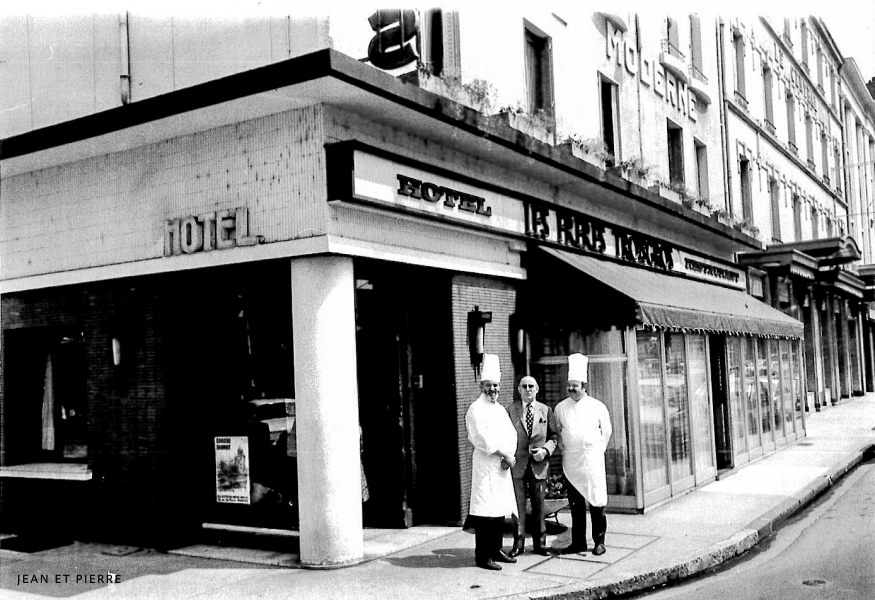
The Troisgros family then made the decisive technical cut. Their family history page says Jean and Pierre Troisgros, taking over in the early 1950s, set themselves against the demonstrative culinary fashion of the day through a quest for simplicity in both taste and presentation.[5] In 1956 came the first Michelin star. Seven years later came the famous salmon with sorrel, described by the family as a startlingly pure recipe and one of the earliest incarnations of nouvelle cuisine.[5]
That is the important phrase: startlingly pure. The great move was not merely to make food lighter in a nutritional sense. It was to relocate intensity. Instead of piling prestige into visible heaviness, the Troisgros line put force into precision, acidity, timing, and a plate that arrived already edited. Sorrel was not a reduction of ambition. It was a new way of carrying ambition.
The present-day Troisgros pages show that this was not a one-dish accident. The family history explicitly ties the line to audacity, change, and an ability to create new paths across four generations.[5] Then the current Le Bois sans feuilles page makes the inheritance almost explicit in flavor terms: César Troisgros comes from "a lineage devoted to simplicity," has "a particular taste for acidity," and favors clean, precise flavors sharpened by brightness, smoke, purity, freshness, and lightness.[6] That reads less like a break from Jean and Pierre than like the same sentence written in a new hand.
This is why the French line matters far beyond France. Once the Troisgros move entered the bloodstream, tasting menus everywhere could become more seasonal, more acidic, more vegetable-conscious, and more rhythmically varied without feeling casual. Lightness stopped meaning lack. It started meaning control.
4. What modern tasting menus still borrow
Put the three houses together and the sequence becomes unusually clear. Brazier established that fine dining needs a hard base of labor, product judgment, and repeatable structure.[1][2] Bocuse made simplification public and celebratory, proving that a restaurant could modernize without losing its social voltage.[3][4] Troisgros then gave the plate a cleaner line, moving luxury toward sharpness, freshness, and edited clarity.[5][6]
That combined inheritance still structures the best contemporary rooms. You can see it whenever a menu alternates a deep classical note with something bright and cutting; whenever an open kitchen is used not as casual theater but as proof of control; whenever a luxurious meal feels long in duration yet not deadening in the body. Even the supposed oppositions of the modern scene, tradition versus innovation, richness versus restraint, ceremony versus freshness, look less convincing once you read the French lineage closely. The modern tasting menu is often just the old French promise redistributed more intelligently.
So the real story is not that French fine dining got lighter because it became timid, vegetable-forward, or embarrassed by its own history. It got lighter because three linked kitchens taught it how to carry authority with less drag. Brazier gave it backbone. Bocuse gave it public confidence. Troisgros gave it line and lift. The result is the form that still dominates serious dining today: luxury that moves.
Sources
- La Mère Brazier, "L'histoire d'Eugénie Brazier" — 1933 Michelin milestone, the Col de la Luère house, and Paul Bocuse's 1946 apprenticeship.
- La Mère Brazier, "Cartes & menus" — current menu language including the artichoke and foie gras homage to Mère Brazier.
- Paul Bocuse official biography — training under Eugénie Brazier and Fernand Point, the 1964 Gault/Millau moment, and Bocuse's recommendation to visit Troisgros.
- Restaurant Paul Bocuse homepage — current framing of tradition in motion, celebration, team scale, and modernized dining-room identity.
- Maison Troisgros, "The Troisgros family" — Jean and Pierre's simplicity, the salmon with sorrel, and the four-generation lineage.
- Maison Troisgros, "Le Bois sans feuilles" — César Troisgros's present-day language of acidity, purity, freshness, and lightness.