Mugaritz is easiest to misunderstand when its strangest dishes are treated as dares. Molded bread, fermented skins, edible stones, warm textures, no bread course, no dessert: the quick read is that Andoni Luis Aduriz built a restaurant to annoy diners who came expecting pleasure. The better read is sharper. Mugaritz has spent decades asking whether fine dining can make uncertainty feel hosted rather than hostile.
That distinction matters because decay is not a garnish. Once a restaurant brings penicillium, fermentation, and the edge of disgust into the dining room, the craft problem changes. The chef is no longer only balancing salt, acid, fat, heat, and aroma. The chef is balancing recognition and distrust. A guest has to believe that what looks risky has been made safe, that what feels unfamiliar has a reason to be there, and that surprise is not being used as a substitute for taste.
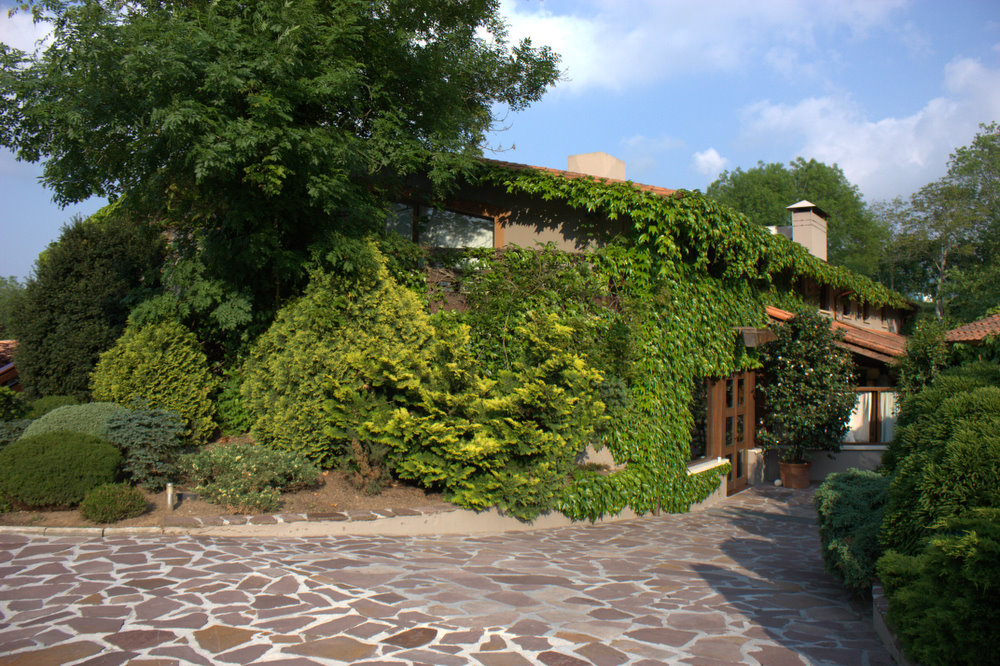
Mugaritz's own public language makes the border explicit. The restaurant describes itself as a space for research and exploration, more interested in process than in fixed answers, and its 2026 season is framed around "common ground": what people assume tastes good, what feels familiar, what luxury means, and what comfort conceals.[1] The location reinforces the metaphor. Its official directions place the restaurant on the dividing line of Errenteria and Astigarraga, tied to the Basque words for border and oak.[1] The building in the article photograph is not just scenery. It is the right threshold image: a rural house where nature, laboratory discipline, and theatrical service keep crossing into one another.[8]
Fermentation Is The Method, Not The Mood
Mugaritz's fermentation writing is unusually plain about the technical premise. Its R&D page describes fermenting as transformation through enzymes released by microorganisms, including bacteria, yeasts, and fungi, practiced in a controlled way during research and development.[3] Reporter Gourmet's 2023 account narrows the mold work further, describing the kitchen's use of penicillium roqueforti or candidum, the role of culinary-safe spores, and the way the restaurant leans on cheese as a shared reference point when it asks diners to confront mold outside its usual comfort zone.[7]
That last detail is the craft key. Mold is not automatically shocking. Diners who happily eat blue cheese, bloomy-rind cheese, soy sauce, miso, koji, charcuterie, or aged wine already trust controlled microbial change. Mugaritz's move is to remove the familiar frame. The diner is not handed a cheese board with a reassuring label. The diner may receive bread that looks compromised, fruit that suggests over-ripeness, or a texture that seems to hover between alive and spoiled.[7] The technique works only if the kitchen has controlled the microbiology enough that the dining room can spend its energy on meaning.
This is why "controlled decay" is a useful phrase. In ordinary life, decay means loss of control. In the Mugaritz grammar, it becomes a designed interval: far enough from freshness to reveal new aroma, texture, and unease, but not so far that the guest is abandoned. The restaurant is not asking whether rot is delicious in a blanket sense. It is asking when transformation becomes legible as cuisine.
The Guest Is Part Of The Technique
The official experience page says Mugaritz runs a two-and-a-half-hour meal with no bread or dessert, hardly any cutlery, and no common order, meant to question certainties rather than simply provoke.[2] That is not a decorative service note. It changes the technique. If there is no ordinary menu arc, no bread to reset the table, no dessert to promise a sweet landing, then each dish has to do more cognitive work. The guest cannot lean on sequence as a comfort mechanism.
The restaurant also states that opening the mind cannot happen without the diner's involvement.[2] In most fine dining, guest participation is polite and limited: choose a wine, listen to the server, taste the course. At Mugaritz, participation is more exposed. The diner has to decide whether to trust an object before knowing how it will behave in the mouth. Texture, temperature, and appearance become part of the preparation, not just the presentation.
This is where penicillium and fermentation become hospitality tests. A kitchen can create an uncanny object, but service has to hold the guest through the moment of hesitation. Too much explanation kills the sensation. Too little explanation makes the restaurant look careless. The right amount of framing gives the diner a handrail without removing the drop.
Technology Has To Amplify Something Worth Eating
In a 2017 interview with MOLD, Aduriz described technology as a magnifying glass: it amplifies what the cook chooses to put beneath it.[6] That idea is useful because it prevents the mold work from being treated as a trick. Fermentation can deepen flavor, blur known references, produce unfamiliar textures, and make a dish smell or feel ambiguous, but it cannot supply purpose by itself. If the underlying idea is thin, the technique only makes the thinness larger.
This is the trap for avant-garde restaurants that inherit Mugaritz's vocabulary without its discipline. A molded surface, a hand-eaten course, or a dish that looks like something else can be powerful, but only when it changes the diner's perception of an ingredient or a meal. Otherwise the restaurant is selling interruption. Mugaritz's better argument is that interruption can be hospitable when it sharpens attention.
World's 50 Best Discovery describes Mugaritz as a 20-plus-course, ever-changing, challenging Basque restaurant where nothing is quite as it seems.[4] The stronger point is not the number of courses. It is the "ever-changing" part. The restaurant's own 2026 page says the season runs from May 1 to October 25 after six months of development, then disappears.[1] A technique like controlled fermentation suits that rhythm because it is temporary by nature. It depends on timing, organism behavior, storage, humidity, safety decisions, and the exact moment when a transformation has become useful but not dead.
Disgust Is A Boundary Ingredient
The most serious fine-dining use of disgust is not gross-out theater. It is boundary management. A bitter flavor can be elegant if the dish gives it structure. A fish sauce can be beautiful if the salinity and fermentation are made precise. A mold can be compelling if the diner understands enough to cross from alarm into curiosity. Mugaritz works in that crossing.
Reporter Gourmet notes that the restaurant's mold explorations can evoke repulsion while still aiming for sensory appeal.[7] That tension is the point. Disgust is one of the body's oldest protective systems. It tells us to avoid spoilage, contamination, and danger. Fine dining cannot simply override that response with prestige. It has to negotiate with it. The plate has to say: your alarm is not foolish, but it is incomplete.
That negotiation is why the work feels different from ordinary luxury. Caviar, truffle, lobster, and aged beef ask for recognition. Mugaritz's mold logic asks for reinterpretation. The guest does not just consume a rare object. The guest reclassifies an object from suspect to edible, from edible to interesting, from interesting to possibly beautiful. That sequence is not always comfortable, and it should not be. Comfort would erase the argument.
The Risk Is Real
Mugaritz's reputation depends on keeping risk in view. The 50 Best Icon Award story presents the restaurant as a project that has survived a difficult start, fire, pandemic closure, and decades of rule-breaking while reinventing itself each season.[5] It also records Aduriz's refusal of standard restaurant logic: no bread course, no dessert, different textures and temperatures, and an annual menu that can include roughly 30 courses.[5]
That history explains both the admiration and the resistance. A restaurant built around questions will not satisfy every diner who wants answers. The meal may feel profound to one guest and self-conscious to another. The important standard is not universal pleasure. It is whether the restaurant earns the discomfort it creates.
For controlled decay, earning discomfort means four things. First, safety has to be non-negotiable and invisible. Second, the microbial technique has to create flavor or texture that could not be reached by a simpler route. Third, the service has to make the guest feel accompanied, not tested for courage. Fourth, the dish has to leave an afterimage stronger than "I ate something weird."
That is the fine-dining lesson. Mugaritz does not make mold interesting by making it expensive. It makes mold interesting by giving it a social role at the table. The technique alters food, but the restaurant's deeper craft is altering the diner's permission structure: what may be touched, what may be trusted, what may be beautiful, and what may count as luxury after freshness stops being the only virtue.
Why It Still Matters
Many restaurants now use fermentation. That makes Mugaritz more relevant, not less. Once fermentation becomes a pantry trend, the hard question is no longer whether a kitchen can ferment. It is whether the kitchen understands what fermentation is doing in the meal. Is it adding acidity? Deepening umami? Preserving seasonality? Creating aroma? Producing discomfort? Telling a story about time? Each answer asks for a different service logic.
Mugaritz's contribution is to treat fermentation as a full dining-room language rather than a background flavor builder. Penicillium is not just a microbial tool. It is a way to make the diner confront the instability of appetite. The meal says that taste is not fixed, luxury is not always comfortable, and hospitality can include the difficult work of helping a guest cross a border.
That is why the front entrance photograph fits the piece better than a glamor shot of a single course. The restaurant's most durable image is a threshold. You arrive at a house partly swallowed by green, on a boundary between towns, and enter a meal built around other boundaries: raw and transformed, safe and suspect, pleasure and doubt, craft and idea. Mugaritz's controlled decay is not a stunt at the edge of fine dining. It is one of the clearest demonstrations that the edge itself can be cooked.
Sources
- Mugaritz official site, homepage and 2026 season notes - restaurant self-description, research framing, 2026 "common ground" theme, and May 1 to October 25 season window.
- Mugaritz, "Experience" - official description of the two-and-a-half-hour meal, no bread or dessert, minimal cutlery, no common order, and guest involvement.
- Mugaritz, "R&D" - official research page covering fermentation as controlled transformation through microorganisms including bacteria, yeasts, and fungi.
- 50 Best Discovery, "Mugaritz" - restaurant profile covering Errenteria location, 20-plus-course format, innovation, challenge, and recent 50 Best accolades.
- Laura Price, "Memories of the future: how 25 years of Mugaritz made Andoni Luis Aduriz an icon," The World's 50 Best Restaurants, May 10, 2023 - history, annual reinvention, fire and pandemic context, and menu structure.
- Vicky Zeamer, "At Mugaritz, Going Beyond the Pleasure Principle to Create 'Techno-Emotional' Cuisine," MOLD, April 17, 2017 - interview with Andoni Luis Aduriz and Dani Lasa on technology, perception, creativity, and food culture.
- Alessandra Meldolesi, "Mugaritz and Its 2 Michelin Stars 'Moldy Dishes': New Creations," Reporter Gourmet, October 13, 2023 - account of Mugaritz's mold work, penicillium use, fermentation framing, and disgust boundary.
- Wikimedia Commons, "File:Mugaritz entrance.jpg" - real 2011 photograph by Krista of the front entrance of Mugaritz, used as the article image.