Omelette Arnold Bennett sounds like a breakfast order, but it behaves more like a small hotel opera. There is smoked fish in milk, egg set just enough to hold, cheese melting under fierce heat, sauce doing the quiet work of luxury, and a dining room that has to deliver all of it before richness turns heavy. The dish endures because it makes service visible without making service loud.
The usual story places the omelette at the Savoy in 1929, when the novelist Arnold Bennett was staying there while researching Imperial Palace, his late novel about the machinery of a luxury hotel. Felicity Cloake's Guardian survey identifies Jean Baptiste Virlogeux, a Savoy chef, as the creator, and notes the dish's long afterlife on the hotel's menu.[2] That origin is almost too tidy: writer studies hotel, hotel feeds writer, dish keeps writer's name. But the tidiness is also the point. Fine dining often turns a guest into an anecdote; the Savoy turned this guest into an operating procedure.
Bennett was exactly the kind of diner who could make a kitchen think institutionally. Imperial Palace was not just a romance with chandeliers in the background. A contemporary 1930 Time notice described the book as crowded with information about hotel management, with the hotel system nearly as important as the plot.[4] A public-domain edition summary likewise frames the novel as a study of a luxury hotel modeled on the Savoy, built around directors, staff, financial interests, and back-of-house motion.[5] The omelette belongs to that world. It is not simply eggs with fish. It is a guest-facing version of the grand hotel's hidden coordination.
A Dish Built Like A Room
The Savoy was designed to make modern luxury feel effortless. The hotel's own history page emphasizes the 1889 opening with electric lights, "ascending rooms," constant hot and cold running water, Cesar Ritz in command, and Auguste Escoffier as Maitre Chef des Cuisines.[3] Those details matter because Omelette Arnold Bennett is a technological dish in the old hotel sense. It depends on heat control, dairy handling, fish timing, grill timing, table pacing, and the confidence to serve a rich thing plainly.
Look at the Savoy Grill recipe now published by Gordon Ramsay Restaurants. The components are not exotic: milk, garlic, smoked haddock, butter, flour, eggs, thyme, Dijon mustard, cheddar, Gruyere, chives, and parsley.[1] Yet the sequence is demanding in a way that exposes bad service. The haddock is poached gently in seasoned milk, then flaked. That milk becomes the base for a white sauce enriched with mustard, seasoning, and nutmeg. The eggs form a buttered base. Cheese and fish sauce cover the omelette. More cheese goes on top, then the whole thing is finished under a hot grill until golden and bubbling.[1]
That is why the dish is richer in discipline than it first appears. If the fish is overcooked, the smoke turns dry and salty. If the sauce is too thick, the omelette becomes paste. If the eggs are over-set, the base fights the topping. If the grill is timid, the dish lacks its browned hotel glamour. If the grill is aggressive, the egg suffers before the cheese sings. It is a plate where a small timing mistake reads immediately.
The Savoy Trick
The Savoy trick is to make that difficulty feel hospitable rather than technical. The diner should not taste anxiety. The diner should taste warmth, smoke, cream, salt, and a browned top that says the kitchen has taken custody of the order. This is why Omelette Arnold Bennett sits awkwardly if it is treated as brunch nostalgia. It is much more precise than a lazy luxury breakfast. It has the tempo of a grill room, not a buffet.
The dish also converts a humble British ingredient into a grand-hotel register. Smoked haddock brings preservation, breakfast, and domestic memory. The sauce and grill bring restaurant polish. Cheese makes the top generous. Herbs make it look less severe. The omelette underneath keeps the whole thing from becoming a fish pie without pastry. Every element has to remember its place.
Cloake's comparison of versions is useful because it shows how chefs keep testing the same boundary: smoked haddock or another fish, hollandaise, bechamel, double cream, scrambled-egg softness, omelette structure, and the danger of drying out the fish.[2] Those variations are not signs that the dish lacks identity. They prove the opposite. A classic becomes durable when cooks can argue with it without erasing it.
Why Bennett Matters
The name matters because Bennett was interested in systems. He was not merely a famous guest who happened to like eggs. His late hotel fiction made the grand establishment legible as labor: managers, staff, procurement, discipline, emotion, status, and money moving through a building that guests experience as ease.[4][5] Omelette Arnold Bennett compresses that same idea into a pan.
It also tells a subtler story about fine dining's relationship to regularity. Many famous dishes survive because they are spectacular once. This one survives because it can be repeated. It does not require a once-in-a-lifetime truffle, an elaborate sugar sculpture, or a theatrical trolley. It requires a kitchen that can be exact with ordinary abundance. That is harder than it sounds. Repetition is where hotel luxury either becomes a standard or collapses into routine.
The dish's stubbornness is especially interesting now, when tasting menus often chase novelty by fragmenting a course into tiny conceptual gestures. Omelette Arnold Bennett goes the other way. It is generous, named, old-fashioned, and unembarrassed about richness. But it is not crude. Its intelligence lies in proportion: enough smoke to anchor the egg, enough sauce to carry the fish, enough cheese to make the grill top feel celebratory, enough herbs to return the plate to appetite.
A Classic With Heat Still In It
The best way to read Omelette Arnold Bennett is not as a museum dish. It is a lesson in how fine dining can make comfort exact. The hotel setting is essential because the plate asks the restaurant to do what a great hotel promises everywhere else: anticipate the diner's desire, absorb the labor, and present the result as if it were natural.
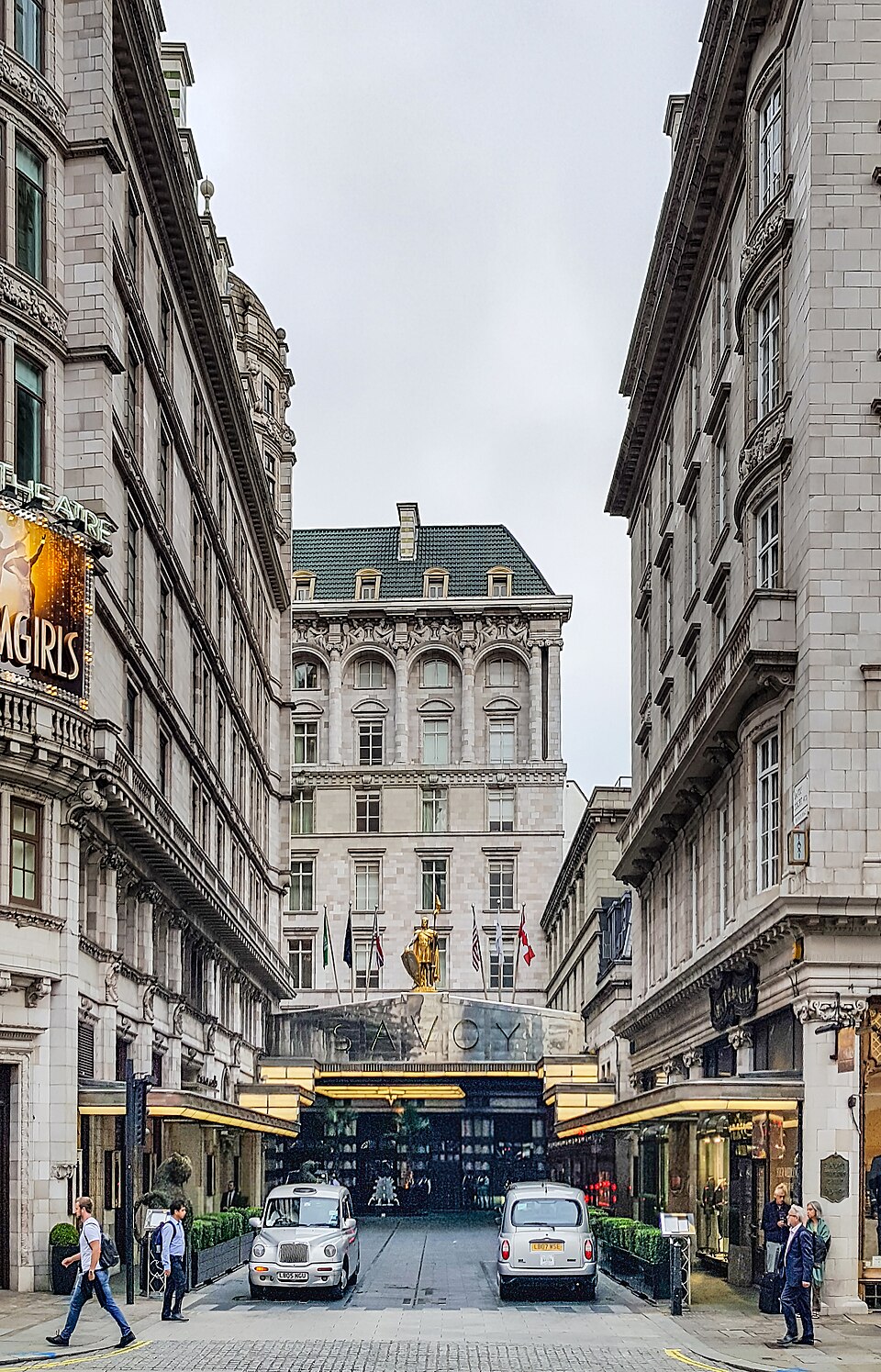
That is why the Savoy entrance belongs beside the story. The photograph is not a picture of the omelette, but it is a picture of the institution that made such a dish plausible: polished public space, theatrical arrival, and a belief that hospitality could be engineered without losing glamour.[6] The omelette is the edible equivalent of that room. It has architecture. It has timing. It has a name over the door.
There are more intricate fine-dining dishes and far rarer luxury ingredients. Few, though, explain grand hotel cooking so compactly. Omelette Arnold Bennett takes breakfast materials and makes them submit to room logic. The fish is comfort, the sauce is polish, the grill is ceremony, and the egg is the stage that holds everything just long enough. That is why the dish still has heat in it. It does not merely commemorate Arnold Bennett. It keeps performing the Savoy's favorite illusion: effort turned into ease.
Sources
- Gordon Ramsay Restaurants, "Savoy Grill Arnold Bennett Omelette" - current restaurant recipe and component sequence for the dish.
- Felicity Cloake, "How to make the perfect omelette Arnold Bennett," The Guardian, 2015 - origin account and comparative cooking notes.
- The Savoy, "The Creation of The Savoy" - hotel history covering the 1889 opening, Ritz, Escoffier, and early luxury technologies.
- Time, "Books: Front!" 1930 - contemporary notice of Bennett's Imperial Palace and its hotel-management density.
- Faded Page, Arnold Bennett, Imperial Palace - public-domain edition page summarizing the novel's luxury-hotel setting modeled on the Savoy.
- Wikimedia Commons, "File:Hotel Savoy The Strand Londres - edited.jpg" - real photograph of the Savoy Hotel entrance used as the article image.