

Moor Hall is easy to flatten into a trophy sentence: a restored Lancashire manor, three Michelin stars, a Green Star, rooms on the property, and Mark Birchall presiding over one of Britain's most polished destination restaurants.[3][4] That sentence is true, but it misses the better reason to watch these two videos together. Moor Hall's luxury is not loud. It accumulates through alignment. The grounds, the walled garden, the kitchen pass, the micro-dairy, the local producers, and the sauce work all keep repeating the same idea until the meal feels inevitable rather than showy.[1][2][3][5]
The first video, a behind-the-scenes Staff Canteen visit, gives the broad system: arrival, garden, kitchen rhythm, room discipline, and the sense that Moor Hall has been built as an estate-wide machine for hospitality.[1] The second video narrows that system into one fish dish, where turbot becomes a test of restraint: careful cooking, precise garnish, and sauce work that makes refinement feel grounded instead of ornamental.[2] Taken together, the videos show why the restaurant's current status matters. Michelin describes Moor Hall as a three-star restaurant in a 16th-century country house where the meal starts with snacks and moves through outstanding produce; Moor Hall's own materials add the Green Star, the low-food-mile sourcing claim, day-boat fish, North West meat, on-site charcuterie, bread-making, and a micro-dairy.[3][4]
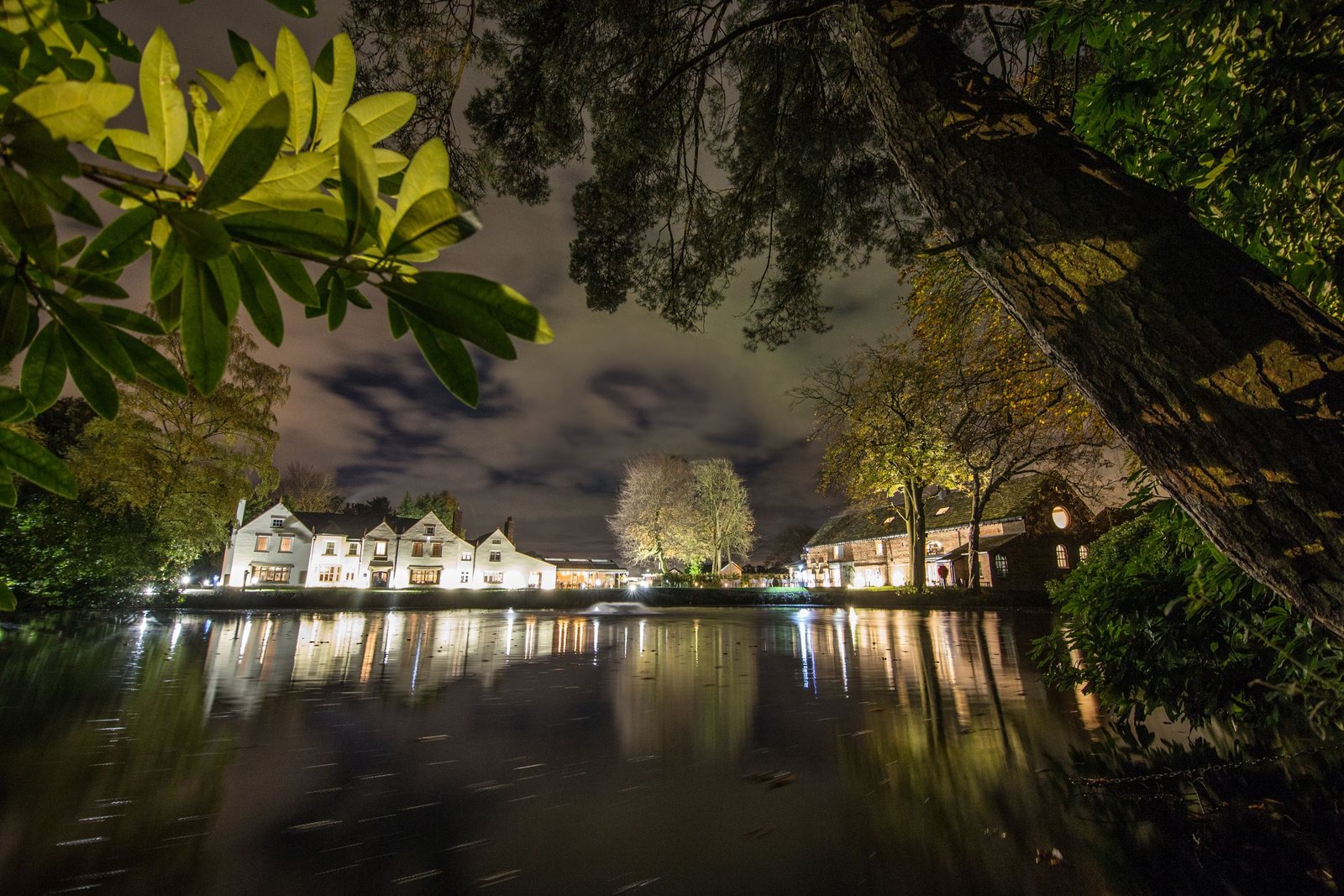
Image context: the cover uses Moor Hall's own real nighttime photograph of the restaurant across the lake. It is the right visual anchor because this article reads the place as a whole system: the building, water, garden, and dining room all prepare the guest for a cuisine built from locality and controlled calm.[7]
The estate video shows luxury as choreography, not decoration
The Staff Canteen's behind-the-scenes video is useful because it does not treat Moor Hall as a single dining room with a pretty estate attached.[1] It moves through spaces, people, and prep in a way that makes the restaurant's claim legible. The grounds are not postcard scenery. The garden is not a sustainability badge. The kitchen is not a theatre set. Each piece feeds the next one.
That matters because country-house fine dining can easily slide into atmosphere as a substitute for thought. Moor Hall avoids that trap by making the surrounding property operational. The official page says the gardens hold fruit, vegetables, flowers, and herbs, while items the restaurant cannot grow are sought from local farmers and artisans.[3] It also says the site keeps charcuterie, bread-making, and a micro-dairy in motion.[3] Those are not incidental details. They change how the guest should read polish. A room can feel calm because a lot of work has already happened upstream.
The video also clarifies Birchall's particular kind of authority. His official biography gives the big credentials: training in Lancashire, years at major European restaurants, executive-chef experience at L'Enclume, a stage at El Celler de Can Roca, and the Roux Scholarship in 2011.[3] The Caterer's profile adds the architectural and operational frame: a restored 16th-century house, a two-acre walled garden, and an interior sequence designed to let older fabric and modern restaurant use speak to one another.[5] The useful point is not biography as prestige. It is biography as method. Birchall learned high technique elsewhere, then built a place where the technique has to answer to a very specific landscape.
This is why the video feels calmer than many restaurant profiles. Its drama is not in a single wild dish reveal. It sits in the transition from garden to prep to pass to table. When a destination restaurant works at this level, the guest should not feel the estate as an accessory. The estate should feel like the reason the dish has its particular balance.
The turbot video makes restraint visible
The turbot recipe video is the tighter companion piece because it shows how Moor Hall's larger estate logic becomes a plate.[2] Fish cookery is unforgiving. It gives very little shelter to a chef who wants to hide behind concept, garnish, or luxury language. The useful thing to watch here is the absence of panic. The dish is built through control: the protein is handled cleanly, supporting elements appear as accents, and the sauce carries much of the final argument.[2]
That sauce discipline is the bridge between rural setting and three-star cooking. Moor Hall's sourcing language can sound pastoral at first glance: North West meat, UK sustainable fish, day boats, low food miles, full traceability.[3] But the video shows that the restaurant is not merely placing good things on plates. It is using the grammar of fine dining to concentrate those things. Sauce gives local produce a second life. Garnish gives the fish direction. The pass gives the dish a final architecture before it reaches the guest.
Michelin's listing helps explain why that matters. The guide points to a meal that starts with snacks, includes a kitchen moment with Birchall introducing produce, and proceeds through refined combinations in a restored country-house setting.[4] The official 2025 three-star report, republished by Moor Hall, frames the restaurant's promotion around the inspectors' view of its exceptional cooking.[6] The turbot video makes that abstract phrase more tangible. Exceptional cooking here looks less like maximal complication than like deciding exactly how much support a beautiful piece of fish needs, then stopping before the support becomes noise.
That stopping point is hard. It is also where Moor Hall's maturity shows. A lesser version of the restaurant could overplay Lancashire identity with rustic signals, or overplay three-star ambition with decorative excess. These videos suggest a more interesting middle path: local material enters the kitchen, but it is not left raw as a virtue signal; technical polish enters the room, but it is not allowed to erase the place that produced the meal.
What the videos reveal together
The collection works because the two clips answer different scales of the same question. The first asks what kind of place Moor Hall is. The second asks how that place survives contact with heat, timing, garnish, and sauce. The answer, in both cases, is disciplined continuity. The garden matters because it gives the kitchen a living calendar. The micro-dairy and bread work matter because they make the estate more than a scenic address. The dish matters because it proves that the restaurant can translate all of that into refined, controlled pleasure rather than a lecture about locality.[1][2][3]
This is the larger fine-dining lesson. "Local" is a weak word when it sits alone on a menu. It becomes stronger when a restaurant has enough infrastructure to make locality operational: growers, gardeners, day-boat fish, nearby meat, in-house processes, room design, and staff rhythm all reinforcing the same meal.[3][5] Moor Hall's strongest luxury is therefore not abundance by itself. It is agreement. The house, the grounds, the kitchen, and the plate appear to understand one another.
That agreement also explains why the restaurant's accolades feel structurally earned rather than merely accumulated. The three stars, Green Star, AA rosettes, and destination reputation are visible outcomes.[3][4] The videos show the quieter cause: repeated small decisions that keep the guest moving from place to plate without a break in logic. For a reader who cannot visit Aughton, that is the reason these embeds are worth watching. They turn Moor Hall from a ranking entry into a working model of contemporary British fine dining: calm, local, technical, and exact enough to make restraint feel generous.
Sources
- The Staff Canteen, "Behind one of the Best Restaurants in The U.K. : The 3 Michelin Star Moor Hall Restaurant with Rooms," YouTube.
- The Staff Canteen, "3 Michelin Star Moor Hall Chef Patron Mark Birchall Makes a Turbot Recipe," YouTube.
- Moor Hall, "Mark Birchall" official page - chef biography, awards timeline, sourcing notes, garden, charcuterie, bread-making, and micro-dairy references.
- MICHELIN Guide, "Moor Hall - Aughton" restaurant listing.
- The Caterer, "Chef profile: Mark Birchall at Moor Hall" - profile of the restaurant setting, walled garden, and house design.
- Moor Hall, "Inspectors Report: Why The Inspectors Awarded Three MICHELIN Stars" (February 18, 2025).
- Moor Hall official image asset used as this article's lead photograph.