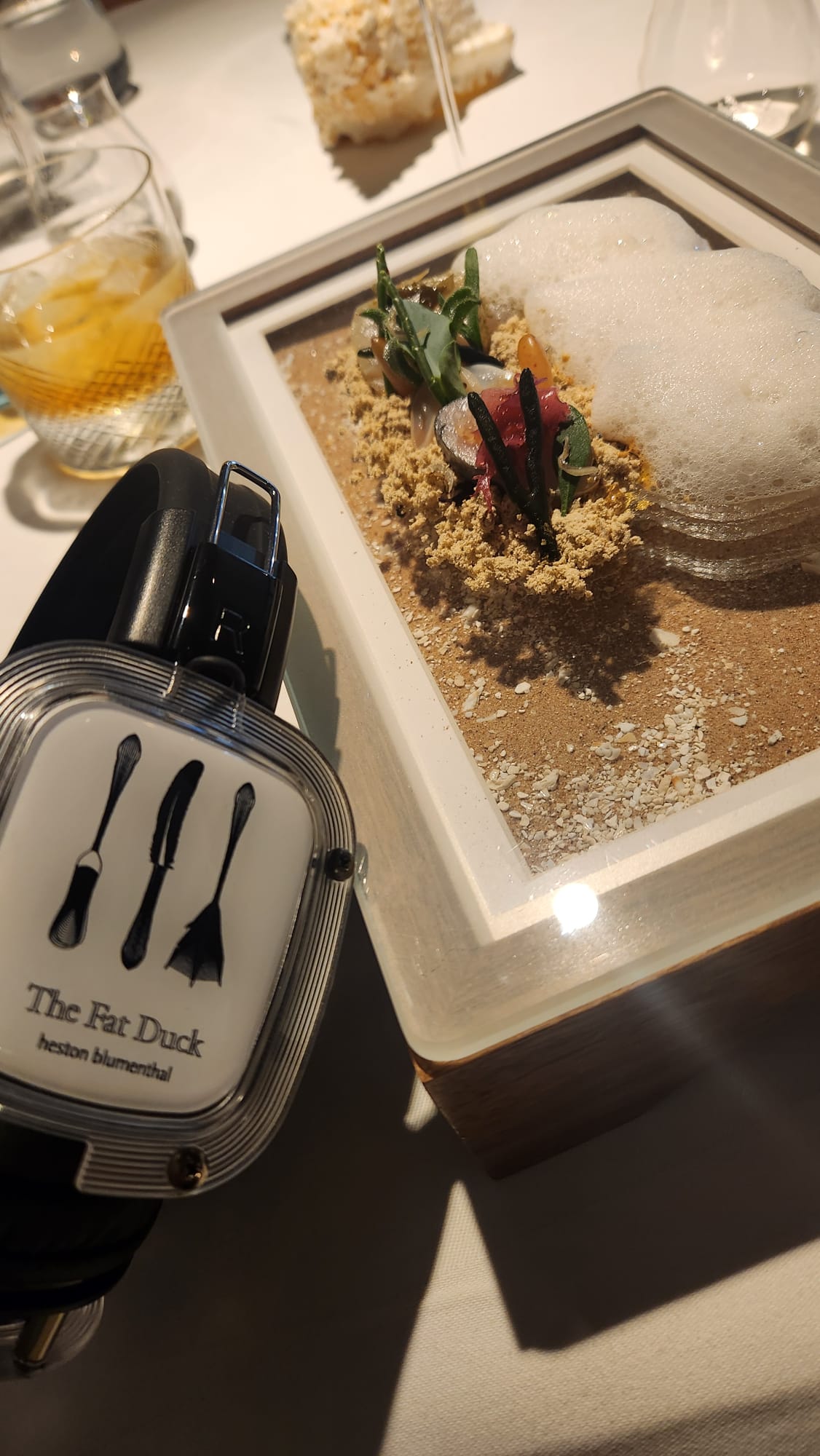
The easy joke about Sound of the Sea is that it is seafood with headphones.
That joke survives because the object is wonderfully strange: a seashore scene on glass, edible sand, shellfish and sashimi, a conch or shell-like audio device, and the sound of waves arriving before the diner has fully decided whether to laugh or lean in.[2][4][6] But the joke also misses why the dish still matters. Heston Blumenthal's most famous Fat Duck course is not only a clever plate. It is a small operating system for perception, built so that tableware, sound, memory, expectation, and appetite all become part of the recipe.[2][5][6]
As of April 21, 2026, The Fat Duck's public site still sells the restaurant around invention, memory, emotion, and sensory play, with The Journey as a core experience and a current public Journey menu PDF listing Sound of the Sea in the sequence.[1][3] That continued presence matters. This is no longer a novelty from the first wave of molecular-gastronomy celebrity. It is a legacy dish being asked to perform inside a restaurant that has had three decades to become its own museum, theatre, and research archive.[1][5]
Image context: the lead image is a real photograph from Wikimedia Commons showing Sound of the Sea as served at The Fat Duck. It is the right visual anchor because the dish's argument is spatial: the food sits on a constructed beach, and the headphones are visible as part of the course rather than hidden backstage.[7]
The beach is the structure, not decoration
The dish's first move is visual grammar. Before taste starts, the table has already given the diner a location.
The Fat Duck's own explanation describes the course as seafood and vegetation arranged to look like the sea washing against shore, placed over a shadowbox with real sand and served with an iPod and earbuds playing waves.[2] The 50 Best account gives the contemporary version a slightly updated service language, with headphones and a wooden box of sand under glass, while keeping the same central idea: the diner receives a beach scene rather than a neutral plate.[4]
That detail is easy to underrate. In ordinary fine dining, the plate frames the food and then politely disappears. In Sound of the Sea, the frame refuses to disappear. The box, glass, sand, shell, and sound all keep telling the diner where the food wants to be eaten. The course therefore does not ask, "Is this mackerel or shellfish well cooked?" first. It asks, "What happens to seafood when the room briefly behaves like coastline?"
This is where the dish becomes more disciplined than its playful reputation suggests. The beach is not a prop pasted onto seafood. It organizes the logic of the bite. Edible sand makes texture part of the scene. Sea foam makes the edge between plate and tide deliberately unstable. Shellfish and sashimi keep the food close to cold brine and clean fat. The audio track then pulls the whole construction away from still life and toward remembered weather.[2][4][6]
The headphones make memory edible
Blumenthal's official philosophy page is explicit about the role of sound. It says sound can trigger feelings around a dish and places hearing among the senses that shape flavour, emotion, memory, association, and nostalgia.[2] Sound of the Sea is the most compact demonstration of that claim because the audio is not background music. It is served as a component.
That is the important distinction. Restaurant music usually belongs to the room. This sound belongs to the dish. The waves arrive through headphones, so the beach becomes private even though the diner is sitting in a public dining room. The result is a strange double exposure: Bray remains around you, but childhood holidays, wet stones, gulls, or the idea of the seaside can intrude into the act of chewing.[2][5]
The scientific literature around digitally enhanced tasting helps explain why the move became so influential. Charles Spence's 2023 paper in the International Journal of Gastronomy and Food Science describes Sound of the Sea as an early successful example of digital technology enhancing a tasting experience and dates its introduction at The Fat Duck to 2007.[6] The point is not that headphones magically season fish. The point is that flavour perception is already cross-modal, and the dish makes that condition visible enough for the diner to notice it.[2][6]
That visibility is why the course has travelled so far in restaurant memory. It gives fine dining a clean before-and-after image: before, the senses beyond taste and smell were atmosphere; after, they could be plated. The course also made that idea legible without a lecture. You put on the headphones, hear the shore, and the seafood's freshness begins to feel staged inside a larger sensory contract.[4][6]
Why it still reads in 2026
There is a risk with dishes this famous. They can become monuments to themselves.
The Fat Duck is especially exposed to that problem because it has every ingredient of legacy theatre: a 1995 opening, a 2005 World's Best Restaurant title, three-Michelin-star reputation, a 30th-anniversary moment, and a chef whose public identity is inseparable from culinary science and wonder.[1][4][5] A restaurant can preserve that history lovingly and still end up serving nostalgia about its own importance.
Sound of the Sea avoids that trap when it is read as a working method rather than as a trophy. The current Journey menu places it among other Fat Duck memory machines: Nitro-Poached Aperitif, Hot & Iced Tea, Bacon & Egg Cereal, A Walk in the Woods, Counting Sheep, and Like a Kid in a Sweet Shop.[3] In that company, Sound of the Sea is not just a greatest hit. It is the hinge that explains why the menu keeps moving between food, childhood, theatre, and perception.
The dish also clarifies what "multisensory" should mean at this level. It cannot just mean more stimulation. A louder room, stranger tableware, or extra scent would be easy. The strong version is more precise: each sensory channel has to change the reading of the food. The beach box changes the visual frame. The edible sand changes texture and expectation. The seafood keeps the bite literal enough that the scene does not float away into theatre alone. The headphones make memory arrive on cue.[2][4][6]
That is why the course still feels useful even after years of immersive dining rooms, projection menus, scent devices, and high-budget restaurant storytelling. Sound of the Sea is small. It does not require the whole dining room to become a screen. It turns one course into a site-specific environment and then hands the diner a very simple instruction: listen while eating.
How to read the dish if you book it now
The best way to approach Sound of the Sea is to resist treating it as a stunt to be checked off. It is more rewarding to watch how service controls your attention.
First, look at the box before the food. The visual setup tells you that the edible part is only one layer of the course. Then notice how the headphones change the tempo. They isolate you from the room for a few minutes, which means the restaurant briefly gives up some of its social energy in exchange for a private memory channel. Finally, return to the food itself. The dish only works if the seafood still tastes clean, cold, and marine enough to justify the stage around it.[2][4]
That last condition keeps the course honest. If the seafood were dull, the beach would feel like camouflage. If the sound were arbitrary, the headphones would feel like a toy. If the edible sand were merely cute, the whole plate would collapse into themed dining. The achievement is that all three are pointed in the same direction: the course keeps asking the diner to taste place through perception, not through provenance alone.[2][6]
For a 2026 diner, that is the reason to care. Fine dining has learned to borrow the language of memory, immersion, and storytelling very fluently. Sound of the Sea remains sharper than much of what followed because it does not simply tell a story about the sea. It changes the conditions under which seafood is tasted, and then lets the diner discover how much of flavour was already waiting outside the mouth.[2][4][6]
Sources
- The Fat Duck official homepage, including current experience framing, address, opening hours, and the restaurant's public language around invention, memory, sensory play, and The Journey.
- The Fat Duck, "Discover more," including Heston Blumenthal's sensory philosophy and the restaurant's own explanation of Sound of the Sea.
- The Fat Duck, "The Journey" public menu PDF, listing Sound of the Sea in the current published sequence.
- Rachael Hogg, "13 of the most iconic dishes at The Fat Duck," World's 50 Best Stories (August 29, 2025), on Sound of the Sea's 2007 debut and service form.
- World's 50 Best Restaurants, "Best of the Best | The Fat Duck," on the restaurant's 2005 award, influence, multi-sensory cooking, and continuing relevance.
- Charles Spence, "Digitally enhancing tasting experiences," International Journal of Gastronomy and Food Science 32 (2023), via Oxford University Research Archive.
- FoodFreakYummy, "THE FAT DUCK - SOUND OF THE SEA - MULTISENSORIAL GASTRONOMY.jpg," Wikimedia Commons file page for the article image.