Moonrise is the kind of Dubai restaurant that could easily be misread from a distance. A rooftop address, skyline views, a tiny counter, a Michelin star, a young chef, and a name that sounds made for reservation-site mythology: all the ingredients are there for another luxury story about scarcity. The better recent reviews point somewhere more specific. Moonrise works because the scarcity is not the product. The product is a chef trying to make Dubai's mixed food memory behave like a coherent counter menu.
The restaurant's own current site describes Moonrise as a 15-seater chef's table on the rooftop of Eden House in Satwa, led by Solemann Haddad, serving an ever-evolving degustation menu rooted in Middle Eastern ingredients and culinary heritage but told through a global lens.[1] That sounds broad until the outside accounts make the format concrete. 50 Best Discovery frames the room as an omakase spot where diners watch Haddad's Japanese technique meet Middle Eastern produce and flavors at close range, with dishes such as hamachi in Syrian sumac sauce and preserved lemon, plus a khoory kabab built around Jordanian A5 wagyu, celeriac, beef jus, and shiso.[2] In other words, the restaurant is not simply borrowing from everywhere. It is trying to make the city itself legible as a route of appetite.
That distinction matters in Dubai, where fine dining can turn into imported prestige very quickly. Moonrise's claim is different: it is homegrown without being provincial, cosmopolitan without hiding its local references. The official chef biography says Haddad was born and raised in Dubai, is self-taught, and now calls his evolving approach "Dubai Cuisine," shaped by Middle Eastern ingredients, Japanese techniques, and the specific mixture of food cultures he grew up around.[1] The National's 2023 review captured the same logic from the table when Haddad described the story as one of a city that welcomes nationalities and cultures, then connected that idea to dishes built from Levantine staples, French technique, Peruvian acidity, Indian shells, local produce, and UAE memory.[5]
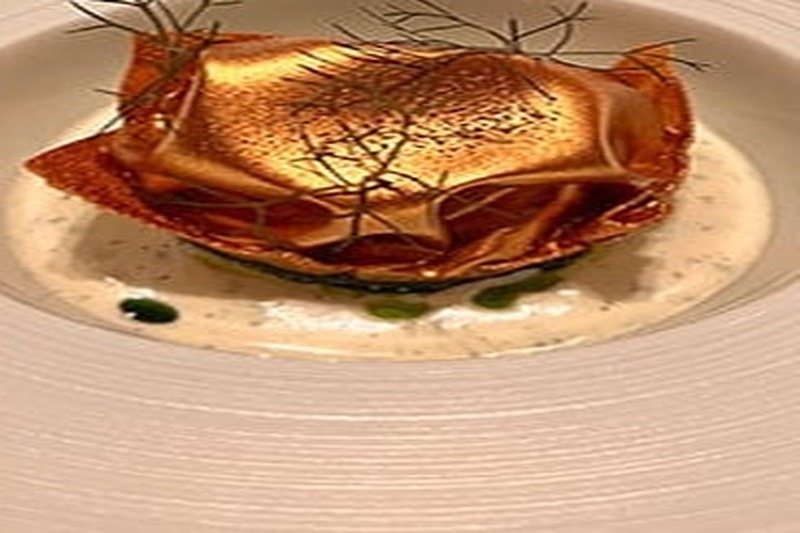
Image context: the cover image is a single-plate crop from What's On's 2025 revisit rather than a room shot, skyline, or collage. That choice is deliberate. For this article, the most useful visual is a photographic reminder that Moonrise's strongest argument arrives through compact courses that look small but carry several registers at once: sauce, garnish, texture, and the handwritten intimacy of a counter meal.[4]
What the recent reviews agree on
The strongest through-line in the recent public record is intimacy. What's On's October 2025 revisit describes Moonrise as a 12-seat chef's counter where every guest has a front-row view of the action, with the redesigned room feeling communal rather than stiff.[4] GreatList's current guide uses nearly the same structural read, calling Moonrise a tiny rooftop chef's table with a dozen seats at Eden House and listing the format as a 12-course tasting menu with two evening seatings.[6] 50 Best Discovery gives a slightly larger current capacity of 15 guests, while the official site also says 15 seats.[1][2] The exact number has shifted across writeups, but the practical meaning is stable: Moonrise is small enough that service cannot hide behind room choreography.
That smallness is not just cozy atmosphere. It changes how the food is received. At a normal luxury restaurant, dishes can arrive as polished objects, separated from the labor that made them. At Moonrise, the counter makes the explanation, plating, and cooking part of the same event. The National noted that the meal follows an omakase-style tradition in which a limited number of diners receive a set meal decided by the chef and prepared on the spot.[5] What's On updates that frame for the redesigned room: the team works across the bar from the guests, and the service feels like a modern campfire gathering rather than a formal procession.[4]
This is why punctuality keeps appearing in the coverage. The National's 2023 review says the restaurant ran two dinner sittings, with bookings prepaid, and What's On's 2025 revisit closes with the same operational warning: be punctual if you want the sequence as intended.[4][5] In a 12- to 15-seat counter, lateness is not a private inconvenience. It changes the rhythm for everyone. The point is not rule worship; it is that Moonrise is built as synchronized storytelling. A course lands best when the room is listening together.
The food reads like memory under pressure
The phrase "Dubai Cuisine" could become branding fluff if the plates did not carry the argument. The reviews suggest the opposite. The National's account of "Explosion," a foie gras-packed pani puri with date syrup, pineapple chutney, and saffron chili oil, is useful because it does not present hybridity as a vague mood. Haddad explicitly links the bite to Dubai's cosmopolitan food memory: Asian, Middle Eastern, and European ingredients carried inside an Indian shell.[5] The dish could sound overloaded on paper. At the counter, its job is to make a city of food courts, family routes, expat cravings, and Gulf ingredients snap into one bite.
That same pattern shows up in the sauces. The National describes fattoush ceviche as a Peruvian turn on an Arabic salad, with cherry tomatoes and zaatar in leche de tigre; it then quotes Haddad connecting the dish to the leftover sauce of childhood fattoush.[5] The line matters because it gives Moonrise's cooking a test. Does the menu use memory as decoration, or does it extract a working flavor principle from it? In the fattoush example, the memory is not "grandmother's salad" sentiment. It is the sauce logic: sour, herbal, salty, hot, drinkable, and sharp enough to structure fish.
What's On's 2025 revisit suggests the menu has widened rather than settled into greatest hits. It describes a 12-course tasting menu where Middle Eastern ingredients mingle with French, Japanese, Italian, and Latin American influences, with dishes such as market prawn with Syrian Aleppo chili and toum, Sarookh and turbot, and multiple beverage-pairing options.[4] 50 Best Discovery adds another current anchor: wherever possible, Moonrise sources locally within the Middle East, while bringing in specialist produce only when necessary.[2] That balance is important. A restaurant can either pretend locality solves everything or import prestige products without restraint. Moonrise seems to be more pragmatic: use the region as the flavor center, then let global craft sharpen the result.
What the room adds
The room's strongest feature is not the view, though the skyline matters. The stronger feature is accountability. At a chef's counter, every gesture is exposed: when the sauce is spooned, when the grill is touched, when the chef explains too much or just enough. GreatList's guide puts the restaurant's appeal in the roof, the dozen seats, and a menu that turns Dubai's multicultural atmosphere into a compact set.[6] What's On's review notes a relaxed sophistication, a team visible across the bar, and small service details such as adjusting a place setting for a left-handed guest.[4] Those details show why Moonrise can feel personal without becoming casual.
The redesigned space also helps because it appears to have caught up with the food. What's On reports that after the Michelin-star recognition, Moonrise redesigned the room to "finally match the cuisine," using that change as the reason for its 2025 return visit.[4] That line is more revealing than a generic interiors note. In the early version, Moonrise's idea may have been ahead of its physical shell: young chef, small counter, big city argument. The redesign gives the story a steadier vessel. It lets guests read the meal as deliberate rather than improvised.
Still, the restaurant's best defense against hype is not decor. It is specificity. 50 Best Discovery ranks Moonrise at No. 10 on the Middle East and North Africa list for both 2025 and 2026 and describes it as a homegrown Dubai talent project rather than as an imported concept.[2] The official site likewise leans into Haddad's self-taught route, his local upbringing, and his relationships with homegrown artisans, mills, and growers across the UAE.[1] The result is a restaurant that can accept international recognition without letting recognition become the cuisine.
The reservation question
For diners, the practical question is not whether Moonrise is "worth it" in the abstract. The question is whether this kind of room suits your appetite. If you want a palace-scale hotel dining room, multiple seating moods, and the freedom to disappear into your own table, Moonrise is probably the wrong target. If you like counter focus, chef narration, synchronized pacing, and dishes that make sense only when their influences are allowed to collide, the restaurant's smallness becomes the point.
The current public numbers keep that point grounded. The official site and 50 Best Discovery present the restaurant as a 15-seat chef's table, while What's On and GreatList describe the operational reality as a dozen-seat counter format.[1][2][4][6] What's On lists the 2025 tasting menu at Dhs995, with beverage and wine pairings from Dhs550; 50 Best Discovery gives a tasting menu from $299.[2][4] The precise final bill will depend on pairing choices, but the spend is not incidental. At this scale, a guest is buying both dinner and proximity.
That proximity is what makes Moonrise compelling in 2026. The restaurant does not ask Dubai to behave like Paris, Tokyo, or Copenhagen. It uses Japanese counter grammar, Middle Eastern ingredients, French and global technique, and a Dubai childhood to make a different proposition: the city has enough culinary memory to become a cuisine when one chef is obsessive enough to edit it. The recent reviews are strongest when they show that editing at work. Moonrise is not great because it is tiny. It is great because the tiny room forces the idea to stay honest.[1][2][4][5]
Sources
- Moonrise official site, covering the Eden House rooftop location, 15-seat chef's table format, Solemann Haddad biography, Dubai Cuisine framing, Middle Eastern ingredient focus, Japanese influence, and artisan-sourcing language.
- 50 Best Discovery, "Moonrise - Dubai - Restaurant," covering No. 10 Middle East & North Africa rankings for 2025 and 2026, rooftop omakase format, 15-guest scale, tasting-menu price, and dish examples.
- MICHELIN Guide, "moonrise - Dubai - a MICHELIN Guide Restaurant," current listing URL for the one-star Moonrise entry.
- Aarti Saundalkar, "Review: Moonrise revisited," What's On, October 6, 2025, covering the redesigned room, 12-seat counter, 12-course menu, service notes, pricing, and the photographic image used here.
- Saeed Saeed, "Moonrise review: What to expect at the Michelin-starred Dubai restaurant," The National, October 19, 2023, covering Haddad's background, omakase-style format, two sittings, dish examples, and Dubai-cuisine explanation.
- GreatList Guide, "Restaurant Moonrise," current guide page covering the Eden House rooftop location, 12 seats, 12-course tasting menu, chef Solemann Haddad, opening days, and seating times.