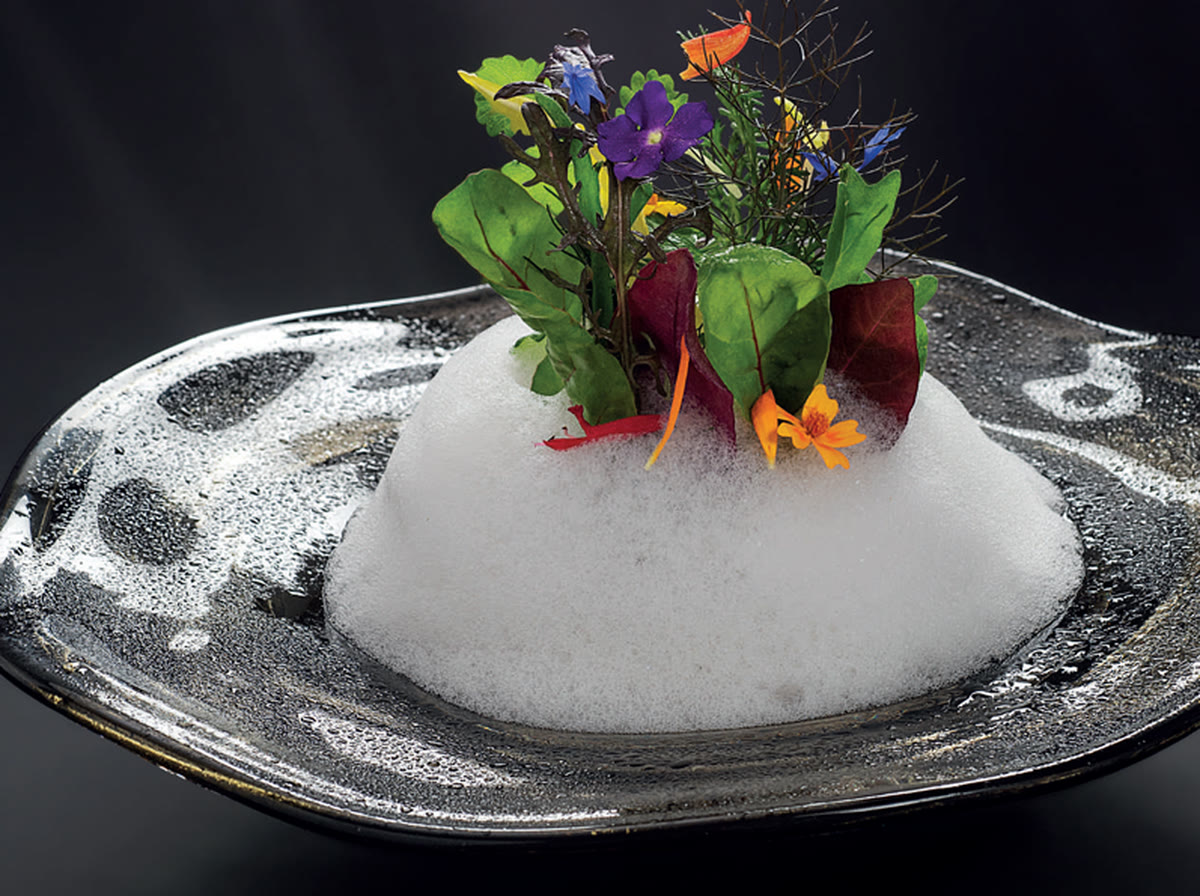
The first trick of Jardin de legumes croquants is that it looks like it wants to float away. Leaves and edible flowers stand upright in a white cloud, the plate glints darkly underneath, and the whole thing seems to belong to the Parisian fine-dining family of pretty vegetable gardens. That first impression is useful, but it is incomplete. Kei Kobayashi's signature dish is not a salad made theatrical by foam. It is a small machine for making freshness behave precisely.
The public recipe published by Thuries Magazine gives the important clues. The visible garden is built from cherry tomato, green and yellow courgette, red radish, daikon, cauliflower, broccoli, romanesco, three colors of carrot, fennel, green beans, black radish, herbs, and flowers. Under and around it sit olive sauce, smoked salmon, rocket puree, a rocket siphon, basil oil, and a lemon emulsion.[2] The dish is crowded, but the crowd is disciplined. Each layer has a job: crunch, bitterness, smoke, salt, acid, perfume, temperature, lift.
That is why the plate deserves to be read as more than a photogenic opener. Restaurant Kei's own biography of Kobayashi emphasizes a long French apprenticeship: he left Japan for France, worked through several French kitchens, joined Alain Ducasse's Plaza Athenee team in 2003, stayed there seven years, opened Kei in 2011, and moved from one Michelin star in 2012 to three in 2020.[1] Gault&Millau's 2026 notice makes the current dining-room frame more concrete: Kei is a 17/20 "Table de Prestige" in central Paris, led by Kobayashi with Louis-Marie Robert in the room, and the review singles out this crunchy vegetable garden with Scottish smoked salmon as a "symphony" of freshness.[3]
The dish, then, is a good way into the whole restaurant. It compresses Kobayashi's French grammar, Japanese sensitivity to placement, and Parisian luxury pressure into one plate that has to stay joyful instead of becoming precious.[1][3][4]
Image context: the hero image is the Thuries Magazine photograph attached to the published recipe, not a generic vegetable still life. It is relevant because the article is about the dish's actual architecture: upright leaves and flowers, a white rocket foam, a dark plate, and the way the garnish hides a more serious layer of seasoning underneath.[2]
The garden begins under the foam
The least interesting way to describe the dish is also the easiest: assorted vegetables with foam. The Thuries recipe shows why that misses the point. Before the vegetables are arranged, the plate receives an olive sauce made from black olives, capers, olive oil, garlic, and water, then a piece of smoked salmon.[2] Those components sit low, almost out of view, but they keep the dish from becoming a bouquet.
The olive base supplies bitterness, salt, fat, and a little Mediterranean shadow. The smoked salmon brings a deeper savor and a soft texture against the cut vegetables. This is important because the upper half of the plate is all lightness: raw or crisp vegetables, flowers, leaves, foam, and lemon air. Without the buried olive-salmon layer, the dish would risk reading as high-end crudites. With it, the freshness has something to push against.
That push-and-pull also explains why Gault&Millau's wording is useful. The review does not merely praise the plate as pretty; it lists the smoked salmon, early-summer vegetables, and freshness as one composed effect.[3] In other words, the dish's luxury is not a single rare product. It is the controlled collision of market crispness and darker seasoning.
The foam carries herb flavor, not a trend
Foam in fine dining has an old problem: it can look like technique announcing itself. Here, the Thuries recipe is more persuasive because the foam is not anonymous. The kitchen first makes a rocket and basil puree with olive oil and garlic, then turns part of that puree into a siphon mixture with yogurt, cream, salt, and sugar.[2] That means the white cloud is not just visual height. It is herb bitterness softened by dairy, sharpened by salt, and stabilized enough to hold the vegetables upright.
This is the plate's quiet intelligence. Rocket can be peppery and rough; basil can go sweet and familiar; cream can blur everything if used heavily. The siphon format lets the herb flavor spread around the vegetables without weighing them down. The foam makes the dish feel airy while doing practical seasoning work.
The lemon emulsion tightens the same idea. Thuries gives it as lemon juice, water, sugar, and soy lecithin, blended into air.[2] Again, the technique is there to adjust contact. Lemon in liquid form would sink too quickly or slash too hard. Lemon as an emulsion can touch the surface in flashes. The dish becomes bright in bursts, not sour as a puddle.
Cutting is the hidden pacing
The recipe's vegetable instructions are almost modest: quarter the courgettes, halve the red radishes, cube the daikon, separate cauliflower, broccoli, and romanesco into small florets, and cut carrots, pink radishes, and fennel into shavings.[2] Yet those cuts are the rhythm section of the plate. A cube of daikon breaks differently from a shaved carrot; a floret holds sauce differently from a flat fennel slice; a halved radish lands with more snap than a leaf.
This matters because the dish has no heavy central protein to organize the bite. The diner has to move through textures. Kobayashi's plate gives the mouth a path: crisp, leafy, foamy, smoky, bitter, lemony, then crisp again. The dish looks vertical, but it eats horizontally, through a sequence of small collisions.
That is also where Kei's broader house style enters. 50 Best Discovery describes the restaurant as a 25-cover Paris room where Kobayashi's rendering of French technique keeps loyal diners returning, naming dishes such as salmon in sorrel cream, shrimp quenelles, and veal chop with eggplant caviar.[4] Those examples point to a chef comfortable with French forms, but Jardin de legumes croquants shows a different kind of control: no grand sauceboat, no roasted centerpiece, just many small preparations made to arrive as one fresh thought.
Flowers are structure when they change the bite
The flowers could easily be dismissed as decoration, because this style of plate has been imitated so often. Thuries lists verbena, tagete, marigold, cornflower, nasturtium, and pineapple sage flowers.[2] That range matters. Nasturtium can bring pepper; pineapple sage can pull the aroma upward; marigold and tagete can add a resinous, citrusy edge. Even when a diner does not identify each bloom, the plate reads as more than color.
The better question is not whether every flower is individually legible. It is whether the top of the dish changes as the fork moves. On a strong vegetable dish, garnish should keep the bite from repeating itself. Kei's flower-and-leaf canopy does that by making each forkful slightly unstable: one is greener, one sharper, one more floral, one more anchored by the olive base. The dish's prettiness becomes functional because it prevents monotony.
That functional prettiness fits Kobayashi's published self-description. The official restaurant page says he seeks perfection and harmony in each creation and frames his career as a deepening of French technique through work across French regions and major houses.[1] Harmony, in this dish, does not mean softness. It means the plate can hold many small accents without letting any one of them become noisy.
Why this plate still feels current
Jardin de legumes croquants is not current because vegetable gardens are rare in fine dining. They are not. It feels current because it refuses the two laziest versions of the genre. It is not a moralizing vegetable plate that treats greens as virtue, and it is not a visual trick where flowers substitute for flavor. The recipe makes clear that its lightness depends on a hidden savory base, a herb foam with real seasoning work, lemon air, careful cuts, and a large cast of vegetables whose shapes are not interchangeable.[2]
That is a serious argument about luxury. The restaurant's public facts can sound formal: three Michelin stars since 2020, central Paris address, menus that climb into high three-star pricing, a compact room with polished service.[1][3][4] The dish cuts through that formality by acting almost playful. It looks like a garden planted in a cloud. Then it eats like a composed French plate that has learned to keep its weight off the table.
Kei's vegetable garden works because the foam is not decoration, the flowers are not filler, and the vegetables are not a wellness signal. They are the visible part of a plate whose real drama is underneath: bitterness, smoke, lemon, herb, salt, and texture being held just long enough to make freshness taste designed.[1][2][3][4]
Sources
- Restaurant Kei official site, "Kei Kobayashi Restaurant" - biography, training path, opening timeline, Michelin-star progression, address, schedule, and reservation policy.
- Thuries Magazine, "Jardin de legumes croquants" - published Kei Kobayashi recipe, ingredient structure, plating method, and Pascal Lattes dish photograph used as the article image.
- Gault&Millau France, "Kei" - 2026 restaurant notice, score, team details, price range, and review language identifying the crunchy vegetable garden with Scottish smoked salmon.
- 50 Best Discovery, "Kei - Paris" - profile of the restaurant's 25-cover format, Kobayashi's French training, representative dishes, and practical restaurant information.