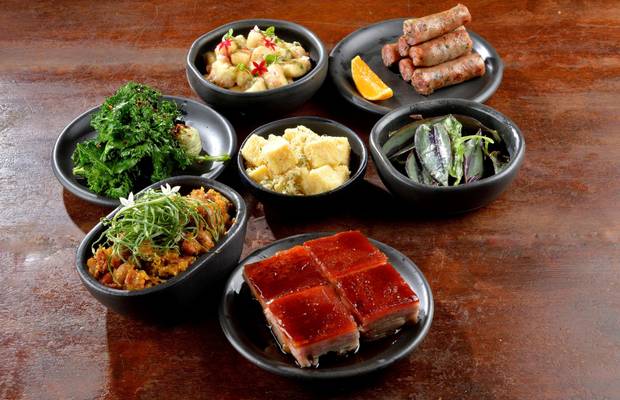
A Casa do Porco has the kind of name that sounds like a joke until the food starts explaining itself. In English, it is simply "House of the Pig." That bluntness is useful. The restaurant is not hiding behind luxury vocabulary, and its signature plate, Porco San Ze, is not trying to make pork disappear into fine-dining abstraction. Its force comes from the opposite move: the pig remains visible, rural, fatty, democratic, and central, but the whole system around it is edited with unusual care.
That is why Porco San Ze deserves to be read as a dish rather than as a mascot. The current Latin America's 50 Best profile describes A Casa do Porco as a downtown Sao Paulo restaurant built around pork in many forms, with a tasting menu and a la carte offering that use every part of the animal.[1] The same profile names Porco San Ze as the house classic: pork with sausage, beans, banana tartare, farofa, and "whatever came from our garden."[1] Michelin's listing tightens the technical cue, calling the classic Porco Sanze a slow-roasted signature and placing it beside Porco Cru, a matured pork loin with anchovy, capers, and fermented mustard.[2]
The easy mistake is to treat this as abundance alone. It is not. Porco San Ze works because it turns abundance into structure. The roast pork supplies ceremony. The sausage pushes the plate back toward butchery. Beans and farofa keep it inside Brazilian everyday grammar. Banana tartare adds sweetness, acidity, and mischief. The garden sides stop the dish from becoming a meat monument. The whole thing says: if pork is going to be the protagonist, it must carry its farm, its city, its side dishes, and its social promise with it.
Image context: the cover image is the 50 Best photograph of the Porco San Ze spread rather than a chef portrait or dining-room view. That choice matters because this article turns on the way the dish uses multiple small bowls and sides to keep roast pork from becoming a solitary luxury object.[1]
The plate begins before the plate
A Casa do Porco's most important claim is not that it serves excellent pork. Plenty of restaurants can buy good pork and polish it. The stronger claim is that the restaurant tries to control more of the chain than the dining room usually reveals. The 50 Best profile says the Porco D.O.C. tasting menu features pork and vegetables from Sitio Rueda, the farm Jefferson Rueda bought in his countryside hometown of Sao Jose do Rio Pardo in 2020.[1] Michelin's listing quotes Rueda saying that the restaurant controls the food chain from farm to consumer, produces its own sustainable pork from Brazilian breeds, supports small producers, and avoids waste.[2]
Those facts change the way Porco San Ze reads. The dish is not a generic roast with a good story attached. It is the visible end of a production loop. Breed choice, animal husbandry, vegetable growing, sausage making, roasting, side dishes, and table service are all part of the same argument.[1][2] That does not make the dish morally simple; pork never is. It does make it more honest than a fine-dining plate that turns animal labor into a decorative protein rectangle and hides everything else offstage.
The restaurant's own current site adds a useful operational note. A Casa do Porco still keeps walk-in tables, asks guests without reservations to leave a name with the host from 11 a.m., and points to calmer weekday windows from Monday to Thursday between 3 p.m. and 6:30 p.m.[3] That is not incidental hospitality information. It belongs to the same democratic idea that shows up on the plate. A dish can be ambitious without the room pretending to be a sealed temple.
Why the sides matter
Porco San Ze would be weaker if it arrived as one heroic slab. The sides are not garnish. They are the dish's syntax.
Beans matter because they pull the pork toward domestic cooking. Farofa matters because cassava flour gives roast meat a dry, toasted counterweight that absorbs fat without erasing it. Banana tartare matters because sweetness and softness can make pork feel broader and more Brazilian without turning the plate into dessert. Sausage matters because it reminds the diner that the restaurant is not only interested in premium cuts. The garden component matters because the 50 Best description leaves it deliberately open: "whatever came from our garden" makes variation part of the dish's promise, not a deviation from it.[1]
That last phrase is the secret. Fine dining often likes fixed signatures because they photograph well and travel easily. Porco San Ze is a signature that still makes room for supply. It can remain recognizable while allowing the farm to interrupt the script. That is a smarter version of seasonality than simply swapping one imported luxury vegetable for another. It lets the dish keep its identity while acknowledging that the side of the plate is alive.
An early CNN Brasil food profile framed the project in similar terms: a downtown Sao Paulo bar and market-like restaurant where Jefferson Rueda's research into pork in Brazil met his other obsession, fire, with Porco San Ze named as the house star.[4] That framing helps decode Porco San Ze. The plate is not trying to escape country food. It is trying to show what country food can do when sourcing, butchery, fire, and service are handled with enough precision to survive international scrutiny.
Accessibility is part of the flavor
The social dimension around A Casa do Porco is easy to sentimentalize, but it is also too central to ignore. In 2024, 50 Best profiled Janaina Torres after naming her The World's Best Female Chef. The piece described A Casa do Porco as one of her downtown Sao Paulo businesses and emphasized her interest in accessible fine dining, social causes, school meals, and the politics of who gets invited into gastronomy.[5] An earlier 50 Best feature made the restaurant's scale even clearer, describing a no-reservations, popular-price model that served 16,000 customers per month and treated democratic fine dining as a serious Brazilian future rather than a marketing phrase.[6]
That tension is exactly why Porco San Ze matters. It is not cheap food pretending to be expensive, and it is not expensive food pretending to be humble. It sits in the pressure zone between those categories. A Casa do Porco's public story repeatedly returns to access, downtown Sao Paulo, high-volume service, and Brazilian popular memory.[3][5][6] Porco San Ze carries that pressure because the plate still looks generous. It has bowls, sides, sausage, beans, and roast. It does not ask the diner to admire scarcity as sophistication.
This is also where the dish avoids a common tasting-menu trap. Many fine-dining signatures become intellectual tokens: one bite, one concept, one caption. Porco San Ze is more table-like than that. It wants appetite. It wants repetition. It wants the diner to move between fat, starch, greens, sweetness, crunch, and sauce. It makes fine dining behave less like a gallery wall and more like lunch with a thesis.
The pig is not the only subject
The phrase "House of the Pig" risks making the animal sound like the only thing being studied. The better reading is that pork gives the restaurant a way to study a whole food economy. The pig is the anchor, but the surrounding system is the point: Brazilian breeds, farm vegetables, small producers, anti-waste logic, downtown service, and a menu that lets both tasting-menu diners and a la carte guests enter the room.[1][2][3]
That breadth is why the dish feels more durable than novelty pork cookery. If Porco San Ze were just about making pork luxurious, it would be easy to exhaust. Luxury pork is not a very deep idea. A pork dish that can hold farm logistics, country cooking, Sao Paulo accessibility, and side-dish memory is deeper. It gives the restaurant room to keep changing without losing its spine.
The best fine-dining signatures do not only show a chef's skill. They show the restaurant's operating belief in edible form. Porco San Ze says A Casa do Porco believes in pork, but not as a trophy ingredient. It believes in pork as chain, table, city, and argument. The roast is the obvious centerpiece. The real achievement is that the plate lets everything around the roast speak too.[1][2][5]
Sources
- The World's 50 Best Restaurants, "A Casa do Porco | Latin America's 50 Best Restaurants 2025" - current profile covering the No. 25 ranking, downtown Sao Paulo location, whole-pig framing, Sitio Rueda farm, Porco D.O.C. menu, and Porco San Ze components.
- MICHELIN Guide, "A Casa do Porco - Sao Paulo" - current listing covering the Bib Gourmand and Green Star recognition, informal room, farm-to-table claim, slow-roasted Porco Sanze, Porco Cru, Brazilian breeds, small producers, and anti-waste statement.
- A Casa do Porco, official website - current address, reservation links, walk-in guidance, weekday calmer windows, and direct restaurant contact information.
- Daniela Filomeno, "Conheca a casa do chef Jefferson Rueda, a Casa do Porco," CNN Brasil Viagem & Gastronomia - profile covering the downtown Sao Paulo location, bar-and-market format, pork research, fire, house products, and Porco San Ze as the restaurant's star.
- Laura Price, "Year of the Jaguar: Brazilian chef Janaína Torres on new beginnings, future projects and being named The World's Best Female Chef 2024," The World's 50 Best Restaurants, March 21, 2024 - profile covering Torres, A Casa do Porco, downtown Sao Paulo, accessible fine dining, social causes, and her wider restaurant group.
- Laura Price, "Why the chefs behind the best-value restaurant in the 50 Best list say democratic fine dining is the future," The World's 50 Best Restaurants, August 14, 2019 - feature covering A Casa do Porco's downtown Sao Paulo opening, popular-price tasting menu, no-reservations accessibility, 16,000 monthly customers, and democratic fine-dining mission.