DILL is easy to misread from a distance. The surface story is compact: a small Reykjavík restaurant, opened in 2009, later known as the first Icelandic restaurant to receive a Michelin star, serving a high-priced tasting menu of fermented, smoked, pickled, foraged, and farmed things.[1][2][4][5] That version is true enough, but too thin. DILL matters because it turns a broad New Nordic idea into an island-specific method. The restaurant does not simply borrow the language of purity, season, landscape, and ethics from the Nordic manifesto. It asks what those words mean in a place where weather, distance, fish, sheep, dairy, berries, sea plants, and preservation have always been more than culinary romance.[3][7]
The official site gives the key to that reading. DILL describes itself as inspired by the Icelandic landscape, committed to fresh ingredients, foraging, and sustainability, and interested in an experience that reflects "the compelling characteristics of our land."[1] Its food-and-wine page says the restaurant honors Icelandic ingredients and traditions through Nordic cooking, with simplicity allowing the ingredients to reach their full potential.[2] Read next to the New Nordic Food Manifesto, which was formulated in 2004 around seasonality, regional ingredients, ethics, producer culture, and new uses for traditional products, DILL looks less like a late adopter of Copenhagen fashion than a local answer to the same question.[7]
The answer is weather. Gunnar Karl Gíslason, DILL's founding chef and current helm, is described on the restaurant's own about page as leading guests through a procession of dishes "as predictable as the Icelandic weather."[3] That line could be marketing copy in a warmer place. In Reykjavík, it lands as a working condition. The restaurant's cuisine has to treat instability as material: summer abundance must be captured, winter must be planned for, and each raw ingredient has to be stretched without losing its identity.[3][4]
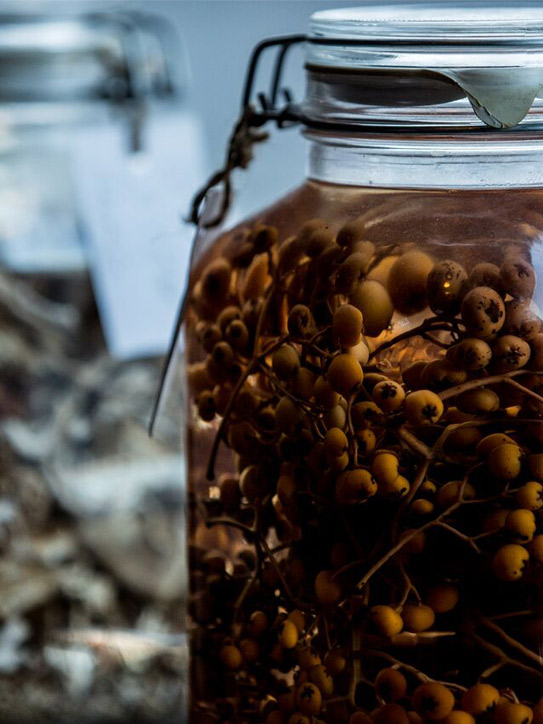
Image context: the lead image is an official DILL photograph of preserved berries in a jar. It fits the piece better than a glossy dining-room shot because the article's argument turns on preservation, storage, and seasonal memory: the beautiful plate arrives later, after the jar has done its quieter work.[1]
The New Nordic frame becomes Icelandic when scarcity enters the room
The New Nordic Food Manifesto was not a recipe book. It was a set of operating promises: express regional purity and ethics, reflect the changing seasons, build on ingredients shaped by Nordic climates, promote producers, develop new uses for traditional foods, and combine local self-sufficiency with regional exchange.[7] That language can turn vague in restaurants where seasonality is mostly a garnish calendar. At DILL, it becomes much more physical because Iceland narrows the pantry and intensifies the consequences of waste.
Michelin's current DILL listing says environmental considerations drive everything at the restaurant, and it quotes Gíslason on owing farmers, fishermen, and animals the effort to use "every single thing" that comes through the door.[4] The same listing makes the seasonal mechanic explicit: in summer, the team forages; some of what it collects is used immediately, and some is preserved for winter.[4] That is the lineage in miniature. DILL inherits New Nordic seasonality, then bends it through Icelandic necessity. Freshness is only one half of the story. Storage, fermentation, smoke, pickling, and respectful use complete the other half.
This is why DILL's cuisine feels more serious than a simple "local ingredients" pitch. The island's raw materials are not presented as a decorative proof of authenticity. They impose a method. If a cold-weather berry, a fish, a sheep, or a foraged plant arrives in a short window, the kitchen has to decide what form will let it speak later without turning it anonymous.[2][3][4] The craft sits in that decision.
Preservation gives the meal its tempo
50 Best Discovery's profile catches the dining-room expression of that method. It describes DILL as approaching Iceland's natural larder through New Nordic technique, with fermented, smoked, and pickled ingredients at the front of the meal, and it names a 15-course menu shaped by offal, svið references, whelk, lamb lard, kombuchas, organic wines, and other locally inflected moves.[2] The details are lively, but the deeper pattern is one of time management. Fermentation, smoke, and pickling are not nostalgia props. They are ways to make time edible.
That matters because fine dining often equates luxury with immediacy: the best product, flown or rushed in, served at its ideal instant. DILL's public materials point in another direction. The luxury is attention over time. A berry can be gathered in one season and speak in another. A by-product can become a snack, a drink element, or a deeper note inside the menu. A traditional Icelandic object such as svið can be treated neither as stunt nor museum piece, but as a living flavor reference that carries social memory into a contemporary room.[2][4]
The official price structure makes the seriousness of this product clear. As of this run, DILL lists its menu at 39,900 ISK, with wine and beverage pairing, mixed beverage pairing, and alcohol-free pairing offered separately; it also states that the menu setup cannot accommodate vegan menus or menus free from milk protein.[1] Those are practical details, yet they reveal the underlying format. This is a tightly authored meal, built from a particular pantry and a particular set of preparations. Flexibility exists around some allergies, but the restaurant is open about the boundaries of the cuisine.[1]
The star history turned local work into public proof
DILL's Michelin story matters because it made an Icelandic fine-dining argument visible beyond Reykjavík. The Reykjavík Grapevine records the essential sequence: founded in 2009, first awarded a Michelin star in 2017, losing it in 2019, regaining it in 2020, and holding it again in 2021.[5] Visit Reykjavík gives the same larger civic point from a later angle: DILL kept its star when ÓX became Reykjavík's second Michelin-starred restaurant in 2022, after DILL had been the city's lone starred restaurant since 2017 except for the lost-and-regained interval.[6]
That star history is not just trophy chronology. It shows how fragile and consequential this kind of restaurant can be in a small market. A one-star room in Paris or Tokyo joins a crowded map. A one-star room in Reykjavík changes the map. It gives visiting diners a reason to believe the island's larder can hold a tasting-menu argument without being translated through imported luxury norms. It also raises the pressure on the kitchen: every course has to carry local specificity without becoming a lecture about locality.
Michelin's current description suggests DILL has kept that balance by avoiding showiness. The listing emphasizes clever combinations, simple ingredients elevated into something special, the open-kitchen arrival, and environmental discipline rather than spectacle.[4] That is an important distinction. The restaurant's claim is strongest when it makes Iceland feel precise, not exotic.
What migrated, and what stayed put
The lineage, then, has two movements. The first movement migrated north through ideas: New Nordic cooking's insistence on climate, season, ethics, and producer culture gave ambitious Nordic restaurants a grammar for competing with older luxury cuisines on their own terms.[7] DILL clearly belongs to that grammar. Its language of landscape, farmers, foraging, simplicity, organic and provocative wines, and full use of raw materials sits directly inside that larger regional turn.[1][2][3][4]
The second movement stayed put. DILL's most convincing details are the ones that refuse to become generic Nordic style: Icelandic weather as a menu metaphor, fishermen on cold nights, preserved summer for winter, svið as a reference point, lamb lard in a sweet format, and a room on Laugavegur that asks diners to read Iceland through restraint rather than abundance.[2][3][4] This is where the restaurant earns its place in the lineage. It does not only repeat the manifesto's virtues. It localizes their cost.
That cost is what gives DILL its flavor as a story. Many restaurants can serve a beautiful local tasting menu when the season is generous. Fewer can make scarcity, preservation, and irregularity feel like aesthetic strengths. DILL's public record suggests that this has been its real work since 2009: to show that Icelandic cuisine does not need to imitate continental luxury to be legible at the highest level. It can build from fishers, farmers, animals, berries, smoke, cold, and jars, then let the weather remain audible in the room.[1][2][3][4]
In that sense, DILL's most important dish may not be any one course. It is the operating idea behind the course: use the whole thing, preserve what the short season gives, let tradition move without dressing it as folklore, and make the island's constraints taste intentional. That is a mature kind of fine dining. It does not ask Iceland to look larger than it is. It asks guests to pay attention to how much can happen inside a narrow season when a kitchen knows how to keep it alive.[1][4][7]
Sources
- DILL official site, "Food & Wine" - current menu price, pairing prices, allergy boundaries, and the restaurant's statement on Icelandic ingredients, traditions, simplicity, and wines.
- 50 Best Discovery, "Dill Restaurant - Reykjavík" - profile covering the 15-course menu, fermented/smoked/pickled ingredients, offal and svið references, whelk, lamb-lard gingersnap, pairings, address, and dinner schedule.
- DILL official site, "About DILL" - founding year, Gunnar Karl Gíslason's role, the Icelandic-weather framing, native ingredients, and full-use raw-material philosophy.
- MICHELIN Guide, "DILL - Reykjavík" - current listing covering the one-star status, open-kitchen arrival, environmental focus, foraging and preservation quote, and sample dishes.
- The Reykjavík Grapevine, "Dill Maintains Michelin Star" - 2021 report summarizing DILL's founding year, first star in 2017, 2019 loss, 2020 return, and continued starred status.
- Visit Reykjavík, "Reykjavík gets its second Michelin star restaurant" - 2022 city tourism report noting DILL's star continuity and ÓX becoming Reykjavík's second starred restaurant.
- Nordic Joint Committee for Agricultural and Food Research, "The kitchen manifesto" - institutional page summarizing the 2004 Nordic Kitchen Manifesto's ten-point frame for seasonality, regional ingredients, producer culture, ethics, and new uses for traditional foods.