The yellow menu at Ministry of Crab turns dinner into a small piece of theatre before anything reaches the table. First comes the crab board: half-kilo, Small, Medium, Large, XL, Kilo Krab, Jumbo, Colossal, OMG!!! and, at two kilograms, Crabzilla. The names grow louder as the shell grows heavier. It is very easy to let the exclamation marks order for you.
Do not start there. Start with the number of diners.
That single reversal makes the Colombo flagship much easier to read. Ministry of Crab is not a tasting-menu room where the kitchen has already decided the sequence; it is a shared-table restaurant built around wild-caught Sri Lankan mud crab, sold by weight and then committed to one preparation. The current menu linked by the restaurant was updated on June 12, 2025, lists prices in US dollars inclusive of service charge and government taxes, and warns that the live catch may not supply every size.[1][2] The restaurant remains visible on the 2026 Asia's 50 Best extended list at No. 94, but the smartest first order is less about rank than arithmetic: decide how many people need feeding, then buy contrast before spectacle.[3]
For four diners, two shells beat one showstopper
The menu's price ladder contains the first useful clue. A Large crab, listed as up to 900 grams, costs $100. Two Large crabs therefore list at $200 and can carry two different preparations. A single 1.8-kilogram crab costs $330 and carries only one.[1]
That comparison is illustrative, not a promise that two crabs on the day's board will land at precisely the top of their tiers. The restaurant weighs and grades a variable wild catch; ask what is actually available before doing the sum. But the direction is clear. The upper tiers contain a trophy-size premium. On a first visit with four people, two crabs in the 800-to-900-gram tiers usually make a more revealing order than one enormous shell: more claws to share, two sauces to compare and less of the budget concentrated in the photograph everyone takes before dinner resumes.
For two diners, the logic changes. One Large or XL crab keeps the meal legible, especially with a starter and sides. If both people have arrived with serious appetites, ask the server whether the actual weight on the board is enough; move up one tier or add a prawn rather than ordering Crabzilla by reflex. The point is not to minimize the bill at all costs. It is to make sure that money buys dinner rather than a nickname.
This is also why the reservation matters. The restaurant provides advance booking, its menu warns that preferred crab sizes may be unavailable, and it closes on listed Poya full-moon days.[1][2] Reserve the table, confirm the current menu, then treat any shortage of a preferred size as information about a wild ingredient—not as a service failure.
Make Black Pepper Dashi the first voice
If the table is ordering one crab, Black Pepper Dashi Crab is the clearest introduction to chef Dharshan Munidasa's grammar. The menu builds the sauce from black pepper dashi, then raises the heat with pepper crushed on a traditional miris gala. It places a Japanese idea of extraction beneath two Sri Lankan ingredients: black pepper and mud crab.[1] That connection is not branding assembled after the fact. Munidasa grew up between Sri Lanka and Japan, later opened the Japanese restaurant Nihonbashi in Colombo, and learned crab grading by questioning vendors at Sri Lanka's wholesale fish market.[4]
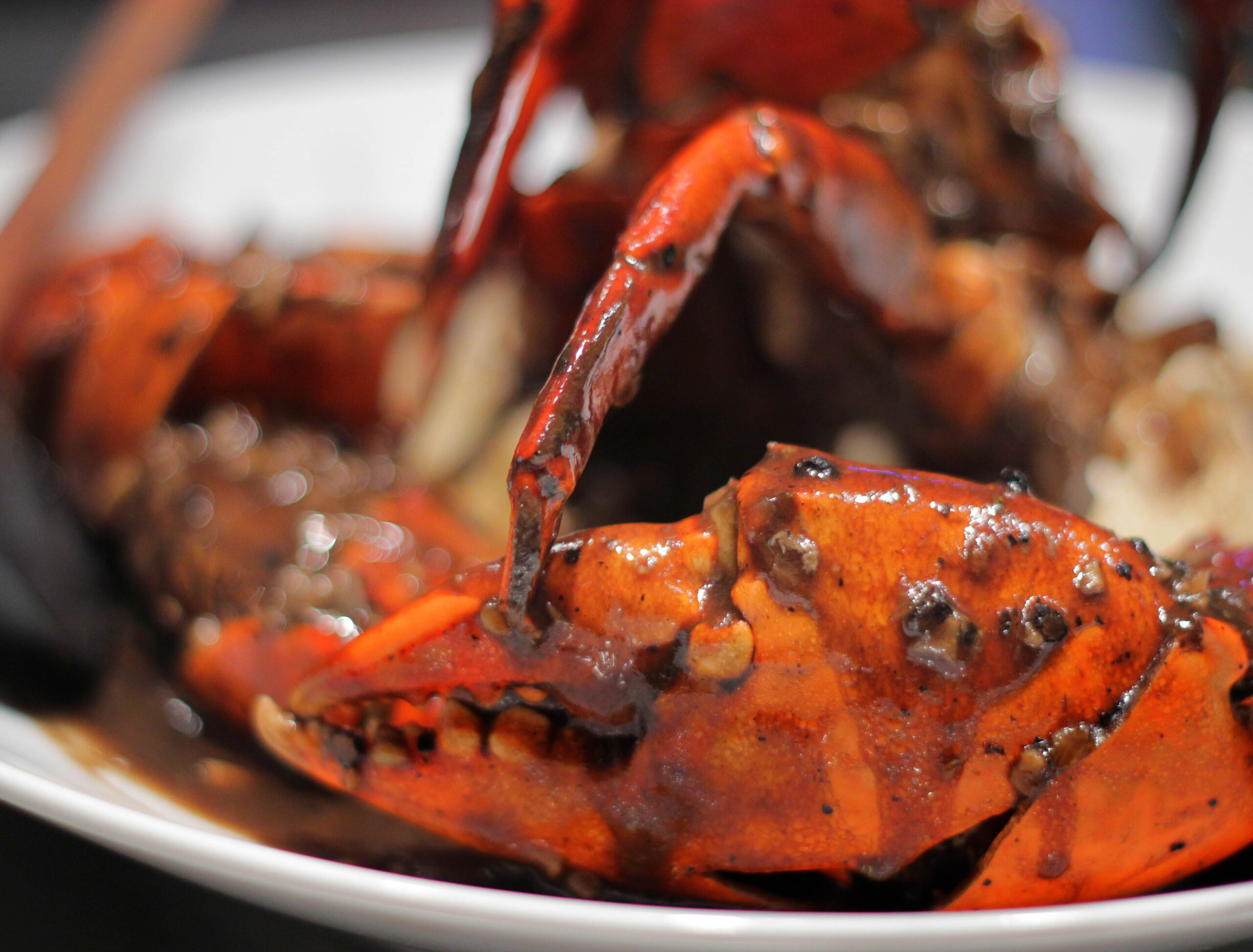
The official cover photograph gets close enough to show why pepper is a useful first preparation. Dark flecks sit against orange shell; sauce collects at the joints and under the carapace rather than hiding the object beneath a smooth glaze.[8] Expect the meal to slow down. A crab like this is not neat fork work. The restaurant supplies specialist utensils and explicitly permits hands, so cracking, pulling and passing are part of the room's tempo.[1][2]
With four diners and two crabs, give the second shell a different job. Garlic Chilli Crab is the sauce-saving order: olive oil, garlic, Sri Lankan chilli flakes and Japanese soy form a thick, savory oil designed for the restaurant's wood-fired Kade bread.[1] Black Pepper Dashi gives the table aromatic heat and broth logic; Garlic Chilli gives it fat, garlic and a reason to keep the bread close. They are related without becoming copies.
Choose Sri Lankan Curry Crab instead when the table wants the meal to lean more decisively into curry, pandan, moringa and local spice. Then order rice or bread and pol sambol around it. The MOC Original Chilli Crab is explicitly described as non-sweet, with onion, tomato and Sri Lankan red chilli, so do not approach it expecting the sweeter Singaporean template.[1]
Save Pure Crab for the diner who wants the ingredient almost unedited. It requires six hours' notice; the crab is steamed, chilled and served with warm butter and a ponzu-inspired aged soy sauce. The menu even lets guests request male crab for more claw meat or female crab for tender, sweet meat.[1] That can be a beautiful return visit. For a first meal, however, it removes the very sauce logic that makes this Sri Lankan-Japanese house distinct.
Open with one idea, not a crab rehearsal
The starter section offers several ways to eat crab before the crab arrives. Resist most of them. Avocado crab salad, baked crab, kaphrao crab and crab fried rice may all sound like efficient research, but together they flatten the evening into repeated sweetness and repeated shellfish before the centerpiece has had a chance to matter.[1]
Choose one opening idea. Crab chawanmushi, at $17, makes sense with a Pepper Crab order because warm steamed egg shows the Japanese half of the kitchen in a quiet register. The $10 clams in butter and soy are an even cleaner alternative if the table wants to preserve its appetite for crab. Limited daily crab-liver pâté is the adventurous option, but its richness and $20 price make it a deliberate choice, not an automatic add-on.[1]
Skip the giant freshwater prawn on the first pass unless the day's crab board is unusually thin or one diner does not want crab. The prawns have their own scale ladder, reaching Prawnzilla at 500 grams and above; that is another meal's centerpiece, not a supporting actor that needs to compete for the same table.[1]
Let the sauce choose the starch
Kade bread is the least expensive important decision on the menu. Two dollars buys 18 cubes of traditional wood-fired bread.[1] With Garlic Chilli Crab, order it immediately: the oil left beneath the cracked shell is part of the dish, and dry bread turns cleanup into a final course rather than waste.
With Sri Lankan Curry Crab, add the $2 pol sambol—coconut, chilli, onion and Maldive fish ground to order—and either Kade bread or steamed Japonica rice, not every starch on the page.[1] With Black Pepper Dashi, rice is the tidier finish, while bread makes the sauce feel richer. These are preferences, not commandments; the governing rule is simply to give each sauce one landing place.
Then add something green. KanKun with garlic costs $5 and interrupts the succession of sweet meat, dark sauce and starch.[1] Button mushrooms or mixed vegetables can do the same job, but one vegetable is enough. A crab order needs relief more than it needs a second supporting cast.
The drinks list offers a useful low-alcohol reset: a 500-milliliter carafe of iced tea soda made with Ceylon tea is $3, the ginger beer is $2, and shaken king coconut with lime is $3.[1] Pick the one that suits the sauce rather than defaulting to an elaborate wine discussion before the shell arrives. Finish with the $5 coconut crème brûlée if the table wants sweetness; its coconut-milk custard echoes the island pantry without beginning another performance.[1]
What to skip
Skip Crabzilla on a first visit unless the party explicitly wants one two-kilogram preparation and understands the $380 commitment. The largest crab may be extraordinary; it is simply a narrow way to learn a menu with four main sauce families.[1]
Skip two similar preparations. Garlic Chilli and its non-spicy Garlic variation are accommodations, not a comparative tasting. Pepper and Garlic Chilli reveal more of the kitchen than Garlic Chilli and Garlic.
Skip crab in every course. One starter, one or two whole crabs, one vegetable, one purposeful starch and a modest finish leave room for the shell to remain exciting.
And skip the idea that ordering the biggest crab is itself a sustainability act. The restaurant says it has refused crabs below 500 grams since opening and describes its supply as wild-caught and weather-dependent.[1][2] Sri Lanka's 2024 fishery rules operate on a different measure: they prohibit catching, selling, processing or exporting wild mud crabs below 130 millimeters in carapace width, prohibit taking egg-bearing crabs and require undersized or berried animals caught in gear to be released alive.[6][7] A restaurant weight floor and a national fishery rule are related signals, not interchangeable proof. The responsible dining move is to accept the day's legal catch, not pressure the room to produce a scarce trophy size.
Two clean first orders
For two diners, begin with one crab chawanmushi, then take one Large or XL Black Pepper Dashi Crab, Kade bread, pol sambol, KanKun, a carafe of iced tea soda and two coconut crème brûlées. At the posted prices, that lands around $139 to $169, inclusive of the menu's stated service charge and taxes but before alcohol, depending on the crab tier.[1] If the actual board weight looks light for the party's appetite, adjust before the kitchen commits it to sauce.
For four diners, start with chawanmushi and clams to share. Order two crabs in the Medium-to-Large tiers—Black Pepper Dashi and Garlic Chilli—then two Kade breads, pol sambol, KanKun, two iced tea sodas and four coconut crème brûlées. Using the menu's tier prices, the edited order is roughly $244 to $264 before alcohol.[1] More important than the exact total, which must be reconfirmed, is what the structure buys: two preparations, enough starch to finish them, a green interruption and no course that exists only because the table lost its nerve.
Ministry of Crab began in 2011 as a way of serving Sri Lankan lagoon crab at home after decades in which the prized catch was more famous as an export.[2][4][5] Its open kitchen in the old Dutch Hospital still gives that homecoming a grand stage, and the live catch still makes a little drama unavoidable.[2][3] Just do not confuse drama with scale. Choose the diners, choose the shell, choose the sauce, and let the exclamation marks wait for another night.
Sources
- Ministry of Crab Colombo, MOC CMB CAODA Menu, updated June 12, 2025 — the current menu linked by the flagship, covering crab sizes, preparations, prices, sides, drinks, taxes and supply caveats.
- Ministry of Crab Colombo, “Elevating Seafood Dining in Sri Lanka” — official flagship page covering the 2011 opening, no-freezer policy, wild-catch availability, Dutch Hospital setting, reservations, hours and 2026 Poya closures.
- Asia's 50 Best Restaurants, “Asia's 50 Best Restaurants 2026: the 51-100 list revealed” — current No. 94 placement and description of the Dutch Hospital room and open kitchen.
- Brennen Jensen, “Dharshan Munidasa's crab empire.” Johns Hopkins Magazine, Spring 2023 — Munidasa's Sri Lankan-Japanese background, restaurant history and account of learning seafood grading at the wholesale market.
- Ministry of Crab Colombo, “The Sri Lankan Mud Crab's Journey to MOC,” June 2, 2018 — first-party account of lagoon origins, live transport, grading and the restaurant's supplier relationship.
- Government of Sri Lanka, Mud Crab Fishery Management Regulations, 2024, Gazette Extraordinary No. 2371/35 — primary text of the 130-millimeter minimum, berried-crab prohibition and release requirements.
- Parliament of Sri Lanka, Official Report (Hansard), January 6, 2026 — parliamentary debate and approval record for the regulations published in Gazette Extraordinary No. 2371/35.
- Ministry of Crab Colombo, “What It Means for Ministry of Crab to Be Ranked on Asia's 50 Best Restaurants,” June 24, 2015 — official source page for the Pepper Crab photograph used as this article's cover.