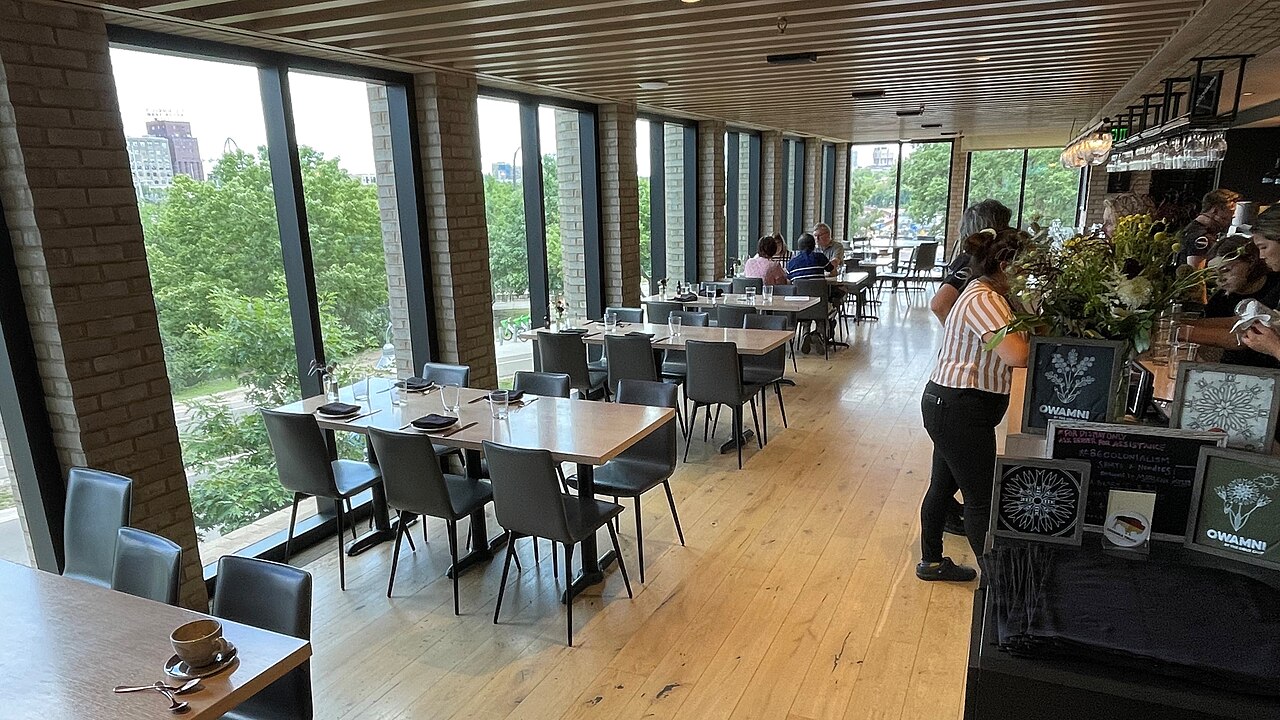
At the new Indígena by Owamni in Minneapolis, dinner can begin on several clocks. A theatergoer can take the pre-show route. A walk-in can arrive after 9 p.m. for bar food. A table can order shareable plates, steaks or seafood, while fourteen guests at the chef’s table encounter a tasting menu or a visiting cook’s residency. Behind the visible choices sit larger game cuts, an oyster bar and a drinks program built around BIPOC producers.[1]
That is a striking expansion from the small Owamni dining room photographed in 2023. Yet the most important change is not square footage or a grander address. It is the restaurant’s decision to behave like a junction. Indígena is owned and operated by North American Traditional Indigenous Food Systems, or NĀTIFS; its menu page names farmers, foragers and food businesses whose products move through the kitchen, and the new chef’s table is designed to make room for other Indigenous authors.[1][2]
This is the more interesting Indigenous dining movement now taking shape across North America. It is not converging on one plating language, one luxury format or even one rule about which ingredients belong. The connective tissue is structural: Indigenous ownership, visible provenance, paid demand for Indigenous products, knowledge carried through kitchens, and enough training and infrastructure for one celebrated restaurant to become more than an exception.
The prestige room is only the front door
Owamni’s first room did essential symbolic work. It made a modern Indigenous restaurant difficult for the national food establishment to ignore, and its 2022 James Beard Award for Best New Restaurant gave the project a level of prestige normally reserved for chef-driven openings with much more familiar culinary ancestry.[7] The earlier menu’s refusal of dairy, wheat flour and cane sugar also gave diners a lucid historical boundary: this kitchen would begin with the foods and techniques of North America rather than treating Europe as the default pantry.[7]
But a boundary is not a food system. A restaurant can serve a brilliant plate of corn, bison, beans or wild rice and still leave the grower without another buyer on Monday. It can make a foraged ingredient fashionable without creating safe processing, steady volume or a path for the next cook to open a business. Prestige concentrates attention; a network distributes capability.
Indígena’s current supplier language makes that distinction unusually visible. The restaurant tells diners that their checks support partners including Native Wise, Red Cliff Fishery, Dream of Wild Health, Red Lake Foods, Bow & Arrow Corn and Ramona Farms.[2] Naming them changes the meaning of provenance. The ingredients are not anonymous evidence of a chef’s adventurous palate. They arrive through businesses and organizations with their own knowledge, geography and stake in the sale.
NĀTIFS then extends the logic beyond the dining room. Its Indigenous Food Lab combines a professional kitchen, classroom, demonstration studio and market, while its published roadmap moves from one urban lab toward regional access, satellite kitchens and tribally operated community kitchens.[3] The flagship restaurant may attract the reservation. The lab asks whether that attention can leave behind recipes, trained people, compliant production space and more places to buy Indigenous food.
Three rooms, three grammars
Calling this a network matters because calling it a cuisine too quickly can flatten enormous differences.
At Indígena, the new scale permits spectacle: an oyster bar, substantial cuts of bison, elk and venison, a late-night bar, a pre-theater menu and a small counter within the larger room where a guest chef can take control of the sequence.[1] The format is elastic enough to hold a quick plate and a ceremonial dinner under one roof. Fine dining is one register here, not the only proof of seriousness.
At Wahpepah’s Kitchen in Oakland, the current spring menu reads with a different rhythm. Cheyenne River bison sits beside a wild-mushroom and pumpkin-seed mole; there are blue-corn tortillas, blueberry bison meatballs, smoked hibiscus taquitos, a Three Sisters bowl and bison frybread. The restaurant warns that the menu changes with ingredient inventory, turning supply into a visible editing force rather than hiding substitutions behind a fixed concept.[5]
The frybread is especially useful evidence against a single house style. Owamni’s earlier pre-contact boundary excluded wheat flour; Wahpepah’s menu makes room for a food shaped by Indigenous survival after dispossession. Frybread became widespread after forced relocation onto reservations, when families used federal rations of wheat flour, salt and lard; its presence makes rupture itself part of the menu’s history.[9] One approach reaches behind colonization for a starting point. The other can hold continuity, rupture and adaptation on the same table. Neither needs to become the universal test of Indigenous legitimacy.[5][7]
At Salmon n’ Bannock in Vancouver, the room is an intimate bistro rather than a monument. Its culinary map begins on the territories of the Musqueam, Squamish and Tsleil-Waututh Nations and moves through wild fish, free-range game and ingredients such as Saskatoon berries, stinging nettle, cedar jelly and sea asparagus. Owner Snitsmana (Inez Cook), a member of the Nuxalk Nation, has built Indigenous hiring and purchasing into the restaurant’s public identity; the staff bring connections to several First Nations rather than performing one composite tradition.[6]
These restaurants share obligations, not aesthetics. One can be a destination dining room inside a major theater, another a daytime Oakland kitchen and another an intimate Vancouver bistro. Their menus should diverge. A genuine movement becomes more credible as the differences get sharper.
A plate needs a supply chain
A 2026 research paper on the Indigenous food business sector supplies a useful reality check. Its preliminary United States database identified 59 food-service businesses, compared with 91 retail operations, 41 wholesalers and 7 food banks. The authors are careful about the limits: only 37 businesses validated their information, and the sector is broader than the database captured.[4] The numbers are not a census. They are a picture of why the restaurant cannot be treated as the whole movement.
Every polished course depends on less photogenic work. Someone has to aggregate corn from a small producer, process nuts safely, move fish through cold storage, translate a school or restaurant order into reliable volume, and keep a business alive between bursts of press. The same paper points to commissary capacity, workforce training, procurement rules and diversified revenue as the connective machinery, while warning that policy volatility and labor constraints can break young supply chains.[4]
This changes how luxury should be read. The old fine-dining reflex is to prize scarcity: the rarer the ingredient and the harder the reservation, the greater the aura. An Indigenous food network has a more demanding measure. The ingredient should remain culturally legible, the producer should be visible where disclosure is appropriate, and success should make the supply relationship more durable rather than merely making the product harder to obtain.
That does not mean every menu must print a lecture beside every dish. Pleasure still has to lead. Blue corn should smell toasted; bison needs to arrive juicy rather than dutiful; cedar jelly should earn its place through flavor, not symbolism. The movement becomes persuasive when context intensifies appetite instead of compensating for weak cooking.
The risk of one famous doorway
There is an obvious danger in using Indígena as the lead image for a distributed movement: one famous chef and one award-winning institution can absorb the oxygen meant for many communities. A network is not real simply because a flagship says the word network. Supplier names must correspond to repeat purchases. A guest residency should transfer attention and opportunity to the guest. Training should help people operate kitchens under regional and tribal control, not reproduce a branded franchise from Minneapolis.
NĀTIFS’s own roadmap sets the right test by imagining multiple tribally operated kitchens rather than copies of Owamni.[3] Wahpepah’s inventory-led Oakland menu and Salmon n’ Bannock’s Pacific Northwest sourcing already show why replication would be the wrong ambition.[5][6] Different lands produce different constraints, flavors and histories. Infrastructure should travel; the menus should not.
Fine dining still has a role because it can concentrate care. A well-run room can pay for skilled labor, create demand for difficult ingredients, give a producer public credit and let a guest experience a long argument through taste. Indígena’s chef’s table can turn that concentration outward by hosting other cooks. Its theater and bar formats can also bring Indigenous food into an ordinary night rather than sealing it inside a tasting-menu pilgrimage.[1]
The movement will have matured when the marquee restaurant is no longer required to explain that Indigenous dining exists. Until then, the strongest sign of progress is not a shared visual style. It is a widening set of routes: bison and oysters before a play in Minneapolis; blue corn and pumpkin-seed mole at an Oakland counter; wild fish, bannock and cedar jelly in Vancouver; a classroom, market or community kitchen supplying the next room not yet famous. The network is the achievement. The fact that its tables do not look alike is the point.
Sources
- Indígena by Owamni, “Indígena by Owamni Celebrates Opening at New Guthrie Location,” June 18, 2026 — official opening details, service formats, chef’s table, game, seafood and nonprofit operating model.
- Indígena by Owamni, “Menu” — current menu hub and the restaurant’s list of Indigenous farmers, fisheries, food organizations and producers.
- NĀTIFS, “Our Vision” — Indigenous Food Lab functions and the roadmap from an urban kitchen and market to regional and tribally operated food hubs.
- Zach Conrad et al., “Achieving Indigenous Food Sovereignty in the United States Requires a Strong Indigenous Food Business Sector,” Frontiers in Sustainable Food Systems, April 10, 2026 — preliminary business database, infrastructure needs and operating constraints.
- Wahpepah’s Kitchen, “Spring 2026 Menu” — current dishes and the restaurant’s note that ingredient inventory drives frequent menu changes.
- Indigenous Tourism BC, “Salmon n’ Bannock Bistro” — ownership, territories, sourcing, staff, ingredients and cultural-education role.
- Guthrie Theater, “Indígena by Owamni,” May 13, 2026 — Owamni’s founding approach, earlier ingredient boundary and 2022 James Beard recognition.
- Bobak Ha’Eri, “2023-0706-Owamni Dining Room,” Wikimedia Commons — July 6, 2023 photograph of Owamni’s former Minneapolis dining room, licensed CC BY 3.0.
- Joshua Binus, “Indian Frybread,” Oregon Historical Society — the dish’s emergence from forced relocation, federal rations and Indigenous adaptation.