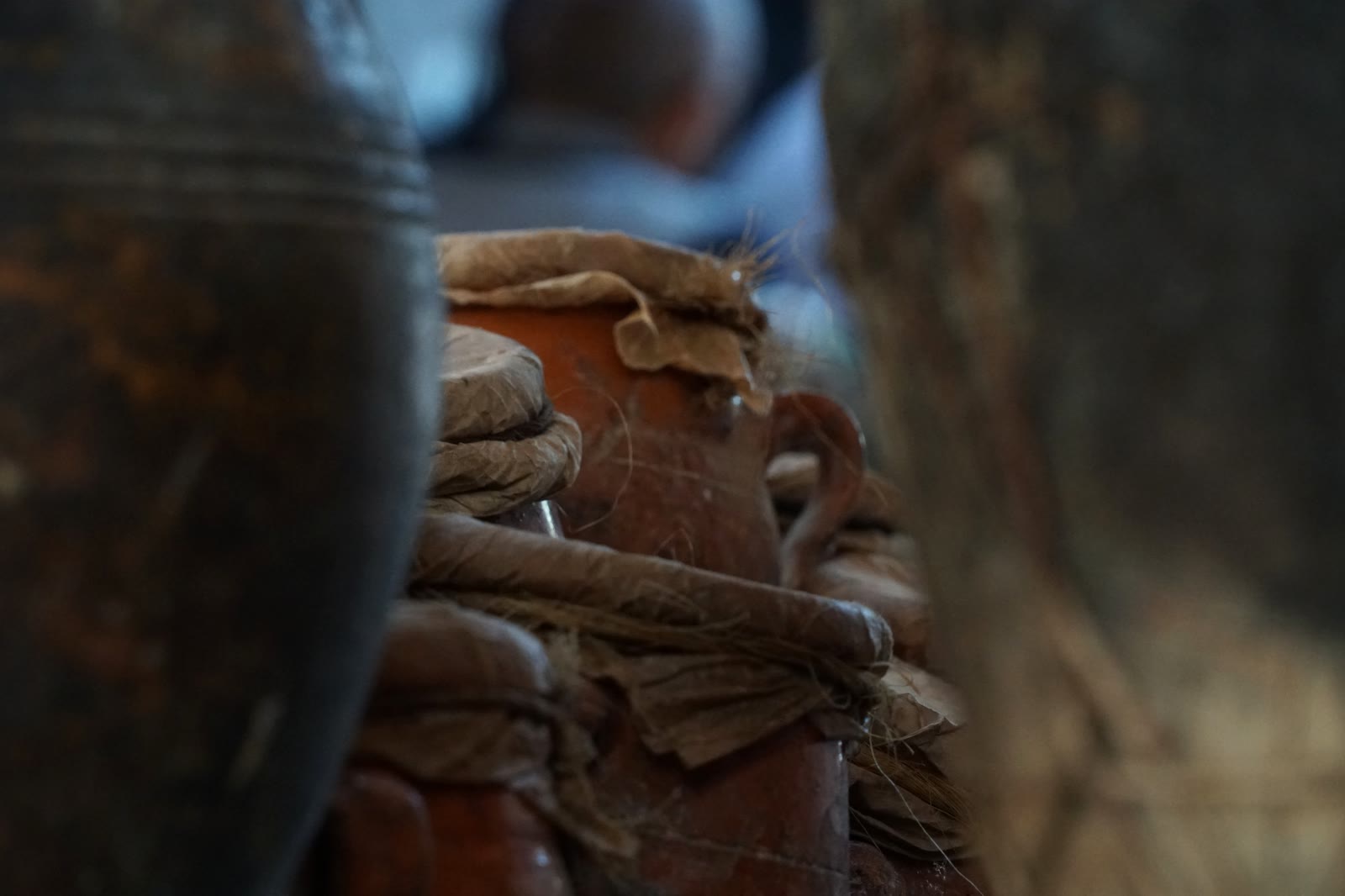
In Adam Harangozó's photograph from a Marrakech souk, the tanjia jars do not look like cookware waiting for a stove. They look like parcels waiting for a journey. Coarse fiber cinches paper across each narrow mouth. One loop handle peeks from a terracotta shoulder. Shelves and shoppers dissolve into a dark blur, leaving the wrinkled seals and orange clay in focus.[5]
The destination is the important part. A traditional Marrakech tanjia does not stay in the kitchen that fills it. The jar travels to a neighborhood oven or the furnace beneath a hammam, where the same fire that heats bathwater supplies hours of low, residual heat. A firekeeper places it among the embers, remembers it and returns it when the meat is ready.[1][2]
That route is still legible at the polished end of the city’s dining spectrum. Dar Les Cigognes describes its offer as fine dining, changes its menu with the market and says its beef tangia cooks overnight in the coals of a hammam fire.[3] The most consequential appliance behind that dish is therefore not hidden behind the restaurant pass. It is elsewhere in Marrakech, tended by someone else.
This is what makes tanjia more than another long braise. Its craft is distributed. The butcher, spice seller, potter, furnace operator and restaurant each hold a different part of the recipe. Fine dining can refine the service, but it cannot honestly compress all that authorship into the name of one chef.
The jar moves; the cook waits
Tanjia names both the food and, in common usage, the vessel that carries it. A World Intellectual Property Organization study of Moroccan culinary traditions also records the jar as a kallouch: a tall terracotta form made especially in Marrakech, related to an amphora once used for transporting and storing liquids.[1] That history survives in the shape. Unlike a broad tagine, which offers a cook a wide base and a removable conical lid, the tanjia has a narrow opening just large enough to load, seal and eventually pour.
There is no single prestige cut or fixed luxury recipe inside. WIPO documents meat, spices and other ingredients enclosed with paper tied by wire; the Moroccan National Tourist Office describes lamb or veal; Dar Les Cigognes names beef; recent reporting from Marrakech follows beef shank with preserved lemon, cumin, saffron, garlic, olive oil and sometimes smen, Morocco's aged butter.[1][2][3][4] The variation is not a defect to be corrected by a definitive tasting-menu version. It reveals where the technique actually resides: in the vessel, the seasoning balance, the seal, the ember heat and the wait.
The hours vary too. WIPO gives four hours for one documented form, then describes an overnight cook; a 2026 Smithsonian report follows a jar collected after roughly four hours; Dar Les Cigognes specifies overnight.[1][2][3] Those accounts should not be averaged into a fake universal timer. Cut size, load, furnace zone and the state of the embers all change the answer. Tanjia is slow cooking, but “slow” is not a setting.
Once the paper is tied, intervention largely ends. There is no searing halfway through, no spoon slipped under a lid, no last-minute reduction in a sauté pan. The cook has to decide the amount of meat, fat, seasoning and liquid before the jar leaves. The furnace operator then decides where it belongs in a heat field shared with other people’s food. Smithsonian describes that operator knowing which tray belongs to which household, which part of the brick-lined oven suits it and when it should move.[2] WIPO is even more concise: the overnight cook is supervised by the fernatchi.[1]
Waiting here is not the absence of technique. It is technique committed in advance.
The narrow neck does quiet work
The jar is not a pressure cooker, and the paper seal should not be described as if it were a locking metal valve. Its useful effect is gentler. The small opening and tied cover restrict evaporation; the meat releases water and fat; the long cook keeps those juices close. Smithsonian reports the narrow neck and tight seal trapping steam so the meat braises in its own liquid.[2]
From there, the culinary mechanism is a bounded inference rather than a published temperature curve. Residual embers deliver sustained indirect heat instead of the assault of an open flame. The clay moderates that heat around a wet interior. Over several hours, connective tissue in a hard-working cut softens into gelatin while rendered fat, preserved lemon, garlic and spice collect in a sauce that has had almost nowhere to escape. The furnace contributes heat and, depending on the jar and seal, an ember-room aroma; it does not magically smoke the meat as though the mouth had been left open above burning wood.
This distinction matters because “smoky” is the easiest word for a menu to sell and the least complete account of the result. Tanjia’s texture comes from a sealed, moist cook. Its concentration comes from time with limited evaporation. Its savor comes from meat, fat and seasoning circulating in a confined space. The hammam fire matters profoundly, but not because visible flames lick the food.
The shape also decides the finish. WIPO records a service sequence in which the paper is removed, the sauce is poured first and then the meat follows directly from the jar, without a ladle.[1] That inversion has its own drama. Sauce arrives as proof that the seal held; the meat arrives after it, surrendered by a vessel too narrow for delicate plating tongs. A restaurant can arrange the final plate, but the jar has already written most of its texture.
One fire works twice
Calling the hammam part of the kitchen is not a metaphor. In Marrakech's medina, the furnace is shared thermal infrastructure. The bathhouse needs continuous heat for water and rooms. Tanjia uses the managed embers beneath that system; communal ovens perform a related role for bread, pastries and household dishes. In recent reporting, residents still hand over sealed jars for a few coins while one fire serves many users.[2]
It is tempting to market this as “cooking with waste heat.” That is a little too neat. The furnace operator still feeds fuel, assigns space, moves food and carries responsibility for timing. The embers have secondary capacity, but they are not ownerless or labor-free. Tanjia turns an already necessary heat system into two services at once: bathing above, cooking below.
The arrangement helps explain why the dish belongs so specifically to Marrakech. The official national tourism page calls tanjia the city's staple; WIPO calls it emblematic and traces its traditional preparation to artisans and other working men who could leave a portable meal at a communal furnace while they worked or went on an outing.[1][4] That “bachelor stew” history should not freeze tanjia into a men-only relic. The same WIPO study notes that it is now also a family and restaurant dish, while Smithsonian reports friends still preparing it for regular gatherings in 2026.[1][2]
The continuity is not an unchanged ingredient list. It is the movement of a sealed vessel through a living city.
The service problem is part of the craft
Tanjia frustrates several habits of contemporary fine dining. A tasting menu wants exact portions. Reservations change. Guests arrive at staggered times. The pass wants food that can be held, reheated or fired again. The traditional jar wants a group, a long lead time and one decisive opening.
WIPO's tourism assessment names those constraints with unusual frankness: advance ordering, a fragile terracotta vessel, difficulty reheating, awkward adaptation to single portions and the risk that traditional ovens and their know-how disappear.[1] These are not side issues for an operations manager. They explain why a faithful tanjia cannot simply be added to tonight's menu at 7:45 p.m. because table twelve saw one carried past.
Dar Les Cigognes offers one workable answer without pretending the dish is instant. Its official page pairs a daily-changing, seasonal menu with guest requests and an overnight hammam cook.[3] The restaurant is not promising that every jar can be summoned on demand. It is building the meal around the clock the technique requires.
That is the stronger fine-dining translation. Reserve the jar against a real number of diners. Let one vessel serve a table instead of miniaturizing it into a row of decorative personal pots. Coordinate collection from the furnace with service, and disclose the method precisely. If the meat was finished in a low electric oven, say so. An indoor adaptation may preserve the moist texture and seasoning logic, but it should not borrow a hammam it never visited.
The same honesty applies to value. The extra money should not buy a speech about how a chef “elevated” an everyday stew. It should buy excellent meat, a sound vessel, skilled furnace work, enough time, careful transport and service that makes the chain visible without turning the firekeeper into picturesque background. Tanjia arrived in fine dining with its sophistication intact.
Open the package, keep the route
Restaurant tanjia now carries two opposite risks. One is erasure: treat it as generic slow-cooked meat, hide the communal furnace and let the chef absorb every credit. The other is theatre without substance: line an entrance with empty urns, promise ancient authenticity and cook an unrelated braise in the back. Smithsonian found both the living neighborhood practice and the tourist spectacle in contemporary Marrakech; tourism can keep attention on the dish even as it turns a daily system into a curated symbol.[2]
The paper seal offers a better model. It does not make the jar glamorous. It makes the jar ready to move. The knot says that the seasoning is finished, the handoff is beginning and somebody at the other end must know what to do.
When that seal is finally cut, peppery citrus steam can rise before the meat slides into its sauce.[2] The pleasure is immediate, but the technique remains spread across the day: clay shaped in Marrakech, a jar filled in one workplace, embers read in another and dinner served in a third. The hammam is part of the kitchen because the city is part of the dish.
Sources
- Kamal Rahal Essoulami, Scoping Study on the Gastronomic Tourism Sector in Morocco. World Intellectual Property Organization and Moroccan Industrial and Commercial Property Office, 2021 — institutional study of tanjia's vessel, ingredients, communal-oven method, service ritual, restaurant constraints and risks to oven knowledge.
- Rathina Sankari, “How Tanjia, a Meat Stew Slow-Cooked in Bathhouses, Shaped Marrakesh's Social Life.” Smithsonian Magazine, June 10, 2026 — on-the-ground reporting on the butcher-to-furnace route, firekeeper labor, braising mechanism, communal ovens and restaurant adaptation.
- Dar Les Cigognes, “Fine dining and cookery classes” — the Marrakech hotel's official dining page describing its seasonal approach and beef tangia cooked overnight in hammam coals.
- Moroccan National Tourist Office, “Food & Drinks” — official description of tanjia as a Marrakech staple made with lamb or veal in a terracotta jar and cooked for long hours in a local oven.
- Adam Harangozó, “Tangia in Marrakech 01,” Wikimedia Commons — source page and metadata for the 2022 documentary photograph of sealed tanjia jars in a Marrakech souk (CC BY-SA 4.0).