The easiest lazy read of Milka is that it is an Alpine destination restaurant with a beautiful lake, a dramatic mountain backdrop, and enough technical skill to justify the drive. That read is not wrong, exactly. It is just too scenic. Milka's own restaurant page is more precise about the real structure. The kitchen says its vision starts with regional seasonal ingredients, Alpine surroundings, and local traditions, then deliberately crosses into neighboring Austria and Italy because the team believes responsible dining begins with the producers actually nearest to them rather than with the neatness of political borders.[1] On the separate cuisine page, the language gets even clearer: the wider region that feeds the menu is "not defined by political maps."[3] That sentence is the key.
Once you put it next to the outside descriptions, the profile sharpens quickly. The World's 50 Best Discovery describes Milka as a lakeside restaurant in the Julian Alps, led by David Zefran, where warm local wood, dove-grey seating, and a tasting menu built around sustainable, foraged, and fermented ingredients make the place feel rooted rather than merely luxe.[4] The Michelin Guide listing and Michelin's Slovenia coverage add the part that makes the story harder to dismiss as a pretty hotel side project: Milka sits at the Julian Alpine tripoint of Slovenia, Austria, and Italy, won its first star within three months of opening in 2022, and now operates at the two-star level.[5][6]
That is why Milka is worth profiling now. It is not just a handsome mountain restaurant that got very good very quickly. It is a restaurant that has turned geography into method.
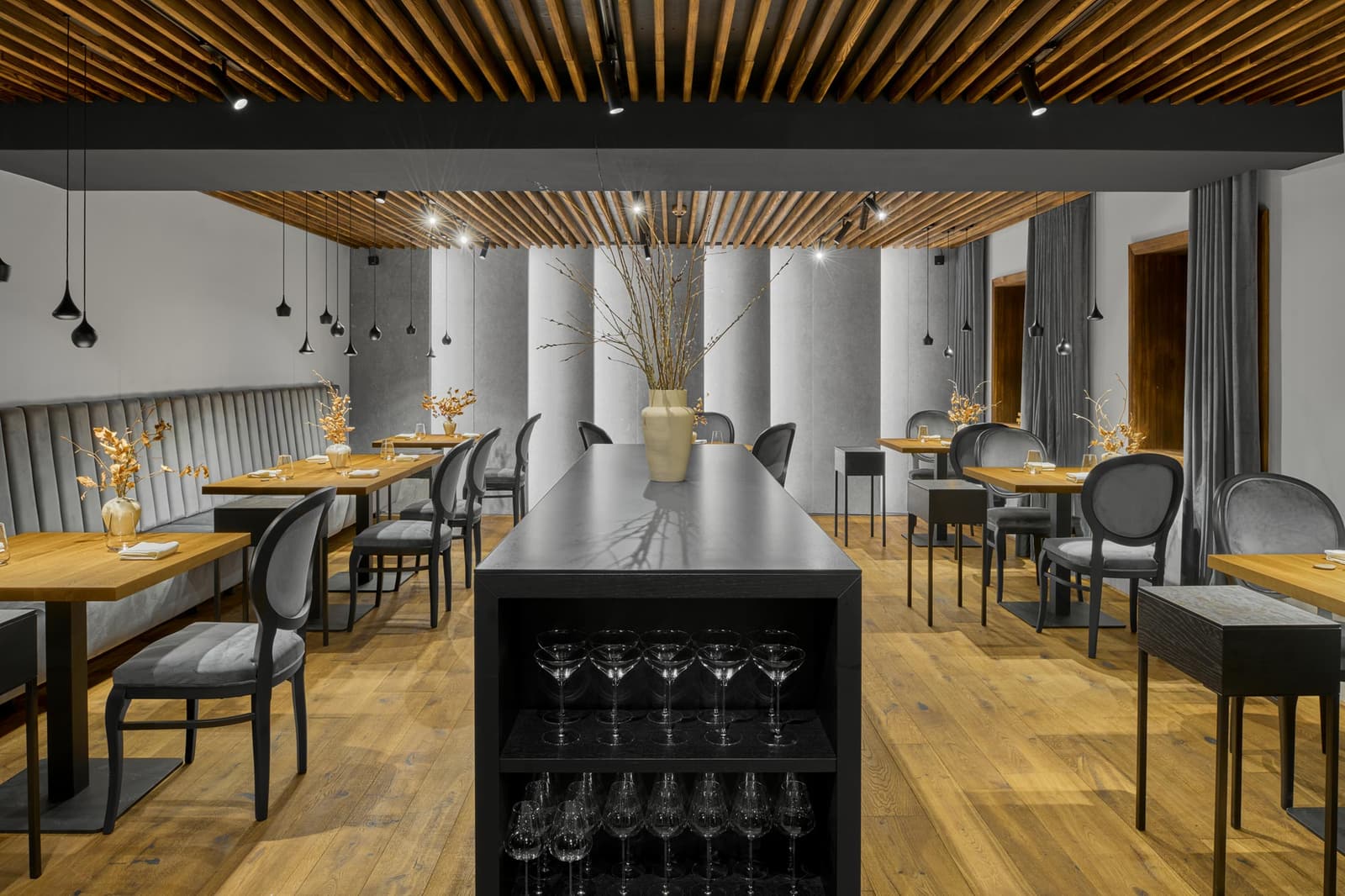
Image context: the lead image uses Milka's official dining-room photograph rather than a plated dish because the room is part of the argument. The profile makes the most sense when you can see how much of the restaurant's identity depends on editing Alpine material into calm, legible form instead of letting the landscape do all the work.[1][4]
1. At Milka, the border is pantry logic, not decoration
Milka's strongest move is that it refuses to treat the borderland as a romance line. Restaurants all over Europe borrow regional language. Far fewer make that language operational. On the main restaurant page, the team says outright that its location asks it to "transcend the man-made borders" by building on ingredients from Austria and Italy while still staying answerable to local producers.[1] Michelin's 2023 Slovenia coverage makes the same point from the outside: Kranjska Gora is not just a mountain town in northern Slovenia, but a place shaped by immediate proximity to both neighboring countries, a point Michelin links directly to the restaurant's modern mountain cuisine.[6]
That matters because the tripoint can otherwise become a brochure word. At Milka, it changes what "local" is allowed to mean. Local here is not a patriotic shrink-wrap around one national pantry. It is a radius of terrain, seasonality, and producer relationships. The cuisine page reinforces that reading by talking about a wider region beyond political maps, then grounding that ambition in practices that are materially close to the restaurant: branches of coniferous trees, wild berries, mountain herbs, and old preservation habits built for long winters.[3]
This makes Milka feel more exact than the average cross-border fine-dining slogan. The restaurant is not claiming that nations are irrelevant. It is claiming that mountain life has always made stricter categories look clumsy. Lakes, passes, weather, forage, and supply routes tend to ignore the neat lines that tourists and governments prefer. Milka has simply chosen to cook according to that older reality.[1][3][6]
2. Short seasons keep the menu honest
The next useful thing about Milka is that the mountain setting shows up as pressure, not prettiness. The cuisine page says the restaurant is shaped by the short and harsh seasons that define life in the Alps, and that those conditions make preservation, foresight, and larder work unavoidable if the kitchen wants to stay serious through winter.[3] That sounds like house philosophy until you look at the current menu. The dedicated menu page is unusually concrete: the present sequence is priced at 295 euro and runs through Danube salmon with potato and walnut leaf, squash with quince and pork cracklings, rainbow trout with sauerkraut and chanterelles, chicken gizzard with fermented potato and bell pepper, rabbit with ramson and green asparagus, peas with white asparagus and popcorn, and a final course called Godlja.[2]
What is striking is not extravagance but terrain. The menu reads like a cold-climate pantry that has learned how to stay nimble. Fish appears in more than one register, but so do fermented notes, preserved notes, and ingredients that feel attached to real spring and shoulder-season constraints rather than to a generic global luxury basket.[2][3] Even the named contributors under the menu matter. Milka lists the people and small producers whose work enriches the current sequence, which turns the sourcing idea from mood music into visible infrastructure.[2]
That list is easy to overlook, yet it does serious profile work. Plenty of fine-dining restaurants talk beautifully about sustainability in the abstract. Milka's menu page does something simpler and more convincing: it lets the reader see that the meal is a negotiated product of farmers, makers, glass, grain, meat, and craft. The cuisine page extends that logic into waste reduction, preservation, and a preference for local or long-forgotten techniques rather than unnecessary manipulation.[3] David Zefran's own stated preference on that page is for great products that are not buried under superfluous components, only amplified enough to let their essence travel further.[3]
That is the mountain discipline in one sentence. The restaurant is not trying to look wild. It is trying to remain answerable to scarcity.
3. The room keeps the seriousness from turning stiff
If Milka only had the tripoint thesis and the seasonal argument, it could still have ended up severe. The room prevents that. The World's 50 Best Discovery description is useful here because it notices the exact right things: warm local wood, dove-grey seating, and wildflowers from nearby meadows.[4] The official restaurant page then supplies the emotional target. Milka says it wants approachable yet professional service, and it makes a mildly rebellious claim that feels central to the place: too often fine dining means strong cooking plus overly stringent etiquette, while Milka wants the atmosphere to feel curated, relaxed, and even fun.[1]
This matters because the restaurant's intellectual structure could easily have slid into mountain puritanism. Instead, the room and service appear designed to soften the edge without loosening the standards. The official image used here shows exactly that combination: timber overhead, sober grey banquettes, clear spacing, and no visible pressure to overperform. It looks composed enough for a two-star meal, but it does not look afraid of conversation.[1]
The beverage program pushes the same line. Milka's restaurant page says the wine focus starts in Slovenia, then extends naturally into Friuli-Venezia Giulia, Carinthia, and Styria, before reaching classical French regions; cocktails draw on regional ingredients and Alpine nature; and the non-alcoholic route is treated as a real pairing rather than a concession.[1] 50 Best Discovery compresses that into three distinct pairing lanes: native wines, house-made juices, and a broader "Our Story" option that folds in cocktails, sake, and beer.[4]
That is a revealing combination. The room is calm, the geography is specific, the sourcing language is disciplined, and yet the hospitality seems determined not to become doctrinaire. Milka reads like a restaurant that wants to be exact without becoming brittle.
Why Milka matters in 2026
What makes the profile timely is that the restaurant now looks less like an exciting rise story and more like a coherent house style. Michelin's coverage still defines the early trajectory: first star within three months of the 2022 opening, second star by 2023, and two-star standing maintained in the current guide listing.[5][6] The official pages, meanwhile, show a restaurant that has used the extra attention to clarify its grammar instead of padding it. The menu is current, singular, and priced clearly at 295 euro.[2] The sourcing argument is repeated across pages without drifting into vagueness.[1][3] The room and pairings back up the same borderland idea rather than competing with it.[1][4]
That is what makes Milka more than an attractive place to sleep near Lake Jasna before or after dinner. The restaurant has figured out how to make a mountain tripoint behave like an organizing principle. The best fine-dining profiles usually turn on one question: what is this place actually built to make legible? In Milka's case, the answer is not Slovenia alone, not the Alps alone, and not luxury alone. It is the feeling that a border region can produce a cuisine tighter than national branding and warmer than severe modernism.
Milka does not ask the guest to admire the view and then forgive the concept. The concept is the reason the view matters.
Sources
- Restaurant Milka official restaurant page, covering the house philosophy around regional seasonal ingredients, Austrian and Italian borderland sourcing, casual-yet-professional service, local ceramics and timber, beverage philosophy, chef profile, and the official dining-room image used here.
- Restaurant Milka official menu page, covering the current 295 euro menu, the present course sequence, and the named contributors and suppliers behind the menu.
- Milka, "Our Cuisine," covering the restaurant's ever-evolving Alpine and Slovenian frame, harsh seasonal logic, preservation, mountain forage, wider-region sourcing beyond political maps, sustainability language, and David Zefran's product-first remarks.
- The World's 50 Best Discovery, "Milka," covering the Julian Alps and Lake Jasna setting, David Zefran's leadership, the warm wood and dove-grey dining room, sustainable/foraged/fermented ingredients, dish examples, and the three pairing lanes.
- MICHELIN Guide, "Milka - Kranjska Gora - a MICHELIN Guide Restaurant," covering the current two-star status, the lake-and-mountains setting, and the guide's listing details for the restaurant.
- MICHELIN Guide, "A Culinary Journey Through Time in the Kranjska Gora Alps," covering Milka's 2022 opening, first star within three months, promotion to two stars in the Julian Alpine tripoint, and the regional influence of Slovenia, Austria, and Italy on the restaurant's cuisine.