The easy way to sell Flocons de Sel is to call it a three-star Alpine destination and leave the sentence there. That description is accurate, but it does not tell you how the restaurant wants to be read. The stronger clue is in the current published winter menu itself. Emmanuel Renaut calls it "Randonnée aux saveurs d'Hiver" and prices it at 330 euros with a run of eight services after the opening savory bites.[2] That is not just pretty framing. It is the right instruction for the diner. This meal is organized like a mountain walk.
That matters especially now because the public-facing information is split across two official homes. As of May 10, 2026, the newer Emmanuel Renaut site says La Table Gastronomique reopens on June 5, 2026 and runs until November 1, 2026, while the older Flocons de Sel hotel site still shows the standing rhythm of dinner on Monday, Thursday, Friday, Saturday, and Sunday, plus Sunday lunch.[1][4] The booking calendar therefore deserves a direct check before travel. The more stable editorial signal sits elsewhere. Both official sites keep repeating the same house idea: mountain ingredients, little interest in display for its own sake, a single menu that changes with the season, and a room that strips away fuss so Alpine detail can carry the night.[1][4]
The winter PDF is unusually useful because it turns that philosophy into sequence. It begins in frost and undergrowth, slides into lake water and fir-scented broth, forks toward game or veal, then lands in forested sugar and liqueur warmth.[2] Even the accompanying cellar description tells the same story. Flocons de Sel says its wine list holds nearly 1,200 bottles, yet insists that Savoie wines form the cornerstone of a program otherwise rich enough to include Petrus and Romanée-Conti, plus an extraordinary Chartreuse collection reaching back before 1900.[3] In other words, the luxury is real, but the local line stays load-bearing.
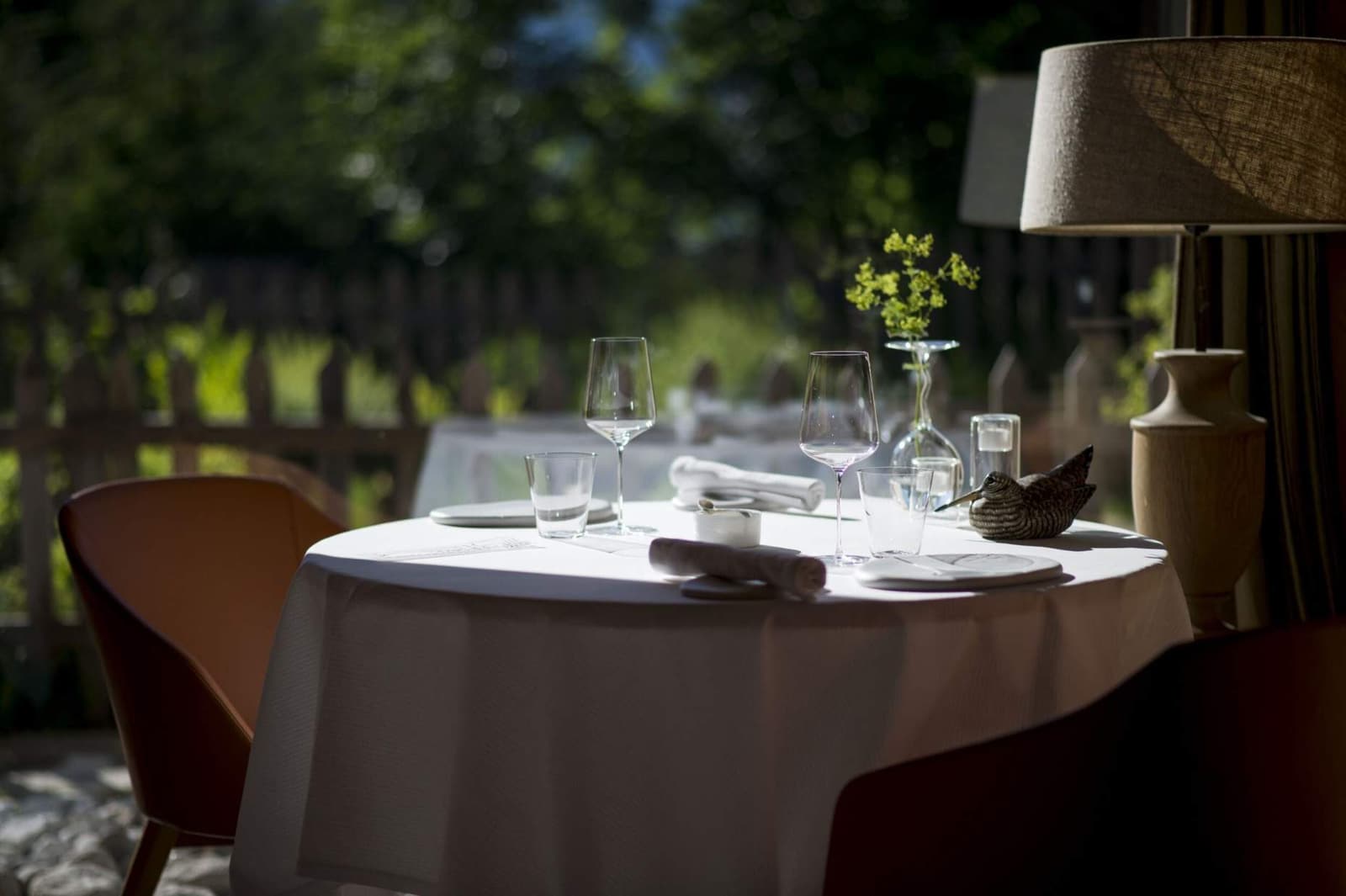
Image context: the cover uses Flocons de Sel's official dining-room photograph because this menu is not a single-plate restaurant. The walkthrough is about progression through texture, altitude, and weather. A room of untreated wood and open light explains that progression better than one isolated glamour close-up could.[1][4]
1. The walk starts in frost, hay, and forest floor
The first important decision is that the menu opens with plants and fungi rather than with brute-force prestige.
Page one of the winter PDF leads with cardon argente epineux de Plainpalais, poached in hay and roasted, with the season's first winter truffles, then follows with a course built around wild mushrooms and button mushrooms from La Motte-Servolex.[2] That is a remarkably specific beginning. Instead of starting with caviar, shellfish spectacle, or an immediate animal protein flex, Renaut starts by making the guest walk through Alpine scarcity: fibrous winter vegetable, hay, truffle, woodland mushrooms.
That opening aligns perfectly with the official restaurant language. The older Flocons de Sel site describes Renaut's Alpine territory as a source of rose hip, wild blackberries, gentian, ceps, and chanterelles before it ever gets to fish or meat.[1] The newer Emmanuel Renaut site says almost the same thing, presenting the menu as a seasonal expression of the Alpine landscape rather than as a generic luxury tasting.[4] The winter menu therefore does not use local produce as scene-setting garnish. It puts that produce first and forces the diner to accept the mountain on its own terms.
The practical reading is straightforward. Do not come to this menu expecting a linear climb in luxury ingredients. Come expecting a shift of terrains. Flocons de Sel wants texture, scent, and cold-season mood to arrive before obvious opulence does.
2. Water under ice is the real middle voice
Once the walk leaves the forest floor, the menu reveals that Renaut's mountain is also a lake country.
The most memorable line in the PDF is still the langoustine course: "Sous une fine tranche d'eau glacee", langoustines cut with a knife and marinated with citron, then brightened by grapefruit, caviar, and gentian root.[2] It is a classic Flocons kind of idea. The luxury element is present, but it is literally placed under ice and acid, as if the shellfish had to pass through weather before it could become indulgence.
Then the menu doubles down on freshwater identity. There is a biscuit of pike with monkfish, grilled onion jus, and jasmine tea, followed by simply cooked Arctic char with carrot mousseline and a buttered broth scented with watercress, fir, and turnip from Artaz.[2] The official restaurant pages had already prepared you for this by naming whitefish and Arctic char from the Lake Geneva zone as part of the restaurant's defining market.[1][4] The PDF shows what that claim means in practice. Flocons de Sel does not merely buy fish near the mountains. It uses lake fish to slow the meal down and give the mountain idea a liquid center.
That is why the menu reads more clearly as a walk than as a parade. Between the mushrooms and the game, Renaut inserts a stretch of thawing water, cold transparency, and broth. The meal is not climbing in a straight line. It is crossing terrain.
3. Meat arrives as a fork in the trail, not as a blunt climax
The menu's most intelligent move may be its treatment of the meat course.
The winter tasting states explicitly that the guest gets a choice of meat in half portion.[2] That detail says a lot about the house. Fine dining often treats the meat course as the unavoidable summit, the point where the diner must submit to weight and finality. Flocons de Sel resists that heaviness. The choice sits between filet of hunted venison with blackberries, blackcurrants, and a jus "like a Grand Veneur sauce," or veal from the Chartreuse massif with Mondeuse jus and sauce poulette.[2]
Both dishes are rich in classical reference, but the half-portion option keeps the menu from collapsing into excess. Renaut seems to want breadth of sensation more than brute force. The guest can encounter game and reduction without losing the long line of the walk.
This is also the point where the Alps stop being a decorative backdrop and become an actual sourcing grammar. The venison points toward forest and hunt. The veal points toward a named massif and a regional red-wine logic through Mondeuse. Then the menu places "Les Alpages sur un plateau" at 35 euros, which reads less like an optional cheese add-on and more like a final proof of territory.[2] The Relais & Chateaux chef profile explains why. Renaut says he works closely with cheesemaker Jacques Dubouloz, trusts him as his "eye in the mountains," and presents around 20 mountain-pasture cheeses from the region and Switzerland because, in mountain cheese, "there are no borders."[5]
That is an excellent clue for diners. If you take the cheese course, read it as part of the menu's geography, not as a generic luxury supplement.
4. The sweet ending stays in the woods, then the cellar answers it
Dessert could easily be the place where a mountain menu goes anonymous. Flocons de Sel avoids that trap.
The sugar page continues the terrain logic almost stubbornly. One dessert is "Balade dans nos bois" with chocolate, local blueberry, and juniper. Another is a hot souffle scented with raspberry eau-de-vie and filled with raspberry liqueur. The last circles around rosehip with quince-scented broth, bugnes, and sorbets.[2] None of these read like a retreat into neutral pastry luxury. The menu ends where it began: in woods, liqueur, shrub fruit, and aromatic cold.
The cellar page makes the beverage logic legible. Flocons de Sel says its program is eclectic and majestic, yet keeps returning to Savoie as the cornerstone: Michel Grisard old vintages, Apremont, Roussette, Chignin-Bergeron, and older grape lines such as Gringet and Persan.[3] At the same time, the cellar houses an "extraordinary collection of Chartreuses," including green and yellow styles, MOF bottlings, Episcopale, Anisette, and a rare Queen of Liqueurs release.[3]
That matters because it tells you how to drink this menu well. The smartest reading is not to overpower the meal with globally prestigious bottles simply because the cellar can support them. The menu's own arc points toward mountain whites, lifted acidity, herbal bitterness, and liqueur warmth. Flocons de Sel clearly has the trophy labels. Its deeper confidence lies in keeping Alpine bottles and Alpine liqueurs central even when the list is broad enough to do otherwise.[3]
What you are really booking
If you book Flocons de Sel later in 2026, the exact dishes will shift; both official sites insist that the menu evolves with the season.[1][4] The more durable reason to care about the published winter menu is that it exposes the restaurant's operating mind. Renaut does not seem interested in making the Alps look plush. He is interested in making them legible.
That is why this winter menu works so well on paper. Cardoon, mushrooms, langoustine under ice, pike biscuit, Arctic char in fir-scented broth, venison or Chartreuse-massif veal, mountain cheeses, rosehip, juniper, and raspberry spirit do not feel like disconnected signatures.[2][3][5] They feel like changes in altitude and weather translated into table rhythm.
So the best way to book Flocons de Sel is not to ask whether it is luxurious enough. The answer to that is obvious. The better question is whether you want a tasting menu that behaves like a mountain day: cold first, then thaw, then lake light, then hunt, then pasture, then liqueur heat after dark. On the evidence of the winter 2026 materials, that is still exactly what Renaut is building.[1][2][3][4][5]
Sources
- Flocons de Sel, "Gourmet restaurant in Megeve" - official restaurant page covering the natural wood room, alpine ingredient framing from wild berries and mushrooms to whitefish and Arctic char, the standing service-day schedule shown on the legacy site, and the official dining-room image used for this article.
- Flocons de Sel, "Carte menu hiver 2026" PDF - the published winter 2026 menu covering the eight-service 330 euro tasting, the course sequence, half-portion meat choice, vegetarian option, cheese supplement, and dessert page.
- Flocons de Sel, "The Flacons of Flocons" - official cellar page covering the nearly 1,200-bottle wine list, the Savoie cornerstone, old Michel Grisard vintages, regional grapes such as Gringet and Persan, and the restaurant's extensive Chartreuse collection.
- Emmanuel Renaut, "La Table Gastronomique" - the chef's newer official page stating the June 5, 2026 reopening, the November 1, 2026 seasonal close, the single evolving menu, and the continued alpine-landscape framing of the restaurant.
- Relais & Chateaux, "Emmanuel Renaut, 3 stars in the Michelin Guide 2025" - chef profile covering Renaut's mountain-cheese sourcing with Jacques Dubouloz and the year-round presentation of around 20 regional and Swiss mountain-pasture cheeses.