The easiest way to praise Lyla is to stop at ingredients. The official restaurant page gives you plenty to work with: line-caught fish, sustainable shellfish from the Scottish isles, close relationships with growers and foragers, and a tasting menu built around seafood rather than around the usual red-meat crescendo of European luxury dining.[1] Critics have also done the obvious work already. The National Restaurant Awards placed Lyla at the center of current Scottish fine dining, while the Good Food Guide describes a meal whose force comes from room sequence as much as from any single plate.[3][4]
That still undersells what the restaurant actually does well. Lyla's real strength sits in operations. Stuart Ralston and the team have arranged the evening so that the meal begins in one room, the appetite in another, and the kitchen remains visible at the exact point when concentration needs to rise.[1][3][4] The result is not simply a seafood tasting menu in an elegant Edinburgh townhouse. It is a service system in which architecture, pacing, and reservation policy all work to make a small dining room feel composed rather than compressed.
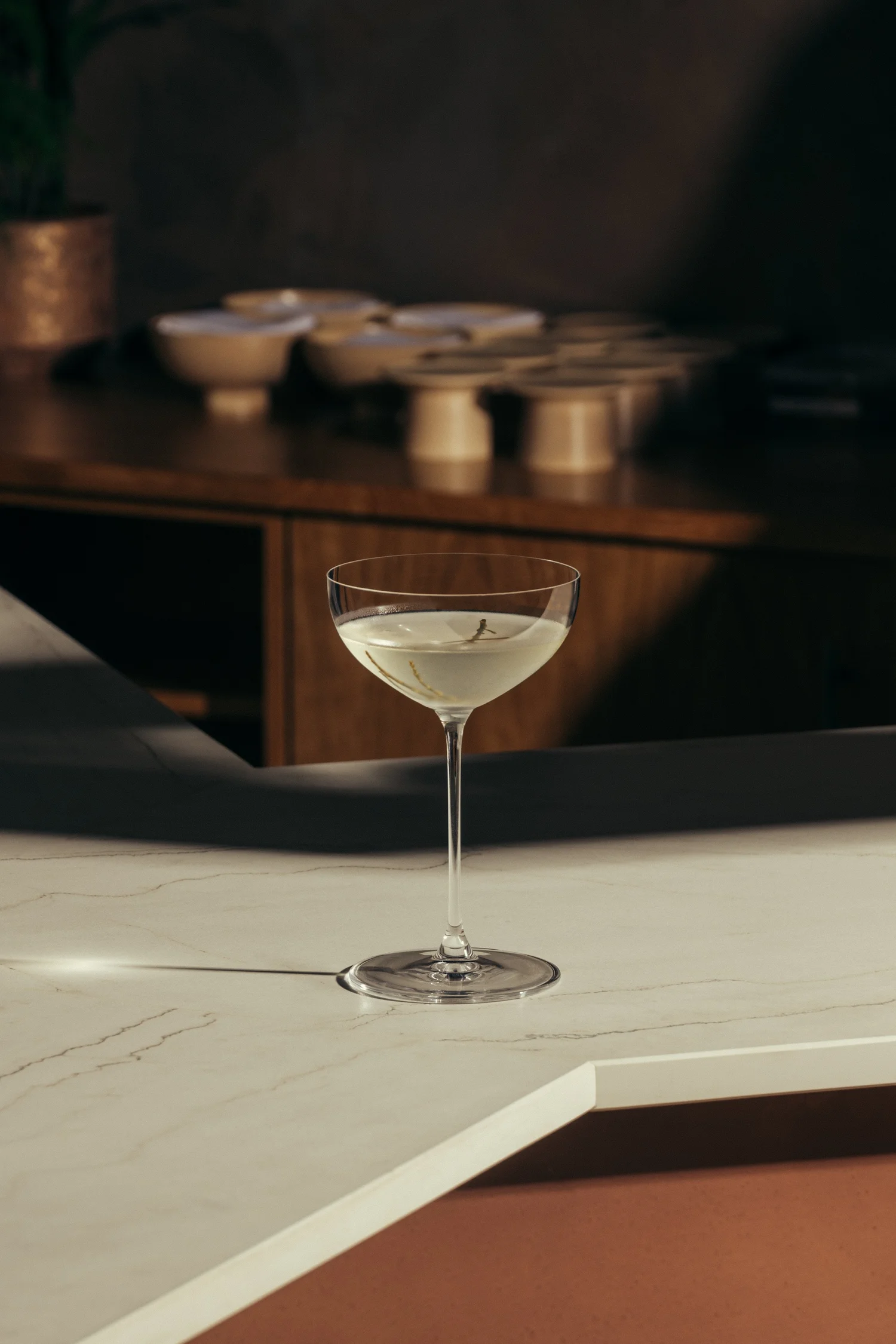
Image context: the lead image uses official Lyla photography of the upstairs drinks setting because this article treats that room as part of service design, not as a decorative holding area.[5]
1. The upstairs bar is a pacing device
Lyla's own description of the evening is unusually explicit. Guests begin upstairs, looking toward the Firth of Forth, with aperitifs or Champagne and snacks prepared at a center counter before the meal progresses downstairs to the main dining room and its open kitchen.[1] That sounds hospitable on first read. Operationally, it does more than hospitality.
An upstairs opening solves several problems at once. It breaks the arrival surge that can flatten a small dining room at the top of service. It lets the team stage coats, drinks, first interactions, and dietary confirmations before every guest needs a table-side introduction downstairs. It also gives the restaurant a chance to set one calm tempo for the whole room, which matters more in a tasting-menu format than many restaurants admit. When everyone enters the main room already settled, the kitchen does not need to spend its first courses fighting staggered attention.[1]
The Good Food Guide captures the experiential side of that decision. Its review describes diners being taken upstairs for Champagne and canapes before moving into the main room, and then notes how seamlessly that room blends into an entirely open kitchen.[4] The key word there is not luxury. It is transition. Lyla has built a soft handoff between anticipation and concentration, and that handoff is one reason the downstairs room can feel so measured.
The National Restaurant Awards profile adds a more visual detail: the upstairs level includes a bar with a Krug-branded champagne trolley, a touch that could easily read as pure display if it were isolated from the rest of the meal.[3] At Lyla it lands differently because the service sequence gives it a job. The upstairs room is where the restaurant widens the evening, then narrows it again.
2. Seafood gives the menu discipline
The second operational choice is the menu's center of gravity. Lyla is direct about what it wants to cook. The official page says the restaurant uses the best line-caught fish and sustainable shellfish it can source from the Scottish isles, supported by top farms, local growers, and foragers.[1] That sounds like ingredient rhetoric until you put it next to the rest of the setup.
Seafood-led tasting menus obey a different pacing logic from menus that lean on heavy sauces and large-format proteins. They ask more from sequencing, temperature control, and restraint. If the room runs late, the menu feels it quickly. If guests arrive overstimulated or the kitchen has to force energy into the early stages of service, delicacy turns fragile. Lyla's upstairs-to-downstairs structure therefore does more than add atmosphere. It protects the kind of menu the restaurant has chosen to serve.[1][4]
The critics noticed the same logic from the opposite end. The National Restaurant Awards piece describes ageing fridges holding whole halibut and plaice, an almost fully open kitchen, and a fish-focused tasting menu that makes the room feel unapologetically fine dining.[3] That combination matters. Displayed fish ageing is not there only to signal seriousness. It tells diners that time, condition, and handling are central to the house style. In a seafood-led menu, those variables shape flavor before garnish or narrative enters the picture.
This is also why Lyla's menu reads as narrow in the productive sense of the word. The restaurant can accommodate pescatarian, gluten-free, and nut-free needs with notice, while also being clear that it cannot realistically absorb vegetarian, vegan, dairy-free, egg-free, fish-free, or shellfish-free requests.[1] Some rooms would present that as inflexibility. Here it reads as scope control. The kitchen knows the menu's grammar and protects it.
3. Small scale is doing real work
Lyla's booking rules look strict until you read them as room design. The official page says dinner is a 10-course tasting menu served Wednesday through Saturday at 6:30 p.m. for 185 pounds, with service lasting around three and a half hours. Lunch runs on Fridays and Saturdays in five- or seven-course formats at 79 or 105 pounds, and tables are limited to parties of one to four guests.[1] The National Restaurant Awards profile complements that with the physical scale: a 28-cover restaurant, currently operating with just 10 tables in the former 21212 townhouse.[3]
Those facts explain the atmosphere better than any adjective can. A room that size cannot absorb disorder cheaply. Large parties would distort timing, acoustics, and staff allocation. A tasting menu that depends on seafood precision would pay for those distortions immediately. Keeping the table count low and the party size capped is therefore not mere exclusivity signaling. It is how the restaurant buys legibility for both guests and staff.[1][3]
The open kitchen downstairs completes the same argument. When the Good Food Guide says the dining room blends into the kitchen, and when the National Restaurant Awards describes that kitchen as almost fully open, both are pointing to a service model with very little hiding space.[3][4] In such a room, confidence comes from control. The restaurant cannot let arrivals, allergies, or course pacing become improvisational noise because the whole dining room will feel it.
This is where Lyla's calm seems earned. Calm is expensive to produce. It usually requires saying no early, shaping the room in advance, and refusing the fantasy that every special request can be folded into any menu without consequences. Lyla's policies read strongest in that light.
4. Why this matters in Edinburgh now
There is a broader reason the restaurant stands out. The National Restaurant Awards notes that Lyla opened in 2023 in Paul Kitching's former 21212 space and traces Stuart Ralston's path through Gordon Ramsay in New York and Sandy Lane in Barbados before he built his Edinburgh group.[3] That background could have produced a room obsessed with polish for its own sake. Instead, Lyla feels more edited than opulent.
The Good Food Guide's account of the drawing room upstairs, the glass-fronted ageing fridges, and the open kitchen downstairs suggests a restaurant that wants diners to register process without being bludgeoned by explanation.[4] The official site reinforces that reading by specifying duration, menu length, and dietary boundaries with unusual directness.[1] Put together, those details describe a restaurant that understands luxury as the removal of friction, not as the multiplication of options.
That is the service lesson here. Lyla is compelling because it spends its glamour carefully. The upstairs drink is there to slow the room. The seafood focus narrows the kitchen into its strongest register. The small table policy protects timing. The open kitchen makes composure visible. Many restaurants can source excellent fish. Fewer can build an evening in which every operational decision helps that fish arrive in the right emotional and physical condition.[1][3][4]
In that sense, Lyla's smartest course may be the one that never appears on the printed menu. It is the move from upstairs to downstairs, from conversation to concentration, from Edinburgh townhouse ease to a more exacting kind of attention. Once that transition lands, the rest of the meal has a structure sturdy enough to matter.
Sources
- Lyla, "Restaurant" - official page covering the upstairs aperitif room, downstairs open kitchen, seafood sourcing, menu formats, prices, durations, party-size limits, dietary policy, cancellation terms, and service charge.
- The Michelin Guide, "Lyla" - restaurant listing page for Lyla in Edinburgh.
- National Restaurant Awards, "Best Restaurant in Scotland" - profile covering Lyla's 2023 opening, Stuart Ralston's background, the former 21212 site, 28 covers, 10 tables, the upstairs champagne trolley, ageing fridges, and the fish-focused tasting menu.
- The Good Food Guide, "Lyla" - review page covering the upstairs drawing room, Champagne-and-canapes start, glass-fronted ageing fridges, and the fully open kitchen feel.
- Official Lyla image asset - photographic source for the lead image used with this article.