The most revealing moment in a long fine-dining meal often arrives after everyone thinks the meal is over. Dessert has landed. Coffee may be on the table. Conversation has loosened. Then a small tray appears: a macaron, a fruit jelly, a chocolate, maybe a tiny tart, something crisp, something cold, something the pastry team wants you to remember after the last formal course has stopped speaking.
Mignardises are easy to misread as generosity by multiplication. More sweets, more luxury, more proof that the kitchen has spare hands. That is the weak version. The better version treats the final plate as service design. It has to restore appetite without restarting dinner, honor pastry without exhausting the guest, and give the room a graceful way to close the check, the coffee, and the emotional arc of the table.
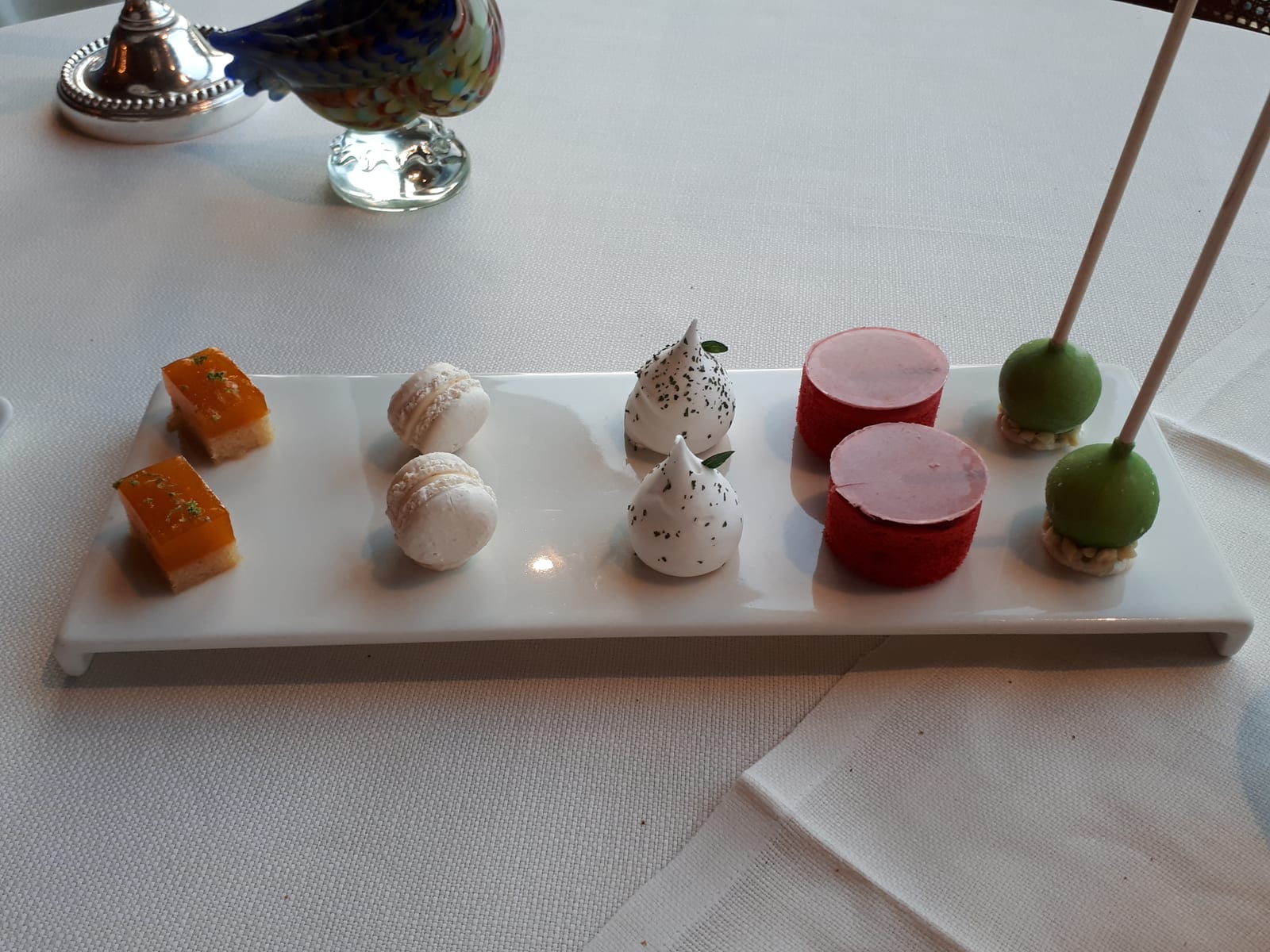
The cover photograph from La Tour d'Argent is useful because it does not show a single heroic dessert. It shows a small procession: orange-topped squares, pale macarons, white meringues, red cylinders, green lollipop-like bites, all arranged on a long white plate with room around them.[5] The restraint is the point. The mignardise course works when it feels like a final sentence, not a new paragraph that the guest did not ask to read.
The Last Course Is Not Another Dessert
Michelin's guide to French fine-dining rituals places mignardises and petits fours at the end of the meal, after dessert, as bite-sized sweets that conclude the experience.[1] That position matters. A dessert course can take the room into a full idea: fruit, chocolate, souffle, frozen element, plated pastry, tableside sauce. Mignardises have a different job. They live after the climax.
That means they must be smaller in more than size. They need a smaller claim on attention. A good mignardise does not ask the guest to restart analytical tasting: What is the sauce? What is the garnish? How does this plate relate to the menu theme? It should work more like a precise farewell. One bite may refresh the palate with acid. Another may provide chocolate depth. Another may give crunch or perfume. The sequence can still be clever, but the cleverness has to fit inside an exit.
This is where many dining rooms lose their nerve. After a careful menu, the final sweets can turn into a sugar dump: truffles, caramels, marshmallows, caneles, macarons, jellies, and cookies arriving because abundance feels safer than editing. The guest smiles, takes one, and silently calculates how many more polite bites remain. That is not hospitality. It is unresolved mise en place pushed onto the table.
The best mignardise service understands fatigue. By the end of a tasting menu, the guest has already processed heat, salt, acidity, wine or non-alcoholic pairings, conversation, explanations, and time. The final plate should not compete with the menu's memory. It should sharpen it.
The Small-Oven Logic Still Matters
The petit four's history helps explain why the format is naturally suited to the end of a meal. Bake from Scratch traces the term to nineteenth-century France and the "small oven" idea: bakers used residual oven heat after bread baking for smaller, more delicate pastries.[2] Even when modern kitchens no longer depend on that exact oven cycle, the logic survives. Petit-four work is about leftover heat, small scale, and precise use of a narrow window.
That old constraint makes the modern service more interesting. A restaurant pastry team is usually managing several clocks at once: breads early in service, pre-desserts, plated desserts, frozen components, chocolates, jellies, filled shells, and sometimes take-home gifts. Mignardises sit in the part of the kitchen where advance preparation and last-minute quality meet. Too much preparation and the bites taste stale, waxy, or fridge-tired. Too much last-minute complexity and the dining room waits while the exit loses rhythm.
Great British Chefs' petit-fours collection shows how wide the category can become: truffles, jellies, fudge, ganache, curd-filled pieces, chocolates, marshmallows, and small pastries all belong when proportion and texture are controlled.[3] That variety is useful only if the kitchen edits it. A tray does not need to demonstrate every skill. It needs to decide which two or three textures the guest should carry out of the room.
Think of the service problem as a small tasting menu inside the larger one. The same balance rules apply, but compressed. If every bite is creamy, the course feels slow. If every bite is acidic, it feels shrill. If every bite is chocolate, the ending becomes heavy. If every bite is dry, coffee has to rescue the pastry. The room needs contrast: perhaps fruit gel for brightness, a nut or chocolate piece for depth, a crisp shell for texture, and one local or house-signature accent to make the ending belong to this restaurant rather than to a pastry textbook.
Coffee Timing Is Part Of The Course
Mignardises are also a front-of-house test because they usually overlap with coffee, tea, digestifs, petit glasses, coats, and the first discreet movement toward departure. That makes timing more delicate than it looks. Send the tray too early and it interrupts dessert. Send it too late and it feels like a delay tactic after the guest has already decided the night is done.
The coffee pairing is not incidental. Bitter espresso can make a chocolate or nut bite feel cleaner. Tea can pull perfume out of citrus, spice, or floral sugar. A digestif can make sweetness feel more adult, but it can also make the end of the meal heavier if the mignardises are already rich. The service team has to read the table: who wants one last sweet, who wants coffee only, who is done, who is lingering, who is trying not to be rude.
This is why the final plate is a real operations feature, not a decorative flourish. It requires pastry production, table pacing, server language, and check timing to agree. The server should not have to give a full lecture unless the bites need identification for allergies or curiosity. A short, clear introduction is enough. The confidence should be in the editing.
Michelin's Singapore feature on petit fours makes the larger industry signal visible: starred restaurants keep investing imagination in these last tiny bites because the end of a luxurious meal is a memory site.[4] The point is not that every room should copy the same tray. It is that serious restaurants understand the final bite as part of the experience, not as a leftover from the dessert station.
The Best Ending Feels Generous Because It Stops
Mignardises fail when they confuse size with lightness. A bite can be tiny and still too much if it is dense, sticky, boozy, and sweet after three hours of tasting. They also fail when they become too self-conscious. A hyper-conceptual last bite can flatten the pleasure of the goodbye. At the end, many guests want clarity more than surprise.
The strongest endings tend to have a simple shape. One bite lifts. One bite comforts. One bite marks the house. That could mean a citrus pate de fruit, a dark chocolate with a clean snap, and a miniature local pastry. It could mean a macaron, a meringue, and a tiny fruit tart. It could mean one exceptional canele and nothing else. The right number is not fixed, but the principle is: stop before generosity turns into fatigue.
That restraint is what makes the mignardise course so revealing. A restaurant that can end well usually knows what the whole meal was about. It does not panic and add more decoration. It does not let the pastry team show every possible technique. It does not use sugar to cover an awkward exit. It chooses a few small objects and lets them complete the room's tone.
In that sense, mignardises are fine dining's last act of manners. They say the kitchen is still paying attention when the guest has already relaxed. They let the server return to the table with something hospitable rather than transactional. They give coffee a companion, pastry a signature, and the meal an aftertaste shaped by intention.
The final bite should not be the loudest thing you ate. It should be the one that makes leaving feel right.
Sources
- MICHELIN Guide, "Demystifying French Fine Dining Rituals" - explanation of mignardises and petits fours as bite-sized sweets served at the end of the meal.
- Bake from Scratch, "Baking School In-Depth: Petit Fours" - overview of the small-oven origin story, nineteenth-century French context, petit-four glace framing, and production notes.
- Great British Chefs, "Petits fours recipes" - collection showing the range of end-of-meal small sweets, including truffles, jellies, fudge, chocolates, curds, and pastries.
- MICHELIN Guide Singapore, "The Final Finishing Touch: Petit Fours At 7 Michelin-Starred Restaurants" - examples of how starred restaurants use petit fours as the final gesture of a meal.
- Wikimedia Commons, "File:Tour d'Argent D170712 13 - Mignardises.jpg" - real 2017 photograph by Guilhem Vellut used as the article image.