Le Gavroche is easiest to remember as a closed room now: a Mayfair door, a famous sign, a wine cellar dispersed after the final service. That is too small a legacy. The better way to read the restaurant is as a training room disguised as luxury. From its 1967 opening through its January 2024 closure, Le Gavroche taught London that French haute cuisine was not only a style of sauce or a way to fold napkins. It was a system for recruiting cooks, disciplining service, educating guests, and turning classical technique into an industry language.[1][2]
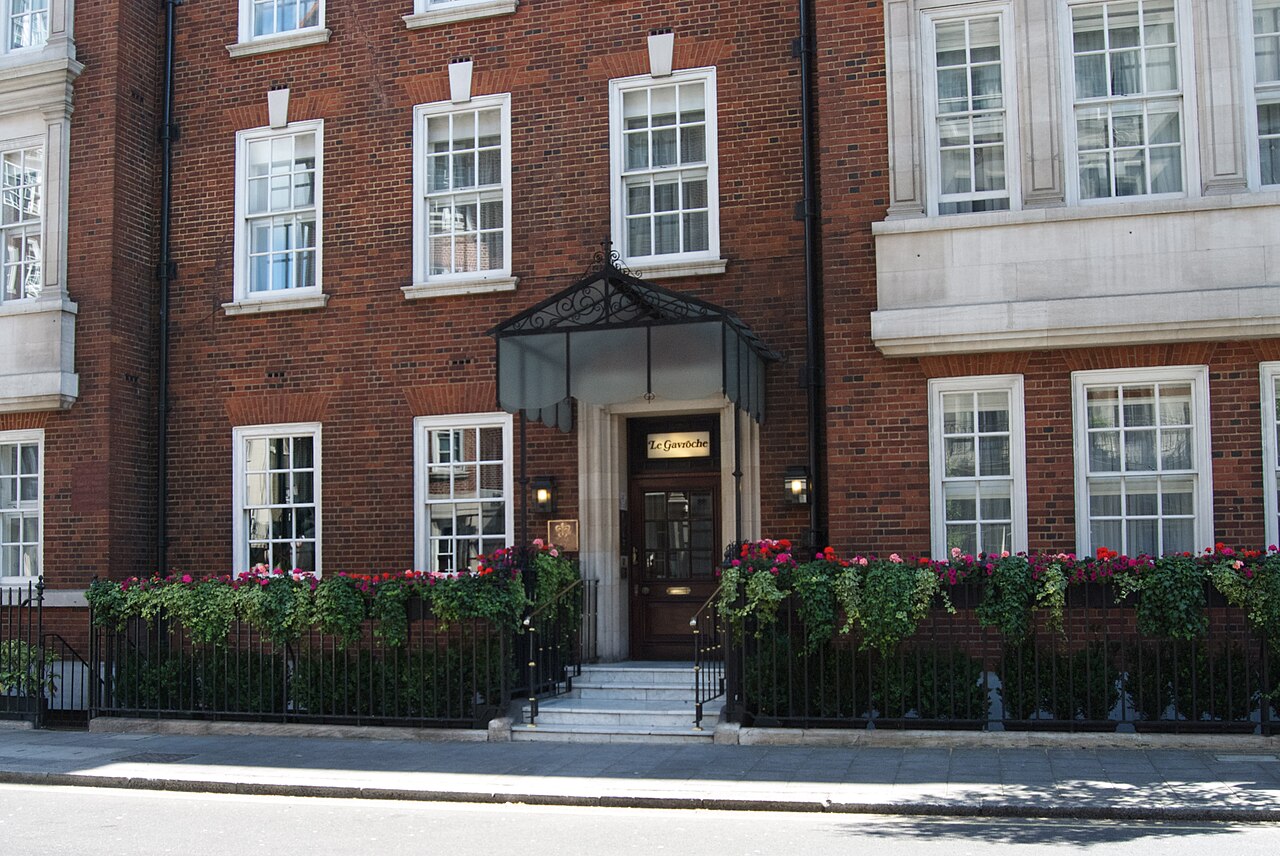
The cover photograph shows the Upper Brook Street entrance in 2008: brick, white-framed windows, flowers, a small canopy, and a sign that does not shout.[6] That reserve matters. Le Gavroche did not change British dining by looking like the future. It changed it by making an old grammar feel operational in a city that had not yet built a comparable fine-dining infrastructure when Albert and Michel Roux arrived.
The Door Before The Dynasty
The official Le Gavroche story is compact but revealing. Albert and Michel Roux opened the restaurant in 1967, and the house later became the first UK restaurant to receive one, two, and then three Michelin stars. The same account also says it was the first Michelin-rated restaurant to offer a set-price lunch.[1] Those facts are often repeated as trophies, but they are more interesting as sequencing. The restaurant first had to make the room legible to diners, then make excellence repeatable enough for inspectors, then make access structured enough that lunch could become a gateway instead of a dilution.
The Caterer fills in the geography and clock. Le Gavroche began on Lower Sloane Street in Chelsea, moved to Upper Brook Street in Mayfair in 1981, and became the first UK restaurant to win three Michelin stars in 1982.[2] That move from pioneering room to institution is the core of the lineage. The restaurant did not merely survive a change of address; it carried its operating system with it.
That operating system was rich, but not vague. The Guardian's obituary of Albert Roux describes the early Le Gavroche world as one of mousses, reductions, emulsions, borrowed paintings, and French produce brought in from Rungis.[3] Read that as infrastructure, not decoration. Rungis mattered because ingredients had to be secured. Emulsions mattered because a sauce could reveal whether the brigade was disciplined. Art on the wall mattered because the room had to persuade London diners that restaurant luxury could be cultural as well as caloric.
Classical French, London Consequences
There is a lazy version of the Le Gavroche story in which two French brothers simply imported Frenchness and Britain learned to applaud. The sharper version is less national and more mechanical. They made a room where cooking, service, supply, price, hierarchy, and hospitality reinforced one another. That is why the restaurant's set-price lunch matters so much.[1] It was not a casual bargain bolted onto a grand dinner house. It was a way to let more diners cross the threshold while preserving the grammar of the room: booking, greeting, pacing, sauce, cheese, wine, farewell.
For fine dining, access is always a design problem. If the price of entry is too high, a restaurant becomes a trophy cabinet for regulars and expense accounts. If the entry format is too loose, the room loses the ceremony that makes it itself. Le Gavroche's set-price lunch solved that tension with a classical trick: it compressed without abandoning form. The guest could come at midday, spend less than at dinner, and still learn the sequence of a serious French restaurant.
That made diners part of the training system too. A city cannot grow a fine-dining culture only by training cooks. It also needs guests who understand why the table is paced, why sauce arrives with authority, why cheese is offered as a decision, why a dining room can feel formal without feeling hostile. Le Gavroche educated that appetite over decades.[1][3]
The Kitchen Became A Network
The most visible proof of Le Gavroche's influence walked out of its kitchen. The Caterer names Monica Galetti, Gordon Ramsay, Pierre Koffmann, and Marco Pierre White among chefs who worked there, while The Guardian also points to Ramsay, White, Marcus Wareing, Koffmann, and Michel Roux Jr as part of the wider line.[2][3] Lists of famous alumni can become lazy prestige counting, but here the list is evidence of transmission. The restaurant mattered because it exported trained people into other rooms.
That is the difference between a landmark and a school. A landmark asks to be visited. A school changes what its students are able to build elsewhere. Ramsay's later empire, Koffmann's La Tante Claire, Galetti's public authority as both chef and broadcaster, and the many less famous careers shaped by the same discipline all show that Le Gavroche's real product was not only the plate in front of a guest. It was professional expectation.
The Roux Scholarship made that expectation explicit. Its history page says Michel and Albert Roux established the scholarship in 1983, at a moment when there were only 33 starred restaurants in the Michelin Guide to Britain and Ireland. The first competition followed in 1984, with Andrew Fairlie as the winner; the broader purpose was to give British-based chefs access to elite stages and a higher technical foundation.[4] That is Le Gavroche thinking beyond its own reservation book. If the restaurant was the room, the scholarship was the pipeline.
This is why the Le Gavroche lineage should not be reduced to nostalgia for rich sauces. The sauces were real, and they mattered. But the larger argument was institutional: a serious dining culture needs apprenticeships, standards, travel, judges, sponsors, alumni, and a shared belief that technique is not snobbery when it teaches cooks how to control flavor under pressure.[4]
The Closure Clarified The Cost
The final chapter also belongs to the story. Michel Roux Jr closed the restaurant in January 2024 after 56 years, with The Caterer reporting his explanation that the daily pressure of delivering at that level had become wearing and that the lease ending gave him a moment to reassess.[2] This was not just a sentimental ending. It exposed the modern cost of the very model Le Gavroche helped define. Classical luxury can be beautiful, but it is also labor, lease, expectation, recruitment, inspection, and repetition.
That is why the post-closure auction felt so symbolic. The Guardian reported that Christie's would sell rare wine, artworks, silverware, porcelain, and even the illuminated sign after the restaurant shut.[5] Those objects were not the restaurant, but they were fragments of its stagecraft. A sign can move to a collector's wall. A bottle can be opened somewhere else. A plate can become a relic. The discipline behind them has to survive through people or it does not survive at all.
Le Gavroche did survive that way. Its name continues through Roux ventures and pop-ups, but the more important afterlife is already dispersed through British fine dining.[2][4] You can see it whenever a London dining room treats lunch as a serious format, whenever a kitchen treats sauce as a test of attention rather than a nostalgic garnish, whenever a young chef understands that a stage is not a photo opportunity but a professional grammar lesson.
The quiet door in the photograph is therefore misleading in the right way. It looks like an entrance to one expensive restaurant. In practice, it was one of the doors through which London fine dining learned to become an industry.
Sources
- Le Gavroche, "Our Story" - official history covering the 1967 opening, Michelin firsts, set-price lunch, and London influence.
- Sophie Witts, "Michel Roux Jr to close Le Gavroche in January 2024," The Caterer, 18 August 2023 - closure rationale, Lower Sloane Street origin, Mayfair move, 1982 three-star milestone, and alumni list.
- Alexandra Topping, "Chef and Le Gavroche restaurateur Albert Roux dies aged 85," The Guardian, 6 January 2021 - Albert Roux obituary with opening context, kitchen style, Rungis supply, and chef lineage.
- Roux Scholarship, "History of the Competition" - official account of the 1983 scholarship launch, 1984 first competition, and its role in developing British-based chefs.
- Donna Ferguson, "Le Gavroche: rare wines from Michelin-starred restaurant to be sold at auction," The Guardian, 3 February 2024 - post-closure auction of wine, artworks, silverware, porcelain, and the restaurant sign.
- Alex.muller, "Le Gavroche 2008 06 19.jpg," Wikimedia Commons - real 2008 photograph of the Le Gavroche exterior on Upper Brook Street.