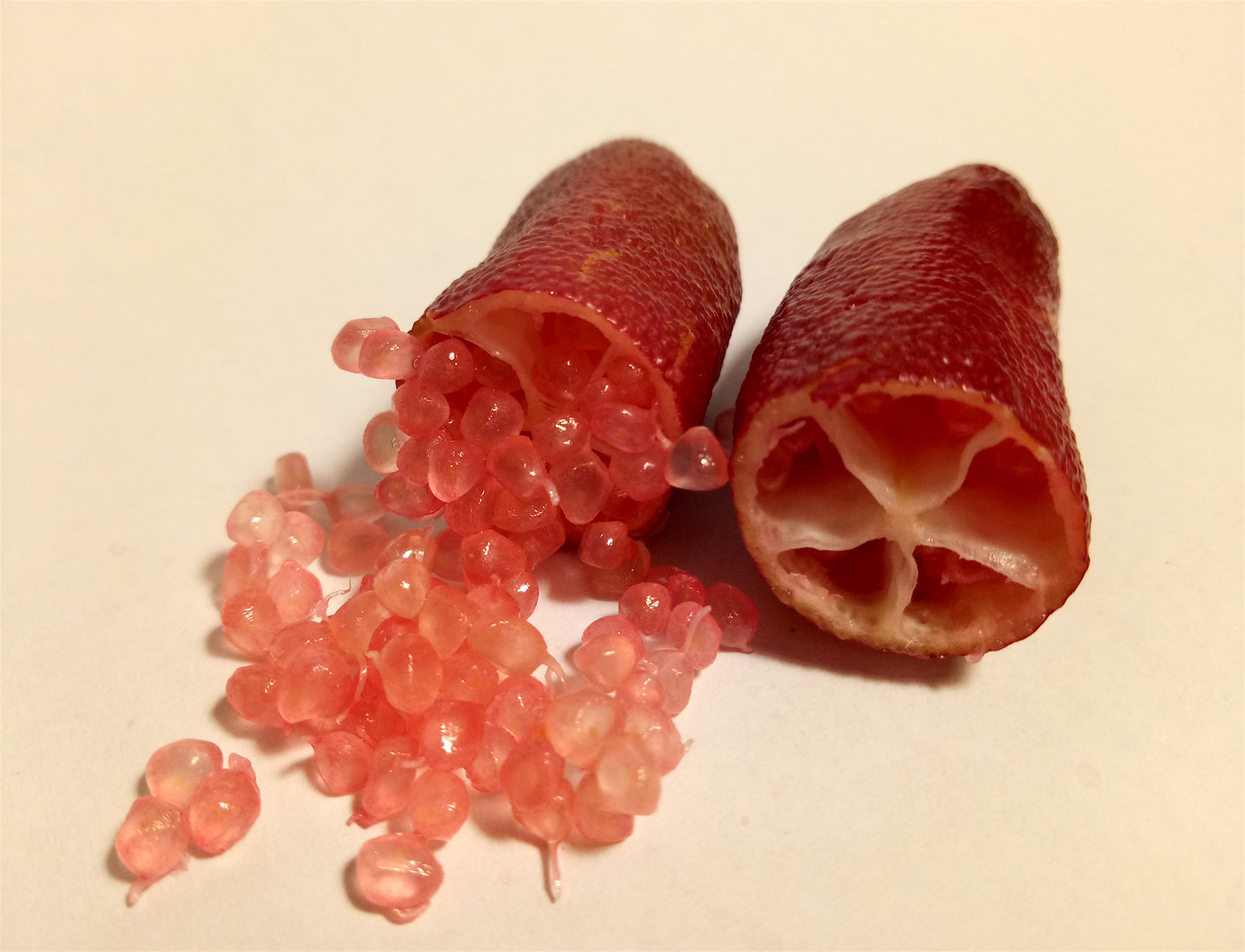
Finger lime looks like a kitchen gimmick until the first bead breaks. A spoon can scatter the pearls over an oyster, a scallop, a spoonful of crab, a raw snapper slice, or a chilled dessert, and the plate stays almost silent for a second. Then the diner bites. The acid does not arrive as a sauce. It arrives as little pops, each one bright enough to wake salt, fat, smoke, cream, or shellfish without flooding the whole dish.
That delay is the ingredient's luxury. Finger lime is not simply a fancy citrus. It is a way of storing acidity in a physical form that survives plating. The fruit's value comes from its rainforest origin, thorny-tree harvest, cultivar variation, careful ripeness call, and fragile postharvest life. If those parts are handled badly, the famous "caviar" effect collapses into bitter juice, damaged rind, or anonymous tart garnish.
The cover photograph shows the argument in one frame: a small opened fruit, pale pearls pressed out, the interior shaped less like familiar citrus segments than like a tiny chamber built to release beads.[6] A restaurant can make that look precious very easily. The harder, better job is to use the pearls only where their structure changes the bite.
A Rainforest Citrus, Not A Decoration
Finger lime's dining-room image is modern, but the fruit is not a recent invention. The University of Hawaii's extension publication identifies finger lime as Citrus australasica, formerly known as Microcitrus australasica, and places its native habitat in the subtropical rainforests of South-East Queensland down to the Richmond River area of north-east New South Wales.[2] It also notes that Bundjalung people called the fruit "gulalung," a useful reminder that fine dining did not discover the ingredient even if restaurants helped globalize its current glamour.[2]
Slow Food's Ark of Taste description gives the fruit's shape in plain culinary terms: small, elongated, roughly mini-cigar-like, indigenous to north-east New South Wales and south-east Queensland, and filled with small caviar-sized pearls of flesh.[3] That last detail is why chefs keep returning to it. Ordinary lime juice enters a dish all at once. Finger lime can be held back until chewing.
The tree helps explain why the fruit never feels fully industrial, even when grown commercially. CTAHR describes a compact or spreading crown with straight thorns, small narrow leaves, cylindrical fruit, rough leathery peel, and translucent flesh whose nearly free vesicles can range from light green to pinkish.[2] The same extension guide is more practical still: the trees are thorny enough that pickers should wear eye protection and gloves during harvest.[2] This is not a garnish that begins as a sterile luxury bead. It begins as a spiny understory citrus that has to be coaxed into a clean market fruit.
That origin matters because the best finger-lime dishes do not treat it as borrowed glitter. They keep some sense of the fruit's native tartness and physical constraint. On a plate, the ingredient wants something to interrupt: brine, dairy, oil, smoke, custard, avocado, raw fish, or a sweet fruit base that needs a sharper edge. If it is scattered on everything, it becomes confetti. If it is placed where the mouth needs timed acid, it becomes structure.
Ripeness Is The Real Service Prep
For fine dining, the most important sourcing detail is that finger limes need to be picked ripe. CTAHR says fruit are picked by size and color, do not ripen off the tree, and may be harvested every 10-14 days for 6-8 weeks or more depending on the flowering period.[2] The same guide gives the kitchen-relevant test: ripe fruit feel full and detach easily, while over-ripe fruit may drop from the tree.[2]
That is the whole dish, in agricultural language. If the fruit is not mature enough, the texture that made it expensive is not ready for service. If it is mishandled, the pearls can still look pretty while the eating quality goes flat. A chef can balance bitterness, but a bitter finger lime is usually not interesting bitterness; it is a harvest error arriving at the pass.
The handling rules are just as revealing. CTAHR says fruit should be handled carefully to avoid mechanical injury, kept out of direct sun, stored in shade, and not held below 42 F; it also gives a possible postharvest life of 4-5 weeks.[2] This makes finger lime a cold-chain ingredient, but not in the simple "keep it cold" sense. It needs the right kind of cold, the right kind of dryness, and enough gentleness that the vesicles and rind do not turn against each other.
That is why a fine-dining kitchen should think of finger lime less like a lime and more like a tiny service clock. Open too early and the pearls dry, weep, or lose their snap. Cut carelessly and peel oil can affect the vesicles' flavor, a risk CTAHR flags in its cutting instructions.[2] Add them into heat and the delayed burst disappears. The best use is late, cool, and deliberate.
Why The Pearls Change A Bite
Finger lime's flavor is not mysterious: citrus acid, a little floral edge depending on cultivar, sometimes a green bitterness if mishandled. The important thing is delivery. CTAHR describes the fruit's translucent flesh as nearly free spherical or ovoid vesicles.[2] Slow Food emphasizes that the fruit lacks the familiar internal citrus architecture and that the individual pearls can be scooped out.[3] The mouth experiences that anatomy as a sequence, not a pool.
That sequence is why the fruit works so naturally with seafood. A squeeze of lime over an oyster or scallop can be beautiful, but it also starts cooking, diluting, and flattening the surface as soon as it lands. Finger lime lets the plate stay visually clean and lets the diner provide the final pressure. The acid arrives inside the chew. On a raw oyster, the first taste may be brine and cold; then the pearls crack and the bite lifts. On crab, the pearls can puncture sweetness without turning the dressing sharp. On grilled fish, they can behave almost like an edible sparkle over fat and char.
The same logic works in dessert, but only when a pastry team resists the urge to make the fruit adorable. A few pearls over coconut, white chocolate, lemon curd, pavlova, panna cotta, or tropical fruit can keep sweetness from going soft. Too many pearls, and the dish becomes sour novelty. Finger lime is most persuasive when the diner notices the timing before noticing the price.
This is also where the "caviar" nickname can mislead. Caviar carries salt, fat, marine depth, and status. Finger lime carries acid, water, plant perfume, and pressure. The resemblance is physical, not culinary. Treat it like roe and the pairing can become silly. Treat it like delayed citrus and the ingredient starts to make sense.
Provenance Is Becoming The Expensive Part
The global interest around finger lime has moved faster than the systems that protect it. Jade King's 2025 Nuffield report frames Australian native finger lime as an emerging industry in need of provenance, research, and representation, and AgriFutures' profile of the same work notes a surprising production problem: the largest producer identified in King's research was not in Australia, but in Guatemala, while California, Italy, France, Spain, and Croatia were also developing commercial operations.[1][4]
That does not make non-Australian fruit illegitimate. It does make provenance harder. AgriFutures reports that King found confusion among some international producers, including cases where Frustrime hybrids were being treated as finger limes even though they do not deliver the signature caviar-like pearls of true finger limes.[4] For a restaurant, that is not a botanical footnote. It is the difference between the ingredient doing its job and the ingredient merely wearing the name.
The research world is trying to catch up. A 2025 open-access study in the Journal of Food Composition and Analysis argues that cultivar-level identification remains a persistent issue for finger lime supply chains and tests portable near-infrared spectroscopy with SIMCA models as a rapid, non-destructive authentication method.[5] Several cultivars in the study reached 90-100% classification accuracy, and the authors frame the method as a way to support traceability, provenance verification, and market integrity for Australian native foods.[5]
That may sound far from the pleasure of pearls over a scallop, but it belongs to the same story. A high-value native ingredient attracts loose naming, hybrid confusion, and uneven standards. Once chefs build menu language around cultivar color, pearl quality, and origin, the supply chain has to prove what it is selling. The luxury is no longer only in the fruit. It is in knowing the fruit is true to type.
AgriFutures says the Australian Native Fingerlime Alliance was established in early 2024 and now represents more than 34 growers and over 50,000 trees across eastern Australia.[4] That kind of industry organization matters because finger lime is not just another imported garnish. It sits at the intersection of Indigenous food heritage, Australian native-food commercialization, global chef demand, and cultivar science. A serious dining room should be honest about that complexity rather than hiding it under the cute phrase "lime caviar."
How A Kitchen Should Use It
The best finger-lime cooking is restrained because the ingredient is already theatrical. A chef does not need to turn it into a joke, a faux-roe illusion, or a whole course about popping beads. The fruit has three jobs: hold acid until the bite, show freshness without wetting the plate, and make a clean ingredient feel more alive.
That means it belongs on dishes where the diner can meet it intact. Scatter it over cold shellfish. Fold it into a last-second oyster garnish. Place it over cured fish with a mild oil, not a shouting vinaigrette. Let it brighten avocado, cucumber, crab, seaweed, or dairy. In sweets, use it as punctuation against cream, meringue, coconut, mango, or white chocolate. Avoid burying it in hot sauces, long emulsions, or mixtures where the pearls rupture before service.
The fruit also asks for humility in sourcing language. If a menu names finger lime, the kitchen should know whether it is buying Australian-grown fruit, locally grown Citrus australasica, a named cultivar, frozen pulp, or a hybrid being sold loosely. Not every dinner requires a lecture, but the buyer should know. The better the restaurant, the less excuse it has for treating a provenance problem as garnish.
Finger lime's charm is that it makes acid behave politely until the last possible second. The fruit waits on the plate, small and bright, holding itself together through harvest, packing, storage, prep, and service. Then the diner breaks it. That tiny delay is the reason the ingredient still earns its place in fine dining: not because it looks luxurious, but because it makes freshness happen in the mouth, exactly on time.
Sources
- Jade King, "The commercial production of Australian native finger lime (Citrus australasica) as an emerging industry in need of provenance, research and representation," Nuffield Australia, 2025 - report on provenance risk, international production, cultivar confusion, industry representation, and Australian native-food leadership.
- University of Hawaii at Manoa CTAHR, "Finger Limes" - extension publication on taxonomy, native range, Bundjalung name, tree morphology, fruit structure, cultivation, and hotel/restaurant demand.
- Slow Food Foundation, "Finger lime - Arca del Gusto" - Ark of Taste entry summarizing native geography, mini-cigar fruit shape, small size, and caviar-sized pearls.
- AgriFutures Australia, "Nuffield scholar leading the world in Australian native finger limes" - 2025 profile on Jade King's research, global production, varietal confusion, cultural recognition, and the Australian Native Fingerlime Alliance.
- Joseph Robert Nastasi et al., "Authentication of Finger lime (Citrus australasica) cultivars enhances provenance in Australian native food supply chains," Journal of Food Composition and Analysis, 2025 - open-access study on cultivar authentication, NIR/SIMCA classification, traceability, and provenance verification.
- Wikimedia Commons, "File:Finger lime - half and half.jpg" - real 2018 photograph by Ivar the Boneful used as the article image.