The chocolate coulant is easy to misunderstand because its descendants are everywhere. Once a dessert becomes a supermarket freezer product, a hotel banquet standby, and a casual "lava cake," the original problem can disappear under familiarity. Michel Bras's version was not simply a cake pulled early from the oven. It was a designed collision between two prepared states: a biscuit shell that sets around a separately frozen ganache core, then a service window narrow enough to make the center flow at the table.[2][5]
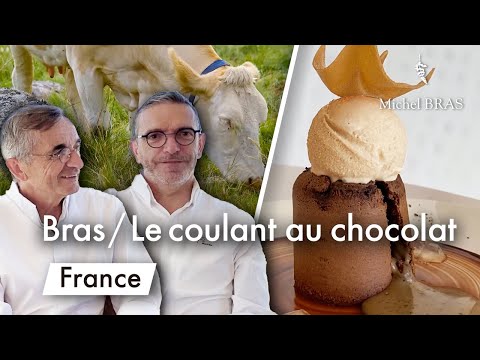
That is why the embedded video matters. Michel and Sébastien Bras treat the coulant less like a trick dessert than like a small architecture project: emotional memory first, then technical containment, then timing.[1][3] The Bras Côté Japon recipe page gives the useful practical baseline. The ganache core is prepared ahead and frozen; the molds are lined and dusted; batter is piped around the core; the assembled cakes are frozen again before being baked from frozen just before service.[2] The flow is therefore not an accident. It is staged.
Fine dining often makes difficulty visible through rare ingredients or intricate plating. Coulant does the opposite. Its difficulty is hidden until the spoon breaks the shell. The guest sees one modest cylinder, then a warm center moves across the plate. That reveal is the dish's contract: the kitchen promised a temperature contrast, protected it through mise en place, and delivered it at the exact moment when pleasure depends on seconds rather than decoration.[1][2][3]
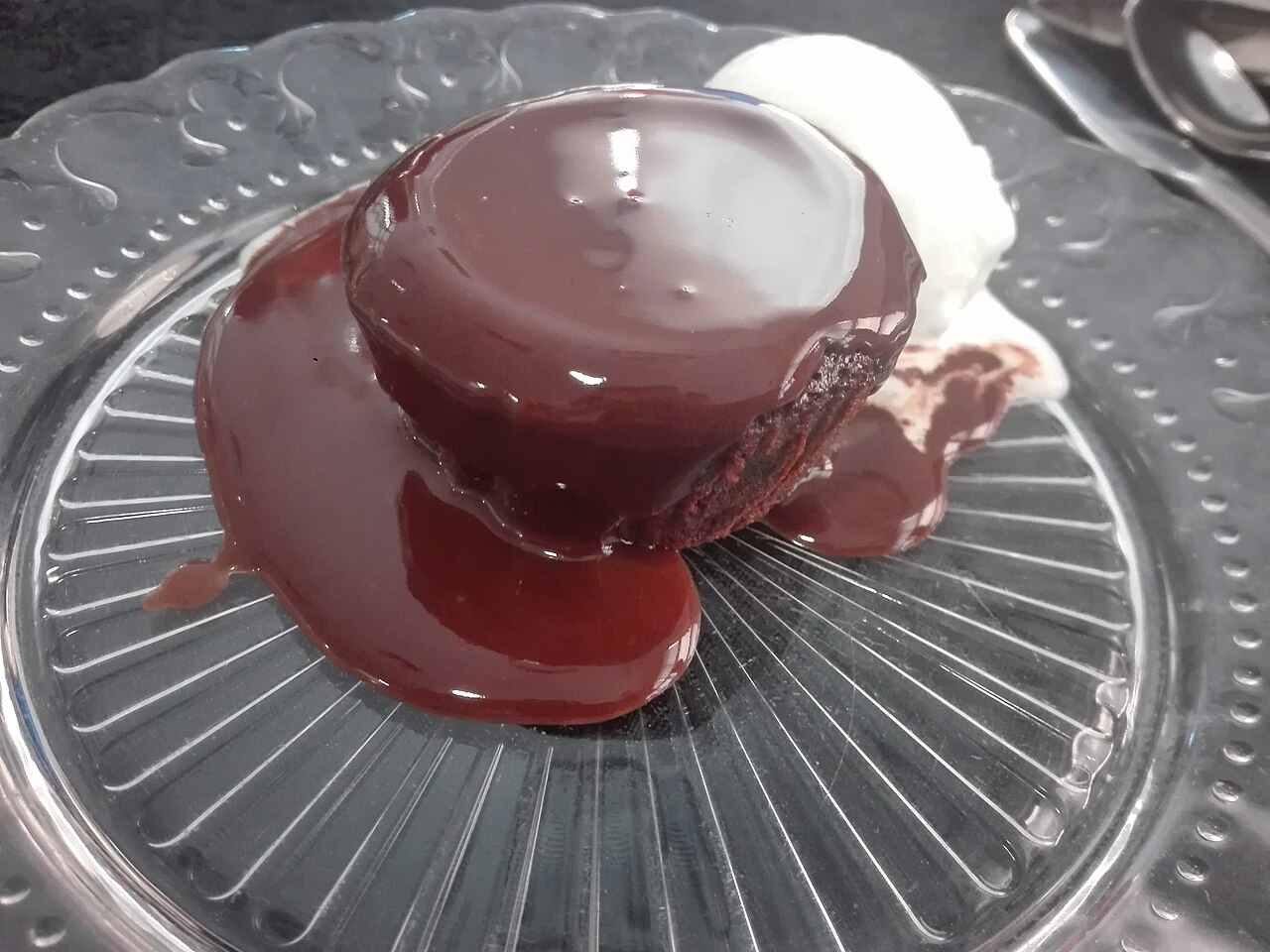
Image context: the cover uses a real photograph of a coulant after it has been opened, not a diagram or generated visual. It shows the service question directly: did the cake set enough to stand, and did the center stay fluid enough to move?[6]
The Center Is Built Before The Cake
The key thing to notice is that the coulant's center is not produced by undercooking the same batter. Bras's method separates the liquid future from the cake surrounding it. Pastry author Nick Malgieri's useful distinction is that Bras's version calls for a frozen chocolate truffle baked inside the cake, unlike molten cakes where the batter itself supplies the warm semiliquid flow.[5] Both can be delicious, but they solve different problems. Bras's version is about containment.
That containment changes how the dessert reads in a dining room. If the center is simply underbaked batter, the drama belongs mostly to oven timing. In Bras's version, the drama begins earlier: ganache composition, mold size, parchment lining, batter thickness, freezing, baking, unmolding, and transfer all have to cooperate.[2] The recipe page is explicit about the pressure points: the ganache core must sit in the middle, the bottom layer must be thick enough to avoid leaking, and the two freezing steps help secure the result.[2]
Watch the video with those steps in mind.[1] The emotion of the dish can sound simple: the comfort of hot chocolate after a cold day, concentrated into cake.[3] But simplicity is not the same as ease. So Good Magazine's interview frames the dessert as a collision of texture and temperature, refined through trial and error until the formula could carry that memory without collapsing into mess.[3] The dish works because the technical construction protects a childlike sensation rather than replacing it with pastry cleverness.
Flow Is A Service Standard
The most important word in coulant is not chocolate. It is flow. Paris chez Sharon's overview places the dish in the Bras repertoire as a 1981 invention that later moved into many renditions around the world.[4] Copying is not surprising. A flowing center is instantly legible on camera and at the table. But that legibility is also unforgiving. If the shell cracks too early, the plate looks failed. If the center stays solid, the promise dies. If the cake is over-sweet or the ganache is dull, the reveal becomes a visual stunt without a second bite.
That is the fine-dining lesson. A signature dessert is not only an idea; it is an operational repeat. The kitchen has to make the same surprise arrive over and over, under service pressure, without asking the guest to admire the prep list. Bras's own recipe turns the dessert into a timing machine: prepare the core a day ahead, freeze the assembled cakes for hours, bake from frozen, then serve immediately.[2] The pleasure at the table is brief because the hidden calendar was long.
The video is strongest when it lets that paradox sit in the open.[1] Coulant feels spontaneous only because it has been made less spontaneous behind the scenes. Fine dining depends on that kind of misdirection all the time. Bread seems to arrive naturally warm. Sauce seems to gloss a plate at the last second. A dessert seems to release its center because the spoon asked nicely. In reality, each moment is a controlled handoff between prep, heat, and service.
Why The Copies Often Feel Smaller
The coulant's popularity created a second problem: when the format spread, the visible effect often separated from the original discipline. A diner can recognize molten chocolate instantly, but recognition is not enough. The Bras version asks the cake to express contrast: warm and cold memory, crust and liquid, restraint and release.[2][3] A poor copy gives only goo.
Malgieri's comparison with later molten cakes helps explain why the category became confusing.[5] Many versions are built for speed, convenience, or banquet reliability. That is not automatically a flaw; restaurants need formats that survive service. But Bras's original is more specific. The frozen ganache core gives the center its own identity. It is not merely the part of the cake that failed to bake. It is a prepared interior with its own texture, fat, cream, chocolate, and melting behavior.[2][5]
That distinction matters because the coulant is a dish about trust. The guest cannot inspect the hidden core before ordering. The server cannot prove the dessert worked until it is broken. The kitchen has to trust the freezing, the bake, the unmolding, and the carry to the table. When the spoon opens the shell, the plate gives an immediate verdict on the entire chain.[1][2]
What To Watch For
First, watch how the Bras family narrates invention through feeling rather than through novelty.[1][3] The origin story is not "we wanted a viral dessert." It is closer to "we wanted to recover a sensation." That keeps the technical language grounded. The ganache core, the biscuit shell, and the freezing sequence serve memory.
Second, notice the way the dessert resists heavy decoration.[1][2] A coulant can be plated with ice cream, caramel, nuts, fruit, or sugar, and the recipe page allows variations.[2] But the essential object needs visual quiet. If the plate is too busy, the flow stops being the event. The shell must remain readable; the center must be visible; the guest must understand the contrast without a lecture.
Finally, notice that the coulant's lesson is not nostalgia for one famous chef. It is a model for how fine dining can make engineering feel generous. Bras turned a precise frozen core and a narrow service clock into something that still reads as warmth. The best version of the dessert does not ask the guest to think about the freezer. It lets the guest feel the freezer's discipline as flowing chocolate.
Sources
- Michel BRAS Côté Japon, "A Dessert's Revolution: Chocolate Coulant told by Michel & Sébastien" - YouTube video source for the embedded discussion of the coulant.
- Michel BRAS Côté Japon, "[Michel Bras Recipe] Christmas special - MOLTEN CHOCOLATE CAKE (Le biscuit de chocolat coulant)" - official recipe note covering the ganache core, mold preparation, freezing steps, baking, and service.
- Jaume Cot, "Coulant by Michel Bras: 'No one will ever be able to take away from me the emotion after the first successful cooking tests'." So Good Magazine, February 2, 2021 - interview and historical context on the dessert's emotional origin, trial-and-error refinement, and later variations.
- Paris chez Sharon, "Molten Chocolate Cake - Coulant au Chocolat" - overview of the coulant as a Michel Bras dessert from 1981 and its later worldwide renditions.
- Nick Malgieri, "Molten Center Chocolate Cake" - pastry note distinguishing Bras's frozen-chocolate-core method from versions where the cake batter itself supplies the molten center.
- Wikimedia Commons, "File:Coulant de chocolate.jpg" - real photographic image of a cut chocolate coulant, used as this article's static image.