Fleur de sel is easy to mistake for a luxury version of something ordinary. It is salt, after all. Every kitchen already has salt. Every chef already knows that salinity wakes up fat, fruit, bitterness, chocolate, meat, fish, and vegetables. So the interesting question is not why a dining room would use a better salt. The interesting question is why this salt, with its little flakes and damp crunch, can make a finished dish feel more precise than a heavier hand with cheaper crystals.
The answer begins in the marsh, not in the silver salt cellar. The European Union's PGI document for "Sel de Guerande/Fleur de sel de Guerande" defines both salts as hand-harvested sea salts from the Guerande peninsula, unrefined, unwashed, additive-free, and produced by moving seawater through pools until it reaches crystallization in the final salt pan.[1] Grey salt forms against the clay base. Fleur de sel forms differently: under favorable wind and sun, light brittle crystals appear on the surface of the brine and have to be skimmed before they sink.[1]
That surface fact is everything. Fleur de sel is not mined, boiled, purified, and standardized into obedience. It is caught. The salt worker is dealing with a moment: enough evaporation for crystals to gather, enough wind to help them form, enough gentleness to lift them, enough timing to prevent the white crystals from dropping into the pan and becoming something else. Fine dining likes ingredients that arrive with a story, but this one arrives with an operating rule. If the surface goes, the luxury goes with it.
The Marsh Sets The Texture
The Guerande system is a landscape machine built to slow seawater down. The PGI document describes a chain of pools, clay soils, tide position, wind, sun, water levels, and non-mechanized harvesting as the basis for the salt's identity.[1] That matters because fleur de sel is often sold as a romantic sprinkle, when its real romance is infrastructural. A pinch on a tomato or scallop is the final visible point in a long sequence of water control.
The cooperative Le Guerandais frames the work in similarly physical terms. It says fleur de sel is picked from the surface by salt workers with a traditional tool called a lousse; the crystals are light, fine, and crumbly, and dry sunny weather with an easterly wind must cooperate for the "white gold" to form.[2] Producer language can sound polished, but here the details are useful because they name the fragility. This is not a commodity that simply waits in a pile for industrial extraction. It appears in weather.
Taste France's product guide adds the serviceable kitchen detail: harvesting happens from warmer weather into late fall, weather permitting, and is done in late afternoon before evening dew, gently enough that the skimmer does not break the crystals or touch the clay below.[3] That late-afternoon image is the key to understanding the salt at the table. Fleur de sel begins as a finishing act even before it reaches a restaurant. It is finished in the marsh by being lifted at the right instant.
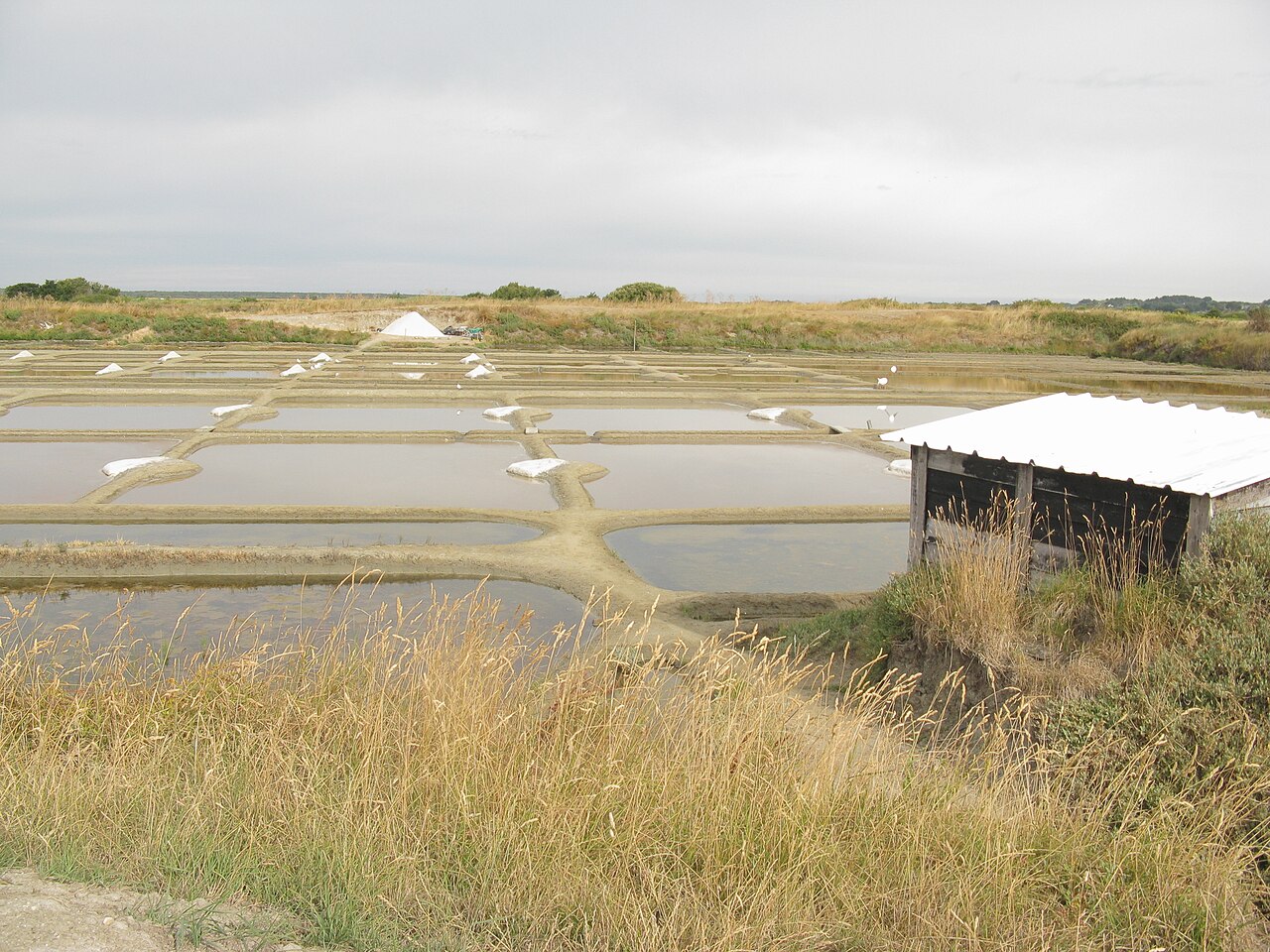
The image used with this article shows the Guerande salt marshes in July 2009: rectangular basins, clay partitions, water, paths, and a working geometry that looks calmer than the labor it contains.[5] It is a better photograph for this ingredient than a glamorous close-up of crystals. The marsh explains why the salt is not just a seasoning. It is a small edible result of a managed coastal environment.
Why It Does Not Behave Like Table Salt
In a dining room, fleur de sel's value is not that it is "saltier." The better word is spatial. Its crystals sit on the surface of food long enough for the diner to feel them, then dissolve in little pulses. The PGI description notes the salt's brittle texture, natural white color, unwashed and unrefined character, mineral richness, trace elements, and relatively high moisture content.[1] Those traits explain why it can finish a bite without disappearing into the food too early.
This is why the common instruction to use it at the end is more than snobbery. Taste France says fleur de sel de Guerande adds depth to dishes when added at the last minute before serving, lifting flavors and adding crunch.[3] Le Guerandais makes the same practical distinction, recommending it after cooking or just before serving and emphasizing a few crystals pinched between thumb and forefinger.[2] The point is not to season a stockpot. The point is to create contact at the surface of the finished bite.
David Lebovitz's long-running kitchen note is useful because it catches the ingredient from the cook's side rather than the protected-designation side. He describes Guérande salt as hand-harvested from Atlantic water guided through shallow marshes, and he treats fleur de sel as something used sparingly because its texture and delicate flavor are part of the pleasure.[4] That is where fine dining and home cooking briefly agree. A little is the correct unit. The salt works by punctuation, not volume.
The mistake is to use fleur de sel where it cannot be noticed. Stir it into pasta water, and the crystals lose their reason to exist. Dissolve it into a long braise, and the marsh's fragile surface has been bought only to vanish before service. There are cheaper and better salts for that work. Fleur de sel belongs where the diner can meet it: the ridge of a radish with butter, a slice of rare beef, a raw scallop, a caramel, a chocolate tart, a tomato still warm from sun, or the glossy skin of a grilled fish just before the fork breaks it.
The Fine-Dining Trick Is Restraint
Fleur de sel can make a plate feel expensive in the wrong way if a chef treats it as proof of seriousness. Too much becomes crunchy swagger. Too early becomes ordinary salinity. Too many competing garnishes make the salt decorative rather than functional. The best use is almost quiet: a few crystals placed where fat, sweetness, water, or bitterness needs a small edge.
On butter, it turns cream into architecture. The cold fat carries the grain, then the salt breaks it open. On raw fish, it can replace a heavier sauce if the fish already has sweetness and oil. On grilled meat, it gives the browned exterior a second register without dragging the bite toward a wet condiment. On chocolate or caramel, it keeps sweetness from becoming flat by making the tongue alternate between sugar, bitterness, dairy, and a clean mineral flash.
That restraint is why fleur de sel belongs in fine dining even when the plate is simple. A luxury dining room does not always need more technique. Sometimes it needs a better last move. The salt's whole history teaches that lesson: surface, timing, lightness, lift. A kitchen that understands those words will not bury it. It will use the salt where a tiny crunch can make the main ingredient more vivid.
What The Price Actually Buys
The price of fleur de sel is not only the price of rarity. It is the price of a production system that resists total control. The PGI document ties the product to a defined area, traditional expertise, non-mechanized harvesting, storage knowledge, and traceability.[1] Le Guerandais says its cooperative supports 220 salt workers and a traditional production method.[2] Taste France emphasizes weather windows, late-afternoon harvest, and the need to keep the crystals from breaking or falling.[3]
Read together, those details make the ingredient less mysterious and more demanding. The diner is paying for the fact that the salt has not been forced into perfect industrial sameness. It is white because it did not touch the clay base. It is moist because it was not dried into a dead powder. It is flaky because it formed as a surface skin. It is expensive because a human had to arrive at the right moment with the right tool and the weather had to allow the moment in the first place.
That does not mean every restaurant should sprinkle it everywhere. The better test is whether the salt's behavior changes the bite. If a dish already has a salty sauce, cured component, cheese, roe, broth, or reduction, adding fleur de sel may only confuse the line. If the dish has a clean surface that needs sparkle, it can be exact. The luxury is not the label on the tin. The luxury is using a fragile ingredient only where fragility still matters.
This is the small pleasure of a good fleur de sel finish: it arrives late, speaks clearly, and leaves quickly. It does not make salt grand. It makes salt attentive. A few crystals remind the diner that the final millimeter of a dish can carry as much craft as the hours behind it.
Sources
- European Union, "Single Document: Sel de Guerande/Fleur de sel de Guerande" - PGI application document covering origin, production area, hand harvesting, surface crystallization, texture, moisture, and traditional expertise.
- Le Guerandais, "Fleur de Sel" - cooperative product page describing lousse harvesting, weather dependence, after-cooking use, crystal texture, and the cooperative's salt-worker base.
- Taste France Magazine, "Fleur de sel de Guerande sea salt PGI" - product guide on crystallization, late-afternoon harvest, gentle skimming, last-minute use, crunch, and pairing logic.
- David Lebovitz, "Fleur de sel" - culinary field note on Guerande marsh harvesting, texture, delicacy, and sparing use in the kitchen.
- Wikimedia Commons, "File:Guerande Salt marshes.JPG" - 2009 real photograph of salt-production basins in the Guerande salt marshes used as the article image.