
Meza Malonga is easy to file under the flattering but lazy phrase "African fine dining." The phrase is not wrong, but it skips the restaurant's most interesting move. Dieuveil Malonga is not trying to make one national cuisine behave like a luxury tasting menu. He is trying to build a working system in Kigali where a pan-African larder, young cooks, farmers, travel, and service language all become part of the same meal.[2][3][4]
That is why the 50 Best video below is useful. It catches Malonga at the scale where the project actually lives: not only the plate, and not only the biography, but the handoff between memory and institution.[1] The public facts already make the story unusually broad. 50 Best describes him as a Congolese chef who lived in Germany, competed on Top Chef in France, created the Chefs in Africa platform, and opened Meza Malonga in Rwanda as a restaurant-cum-cooking school.[2] Madrid Fusion's profile adds the European training line: Schote, Life, Aqua, Marseille, and then the return toward Afro-fusion from Kigali.[5]
The sharper question is how those experiences become dinner. Meza Malonga's dining room is not just a place where rare ingredients are displayed. NPR's 2024 visit describes a laboratory-like wall of seeds, spices, and fermented fruits, a no-fixed-menu dinner shaped by seasonal availability, and a staff culture where course explanation and creation are part of the guest experience.[4] 50 Best Discovery's profile gives the restaurant's more outward-facing frame: a Remera address, hillside views, dinner from Wednesday through Saturday, a tasting menu from $80, and a 10-course structure that moves through ingredients such as Nigerian uziza leaves, Cameroonian mbongo pepper, Mombasa shrimp, and Tanzanian baobab.[3]
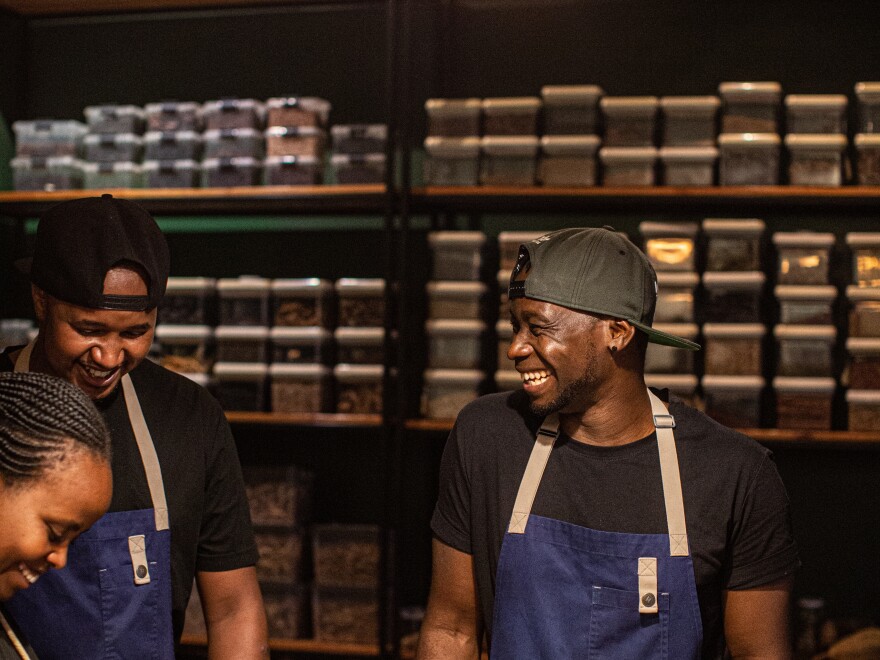
The video is best watched with that operating system in mind. It is short, but it shows why Malonga's restaurant cannot be judged only by whether an individual dish looks refined. The refinement matters, of course. Fine dining needs polish, pacing, temperature, and precision. But here the deeper test is whether polish can carry knowledge gathered from many places without flattening those places into a decorative theme.
The Pantry Is Not A Mood Board
The first thing to watch for is Malonga's refusal to treat ingredients as trophies.[1] In weaker global tasting menus, far-flung products can become passport stamps: one spice from here, one leaf from there, one story line per course. Meza Malonga has to solve a harder problem because the map is so large. 50 Best Discovery describes the cooking as cross-border, blending Maasai, Bantu, and Zulu influences while using a lesser-known larder to narrate pan-African cuisine.[3] NPR's reporting makes the same point at room scale: the wall of jars is not decorative shelving, but a live archive for experiment and service.[4]
That distinction matters. A pantry used as display says, "look how much we found." A pantry used as method says, "watch how one ingredient changes the next decision." When Malonga brings Cameroonian peppercorns into dessert, or when a course uses Nigerian spice in a beef preparation, the interesting question is not novelty. It is grammar.[3][4] Does the ingredient change sweetness, smoke, heat, acidity, or finish? Does it help the diner understand a place through appetite rather than through explanation alone?
Training Changes The Meaning Of Luxury
The second thing to notice is that Malonga keeps linking the restaurant to training.[1][2] That shifts the whole fine-dining value proposition. In many expensive rooms, the guest buys proximity to a finished chef identity. At Meza Malonga, the more persuasive claim is that dinner supports a transmission machine. 50 Best reports that Chefs in Africa connected thousands of food-industry workers and that Meza Malonga was built as both a restaurant and a teaching model, with cooks progressing through farming, cold kitchen, sauces, fish, meat, and eventually the ability to explain and teach others.[2]
That makes the service feel less like a one-way performance. NPR describes staff members presenting courses and working in a dining-room laboratory where the menu changes with seasonal availability and with what the team has recently found compelling.[4] The restaurant is still authored by Malonga, but the authorship is deliberately shared. That is a serious hospitality choice. It asks the guest to value the team's ability to learn, explain, and carry the idea forward, not only the chef's ability to compose an impressive plate.
In fine-dining terms, that is quietly radical. Luxury usually hides apprenticeship. The plate arrives clean; the hierarchy stays backstage. Meza Malonga brings the learning process closer to the surface. The guest sees a room in formation, not a museum of settled signatures.
Travel Is The Research Budget
The third annotation is the travel logic. Both 50 Best and NPR describe Malonga's habit of crossing the continent to learn from farmers, home cooks, and local food cultures, though the exact country count differs by profile and moment.[2][4] The exact number is less important than the pattern. The restaurant closes part of the year so the team can travel, taste, source, and return with new material.[4] That turns travel from chef branding into research infrastructure.
This is where Meza Malonga avoids a common trap in "heritage" dining. Heritage can become fixed very quickly: a chef chooses a few emblematic foods, polishes them, repeats them, and eventually the restaurant becomes a tasteful archive of itself. Malonga's model is more restless. If the team keeps moving, the menu has to keep admitting new evidence. Cassava, plantain, baobab, beans, mushrooms, pepper, fermented fruit, and regional spice do not sit still as symbols. They keep re-entering the lab as problems of taste, texture, season, and sourcing.[2][3][4]
What The Video Leaves You With
The strongest reading of Meza Malonga is not that it proves African cuisine can be fine dining. That framing is too defensive. The better argument is that the restaurant changes what fine dining has to account for. A global luxury menu cannot keep pretending that value comes only from imported prestige products, European technique, and inherited guide geography. Meza Malonga asks whether a restaurant can turn neglected ingredient knowledge, young cook development, local farming, and continental travel into the actual structure of dinner.[2][4][5]
The video works because it makes that ambition feel practical rather than abstract.[1] Malonga is talking about opportunity, training, ingredients, and communication, but the restaurant gives those ideas a service format: a Kigali room, a pantry wall, a changing menu, cooks who explain, and courses that try to make the continent legible through taste. That is why the project feels more durable than a chef profile alone. The menu may change, and it should. The deeper design is the loop: travel out, learn, bring back, train, cook, explain, repeat.
Sources
- 50 Best, "50 Best Champion of Change: Dieuveil Malonga" - YouTube video source for the embedded profile.
- Giulia Sgarbi, "How Champion of Change Dieuveil Malonga is empowering the new generation of African gastronomic talent," 50 Best, May 4, 2022 - profile covering Chefs in Africa, Meza Malonga's restaurant-school model, travel, training, Musanze plans, and the video context.
- 50 Best Discovery, "Meza Malonga - Kigali" - restaurant profile covering the Remera location, pan-African larder, 10-course menu, representative ingredients, price, and service days.
- Matt Ozug, Juana Summers, and Tinbete Ermyas, "This chef in Rwanda wants to create a revolution in African cuisine," Ideastream Public Media / NPR, June 3, 2024 - reporting on Meza Malonga's laboratory room, changing menu, staff culture, travel cycle, fine-dining ambition, and Jacques Nkinzingabo's photograph used here.
- Madrid Fusion, "Dieuveil Malonga" - speaker profile covering Malonga's Congo background, German training, work at Schote, Life, and Aqua, Top Chef appearance, Basque Culinary World Prize finalist status, Meza Malonga Lab, and Chefs in Africa.