Metiz is easiest to misunderstand when it is filed under the generic label "modern Filipino." That phrase sounds accurate, but it is too flat for what Stephan Duhesme's Makati restaurant is trying to do after its 2025 reset. The sharper reading is that Metiz wants a tasting menu to behave less like a procession and more like a Filipino table: rice, broth, seafood, vegetables, sourness, salt, smoke, condiments, and memory returning in different forms instead of marching past once.[3][4]
That is why the restaurant's refreshed format matters. Philippine Primer describes the reopened Metiz as a five-movement journey inspired by the way Filipinos naturally eat, with accompaniments and multiple dishes encouraging return rather than one-way progression.[3] Tatler's chef profile gives the broader intent: a mestizo-inspired restaurant where Duhesme uses fermentation and familiar produce to push neo-Filipino cuisine forward.[4] Read together, those public signals suggest a restaurant trying to solve a specific fine-dining problem: how do you keep the energy of shared eating when the format still asks guests to sit through a controlled menu?
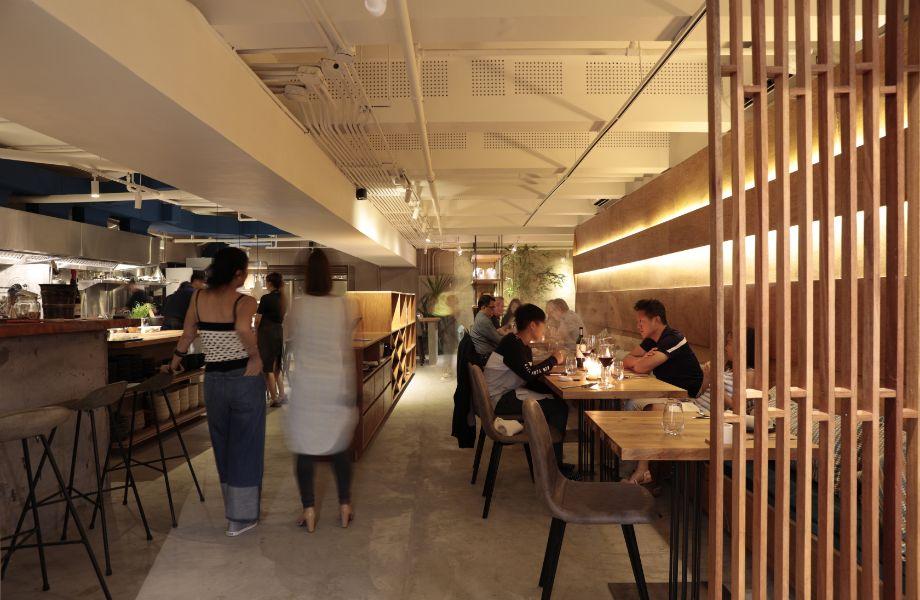
The cover photograph from 50 Best Discovery catches the answer at room scale. Metiz is narrow, warm, and close to the kitchen; diners sit beside an open counter rather than far from the cooks.[1] The image is not glamorous in the banquet-room sense. It is better than that. It shows a room where food can arrive with explanation, heat, smoke, and eye contact still attached. For this restaurant, proximity is not atmosphere alone. It is part of the menu's grammar.
The old course count was not the point
50 Best Discovery's profile describes Metiz through an eight-course tasting menu built around lesser-known Philippine ingredients, fermentation, and Duhesme's half-French, half-Filipino background.[1] That older public frame is still useful because it shows the restaurant's original ambition: make Philippine gastronomy carry the technical attention often reserved for French or Japanese luxury, without letting technique become the author.
The new five-movement language changes the emphasis. A movement is not just a shorter course count. It is a different way of grouping appetite. In a classic tasting menu, dishes often arrive as clean, independent sentences: snack, seafood, meat, cheese, dessert. In a Filipino meal, coherence often comes from simultaneity and return. A spoon of rice changes the sauce. A sour element wakes up fat. Broth resets heat. A vegetable dish is not necessarily a side; it can be the thing that lets everything else make sense.
That is the useful way to imagine Metiz 2.0. The restaurant is not abandoning refinement. It is trying to let refinement serve a table logic that already exists. Primer reports that the current menu is vegetable- and seafood-forward, punctuated by thoughtful touches of meat, with local ingredients handled through global technique.[3] That mix matters because it avoids two weak outcomes at once. It is not a folkloric meal dressed up with tweezers, and it is not a global tasting menu with Filipino references sprinkled on top.
Fermentation gives the meal its memory
The most important tool in the Metiz vocabulary is fermentation because it lets the menu carry time without turning nostalgic. 50 Best Discovery points to aged tanigue with fermented rice and mushrooms, while Tatler's chef profile treats fermentation as central to Duhesme's attempt to redefine familiar Filipino produce.[1][4] The details are vivid, but the deeper point is structural: fermentation gives the restaurant a way to make familiar ingredients behave with delayed force.
That force is different from luxury richness. A fermented rice note can make fish taste more marine and more grounded at once. A sour fruit or vinegar can pull a heavy sauce back into brightness. A preserved vegetable can let a plate hold both freshness and age. At Metiz, fermentation reads less like a fashionable pantry move than like a way to keep Filipino flavors from becoming static. It lets the kitchen ask what happens before and after the obvious taste: what the ingredient was, what time did to it, and how that changed the next bite.
Duhesme's own public framing supports that reading. In Philippine Primer's interview, he rejects the idea that Metiz is simply making fusion food, stressing instead that the cooking is Filipino, rooted in emotional memory and familiar flavors used in unfamiliar combinations.[3] Tatler's chef profile makes a similar claim from another angle, presenting Metiz as a restaurant inspired by mixed Filipino identity but committed to taking diners through the country's ingredients, history, and familiar produce in unexpected ways.[4] The best version of that argument is not about national labeling. It is about control. Imported technique can sharpen the dish, but it should not steal the dish's center of gravity.
Seafood, vegetables, and meat as punctuation
Primer's description of the refreshed menu is especially revealing because it says Metiz is now vegetable- and seafood-forward, with meat used as accent rather than as the meal's gravitational center.[3] That is a strong choice for a restaurant trying to make Filipino food feel both recognizable and newly precise. It keeps the palate moving through salinity, bitterness, smoke, fruit, broth, and grain instead of letting a prestige protein define the whole night.
The reported tuna course shows how this works. Primer names a new creation built around tuna with mechado, smoked mushroom, fermented tamarillo, pineapple ketchup, and oyster "Bernice."[3] On paper, that sounds crowded. In practice, the logic is legible if you read it as table memory rather than as a single plated object. Tuna gives flesh and clarity. Mechado brings a braised, tomato-rich memory. Mushroom supplies smoke and depth. Tamarillo and pineapple push acidity in different directions. Oyster adds marine bass. The dish appears to be built less around one center than around a set of returning signals.
Primer's account of the refreshed menu and 50 Best Discovery's profile point to the same appetite for layered recognition: tuna with mechado, smoked mushroom, fermented tamarillo, pineapple ketchup, and oyster; aged tanigue with fermented rice and mushrooms; banana leaf cake with rice and white beans.[1][3] The important thing is not that these dishes sound unusual. It is that they sound like a kitchen determined to make sweetness, sourness, fish, broth, grain, and vegetable detail interact rather than sit in separate menu zones.
The room makes the format readable
Metiz's dining room is not a neutral container. 50 Best Discovery describes service within narrow walls, with each seat offering a front-row view of the kitchen brigade's operation.[1] That room logic matters because the food asks for trust: unfamiliar combinations become easier to follow when the guest can feel the kitchen's rhythm instead of receiving each plate from a distant, invisible machine.
That layout explains the restaurant's hospitality problem. The menu wants to be exploratory, but the room cannot become a lecture hall. A counter-adjacent seat lets Duhesme's team narrate fermentation, sourcing, and technique as the dishes land. A table seat lets the meal behave more socially, closer to the shared logic the format is trying to preserve. Both readings belong to the same restaurant.
This is where Metiz feels more mature than a simple concept pitch. If the food depends on unfamiliar combinations, the room has to manage trust. Diners need enough explanation to understand why a flavor is behaving strangely, but not so much that dinner turns into a seminar. The open kitchen, narrow room, and counter rhythm give the team a practical way to calibrate that balance. The menu can surprise because the room stays close enough to guide the surprise.
Why this second version matters
Metiz already had international attention before the renovation: 50 Best Discovery records its No.48 placement on Asia's 50 Best Restaurants 2023, GMA's contemporaneous report notes the same ranking, and Michelin now lists the Makati restaurant in its guide.[1][2][5] Awards are never the meal, but here they clarify the stakes. Metiz is no longer a promising young room asking for patience. It is a visible Manila restaurant trying to refine its argument in public.
The more interesting achievement is that the new format does not seem to chase monumentality. It chases loop, echo, and return. That is a more Filipino answer to fine dining than simply extending the menu or making every course more luxurious. A table can be serious without being stiff. A tasting menu can be authored without denying the pleasure of revisiting sauce, rice, broth, sourness, and crunch in a different order.
Metiz 2.0 works, at least as a public proposition, because it understands that modern Filipino fine dining does not need to prove Filipino food is worthy by making it behave like someone else's luxury script. It can make the script bend. The five movements matter because they let the meal circle back to its own logic: fermentation as memory, seafood and vegetables as motion, meat as punctuation, and a narrow Makati room where the guest can still feel the kitchen thinking nearby.[1][3][4]
Sources
- 50 Best Discovery, "Metiz - Makati" - restaurant profile covering the name's mestizo logic, 2019 opening, eight-course tasting-menu frame, fermentation, room setup, schedule, location, and the interior photograph used as the article image.
- MICHELIN Guide, "Metiz - Makati" - current guide listing describing Stephan Duhesme's energetic restaurant, local ingredients, Filipino recipes, and international technique.
- Philippine Primer, "Metiz in Makati: Reimagining Filipino Food" (September 15, 2025) - reopening report and chef interview covering Duhesme's background, Filipino-food framing, five-movement format, vegetable- and seafood-forward menu, tuna course, hours, and location.
- Tatler Asia, "Stephan Duhesme" - chef profile describing Metiz's mestizo inspiration, fermentation, familiar produce, Philippine history, and neo-Filipino direction.
- GMA Integrated News, "Philippines' Toyo Eatery, Metiz are among Asia's 50 Best Restaurants this year," March 29, 2023 - report on Metiz's No.48 Asia's 50 Best Restaurants ranking, Makati location, 2019 opening, and mestizo name origin.