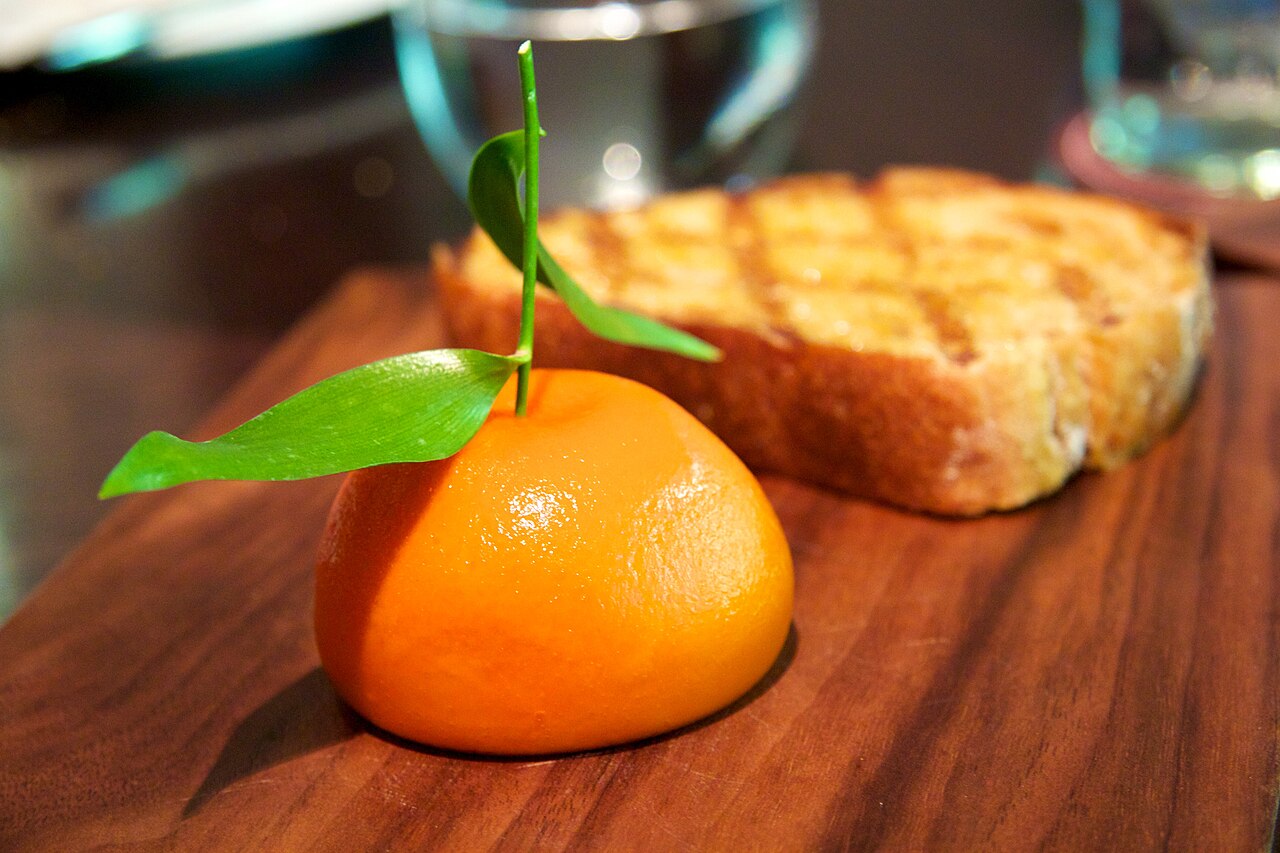
Meat Fruit is funny for about three seconds. Then the knife goes in, the mandarin stops being a mandarin, and the dish has to survive as food. That is the useful test. Plenty of fine-dining tricks work as photographs; fewer keep working after the guest understands the trick. At Dinner by Heston Blumenthal in London, Meat Fruit lasts because the joke has been engineered into texture, temperature, service rhythm, and historical translation rather than left as a cute reveal.[1][2][3]
The object arrives with almost absurd confidence: a glossy orange fruit, complete with leaf and stem, parked beside grilled bread. The cover image used for this article, a 2011 Commons photograph, catches the important part: the dish does not look like an abstract sculpture or a molecular-gastronomy diagram. It looks like a ripe little thing placed on a board, warm light on the skin, toast waiting behind it.[6] That familiarity is the trap. A guest knows how a mandarin should feel, smell, peel, and eat. Meat Fruit wins by inviting all of those expectations to the table, then breaking them gently.
The joke has a historical job
Dinner by Heston was built around historic British gastronomy, not around nostalgia as wallpaper. The restaurant's own account traces the idea through Blumenthal's late-1990s fascination with old cookbooks, royal kitchens, museums, the British Library, and Hampton Court Palace, then into a modern dining room inside Mandarin Oriental Hyde Park.[1] The point is not to reproduce the past in costume. It is to treat old dishes as prompts that can be solved with present-day technique.
That matters because the current public menu does not present Meat Fruit as a random signature snack. It dates the dish to around 1500 and describes it plainly as mandarin, chicken liver parfait, and grilled bread; in one menu format, the restaurant links the inspiration to the 13th to 15th centuries.[2] Eater's dish anatomy connects the lineage to "Pome Dorres," a medieval "apples of gold" idea that Blumenthal and Ashley Palmer-Watts reworked into a contemporary restaurant object.[3] The citrus disguise is therefore doing double duty. It is a playful first impression, but it is also the visible proof of Dinner's whole premise: historical research can be delicious when it becomes a practical plate, not a lecture.
The risk with that premise is museum food. If the dish merely announced "this is old," it would become homework before the bread was touched. Meat Fruit avoids that by making history tactile. You do not need to know the manuscript trail to understand the first move. The fruit shape gives you curiosity, the parfait gives you richness, and the toast tells you what to do with your hands.
The center has to be softer than the gag
The technical heart is the filling. Eater reports that Dinner's version moves away from the medieval minced-pork model and uses a chicken liver and foie gras parfait, with a mandarin jelly forming the orange shell.[3] That decision is crucial. A dense forcemeat sphere could have made the dish clever and clumsy. Parfait lets the illusion collapse into something spreadable, cold, and almost over-smooth, which is exactly what the eye does not expect from a fruit.
This is also where the dish becomes more than a one-bite pun. Chicken liver has mineral depth; foie gras rounds and softens it; reduced alcohol, citrus, and toast keep the fat from turning dull.[3] The guest cuts through a citrus-colored skin and finds something closer to silk than pulp. The surprise is not just "it is meat." The surprise is that the visual lie produces an eating truth: liver parfait already wants acidity and bread. The mandarin disguise makes that pairing look new without inventing a random flavor logic.
The construction explains why the dish holds its shape emotionally as well as physically. According to Eater's account, the team molds and freezes the parfait, joins the hemispheres into spheres, dips them in mandarin jelly, and uses a second coating to build the citrus-skin effect.[3] This is cold-larder labor masquerading as effortlessness. On the plate, the surface reads as cheerful and simple. Behind it is repetition, batch control, gel strength, thaw timing, and a kitchen that has to make every sphere look casually alive.
That hidden labor is why Meat Fruit feels different from a dish that simply uses a trompe-l'oeil mold. The mandarin is not a shell placed around an unrelated filling. The engineering lets the dish behave like a restaurant starter: prepared in advance, stable enough for service, soft enough to spread, and precise enough to reproduce across a busy dining room.
The bread is not a prop
The grilled bread can look secondary in photographs, but it is the part that stops Meat Fruit from floating away into novelty. The restaurant's current menu keeps naming it alongside the mandarin and parfait, not as garnish but as part of the dish's formal identity.[2] Eater's account notes that Dinner treats the bread as its own component, using a grilled sourdough structure rather than plain toast.[3]
That matters at the table. A spoon would turn the dish into mousse. A cracker would make it canape-like. Grilled bread makes it more direct: cut, smear, crunch, repeat. It brings smoke, warmth, and roughness to a preparation that might otherwise feel too polished. The mandarin shell handles the wink; the bread handles appetite.
It also keeps the historical conceit grounded in British dining rather than in pure laboratory spectacle. The 50 Best Discovery profile gets this balance right when it describes Dinner as medieval-inspired but centered on comparatively clear British plates, with Meat Fruit standing out as perhaps the most avant-garde item.[4] The dish works because it is both exceptional and explanatory. It tells you what kind of restaurant you have entered without forcing every course to shout in the same voice.
Why it still matters now
There is a reason Meat Fruit keeps carrying so much of Dinner's public identity. Michelin's 2026 listing still marks the restaurant with two stars and notes that the London room is expected to close in early 2027, which gives the dish a sharper present-tense charge.[5] It is no longer just a famous opener from the modern British fine-dining boom. It is a working object in a restaurant approaching the end of a specific London chapter.
That kind of context can make signature dishes feel tired, but Meat Fruit resists the museum-case problem better than most. Its format renews itself with each guest because the first encounter is physical. You see fruit. You cut meat. You spread it on toast. The experience is quick enough to be playful and exact enough to feel serious. It gives the room permission to be witty without lowering its standards.
The dish also clarifies a broader fine-dining lesson. Surprise is cheap if it only changes the way something looks. The more durable kind of surprise changes the way a familiar pairing arrives. Liver, citrus, and bread are not bizarre companions. Meat Fruit simply hides that old logic inside a tiny performance. The mandarin is the cover story; the real product is discipline.
That is why the dish still feels fresh even after years of photographs. It does not ask the guest to admire technique from a distance. It turns technique into a clean sequence of recognitions: fruit, doubt, incision, parfait, toast, richness, acid, smoke. By the end, the joke has disappeared, but the appetite remains. In fine dining, that is the difference between a trick and a dish.
Sources
- Dinner by Heston Blumenthal, "About" — restaurant premise, historic British gastronomy research, British Library and Hampton Court context, and recognition history.
- Dinner by Heston Blumenthal, "Menus" — current public menu wording for Meat Fruit, including c.1500 date, mandarin, chicken liver parfait, grilled bread, and 13th-15th century inspiration note.
- Hillary Dixler Canavan, "Meat Fruit at Dinner by Heston Blumenthal in London," Eater, July 11, 2014 — dish anatomy, Pome Dorres background, parfait construction, mandarin jelly, stem, and bread details.
- 50 Best Discovery, "Dinner by Heston Blumenthal, London" — restaurant context, medieval inspiration, British gastronomy framing, and Meat Fruit description.
- MICHELIN Guide, "Dinner by Heston Blumenthal - London" — 2026 two-star listing and inspector note on the restaurant's early-2027 closure plan.
- Wikimedia Commons, "File:Meat Fruit at Dinner by Heston.jpg" — 2011 photographic source for the article image.