The easiest way to misread MERTIA is to treat it as one more ambitious Cape Winelands tasting room with polished plates and a moving backstory.[1][3] The stronger reading is operational. Almost everything the restaurant currently says about itself points in the same direction: this is a small Stellenbosch dining room built to control tempo. The official site keeps returning to the same ideas. Marais Kirsten-Uys and chef Matt van den Berg want an intimate space in the town center, an open dialogue between guests and the kitchen, and an experience that evolves through every course and every detail, including the wine pairing.[1] That does not sound like generic hospitality copy once you place it next to the rest of the house rules. The menu formats are fixed, the deposit terms are explicit, the gratuity is pre-declared and shared across the team, dietary changes must be flagged at booking, and even photography is welcomed only within a defined operational boundary.[1]
That is why MERTIA feels worth writing about in 2026. The restaurant's current public standing is strong: it appears in the three-star tier of the March 24, 2026 Eat Out awards coverage, and the same awards list credits it with the Service Excellence Award.[4] But the more interesting fact is that its recognisable style is not founded on maximalism. The room is trying to do something harder. It wants to make refinement feel calm, legible, and well-timed from the booking stage onward.[1][2][4]
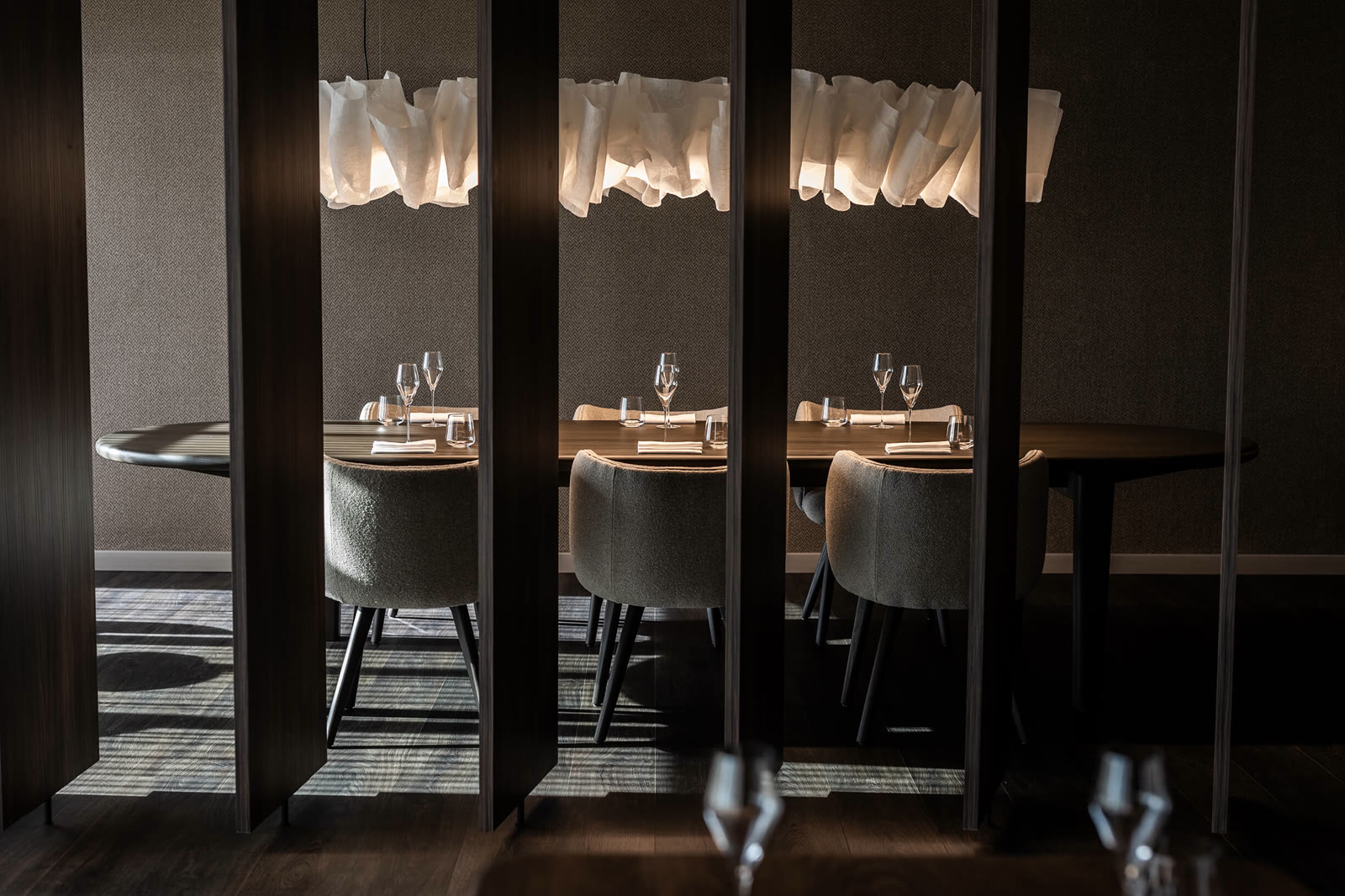
Image context: the lead image uses MERTIA's official interior photograph rather than a plated dish because the article is about room logic before it is about menu poetry. The table is half-screened, softly lit, and clearly spaced; that visual rhythm supports the argument that the restaurant's strongest craft lives in pacing and containment as much as in cooking.[5]
1. The room begins outside the room
The official story page gives away more than it probably intends. It describes crossing the antique gracht from De Wet Square as a kind of threshold: a small rite of passage that lets the guest leave behind the town's noise and "surrender to the ever-evolving experience of celebrating being together."[1] That sentence matters because it frames arrival as part of service design, not just local color. MERTIA is not on a remote estate where isolation is automatic. It sits at 20 Bird Street in central Stellenbosch and has to produce separation through sequencing instead.[1]
The interior image used here reinforces that point. The room is not loud, panoramic, or overtly performative. It is partitioned. Sightlines are filtered. Tables are not stacked on top of one another. The lighting is low enough to slow the eye without making the space unreadable.[5] For a service-and-operations lens, those design choices matter more than generic prettiness. They give the staff a controlled stage for conversation, plate drops, and pairing explanations.
Eat Out's 2024 review catches the effect from the guest side. Michael Cooke describes "smooth and seamless" service, notes the clarity of tableside explanations, and treats the pastry-chef presentation as part of the meal's structure rather than as an interruption.[3] That is the sort of evidence that makes the official "open dialogue" language believable. At weaker restaurants, dialogue usually means over-explaining. At MERTIA, the public materials suggest something narrower and more disciplined: the restaurant wants information to arrive at the table in measured intervals, with enough human personality to feel warm and enough structure to keep the dinner moving.[1][2][3]
2. The menu architecture protects tempo
MERTIA's current autumn menus are especially useful because they show how the restaurant controls pacing without pretending to be infinitely flexible. The public menu offers two clear ladders: a four-course menu at R950, with wine and non-alcoholic pairings at R1505 and R1325, and an eight-course menu at R1350, with pairing tracks at R2450 and R2300.[1] Those numbers are not just commercial details. They are time-management tools. A guest is asked to choose not only spend level, but also duration, repetition, and how much explanatory service they want the table to carry.
The dish names reveal the same structure. The shorter menu runs from Caesar Choux and Curried Mince Vetkoek through Linefish, Brandade, Minestrone and Petit Poussin before finishing with Keitt Mango & Granadilla.[1] The longer version adds a welcome sparkling choice, Kimchi & Crayfish, and an additional dessert course, while keeping the same spine.[1] In other words, MERTIA is not operating two unrelated experiences. It is scaling one argument up or down. That is often the mark of a restaurant that has thought hard about labor and flow. Every extra course has to earn its place without breaking the sequence.
Cooke's review fills in the sensory side of that discipline. He describes an opening summer-tomato gazpacho tied to a named supplier, a smoked concrete-egg presentation for yolk, potato, truffle, and Parmesan, and a menu that feels "carefully orchestrated with precision, detail and finesse."[3] What matters here is not the reviewer's approval alone. It is the verb: orchestrated. MERTIA's public menu, pairing architecture, and review language all point to the same operational identity. This is a restaurant trying to turn tasting-menu complexity into something legible and paced rather than sprawling.[1][3]
3. Service is treated as authored work
The strongest independent evidence for MERTIA's real priorities comes from the service-award material. In Eat Out's March 2026 piece on exceptional service, Marais says the team lives by his grandmother's line, "Everything worth doing, is worth doing well," and ties the award directly to constant training, effort, and the importance of the "little things" that shape a guest's memory.[2] He also makes a harder claim: service cannot be reduced to protocol, because without it the entire experience changes.[2]
That matters because the restaurant's own biography page already suggests a deliberately split authorship model. Marais is the dining-room architect, with front-of-house experience in the Cape, NoMad in New York, and Klein JAN, plus a later return to the US and work around Atelier Crenn.[1] Matt's route runs through Waterkloof, Greenhouse, The Test Kitchen, and La Colombe, then back into a more accessible but still ambitious South African frame.[1] The house is effectively telling you that MERTIA was built by two people who did not want cuisine and hospitality to be separated into unequal departments.
That is also why the restaurant's current rules around gratuity are so revealing. The official menu states that a 13% gratuity is added to the final bill and shared across the whole team.[1] Plenty of restaurants hide that point or leave it to the close of service. MERTIA puts it upfront. Operationally, that creates a cleaner contract. Editorially, it tells the guest that the experience is being authored collectively: kitchen, floor, and support staff are all named in the economics of the meal before the first plate arrives.[1][2]
4. Friction is managed before it becomes awkward
The most mature part of MERTIA's operating system may be its willingness to state boundaries plainly. Reservations require a R500 per guest deposit. Cancellations made more than 48 hours in advance are refundable; later changes or no-shows are not.[1] Dietary requirements have to be declared at the time of booking, not improvised on the day.[1] Children are welcome only if they are older than 12. Photography is allowed, but no flash is permitted, and outside photographers require prior notice and an added fee.[1]
Some guests read these rules as stiffness. In practice, they often do the opposite. They remove the emotional theater of case-by-case negotiation and protect the pace promised by the room itself. The same principle appears in smaller details: corkage is capped, pairings are integrated into the menu logic, office hours are stated, and wheelchair accessibility is addressed directly rather than buried.[1] This is the administrative side of hospitality, and MERTIA seems unusually unembarrassed by it.
That helps explain why the restaurant's recent recognition makes sense. Awards language often drifts into abstraction, but the MERTIA evidence stack is unusually coherent. The official site promises intimate dialogue, seasonal structure, local produce, and care that extends beyond the table through its 1% donation commitment to Huis Horison.[1] Eat Out's review describes a meal whose craft and service are both tightly composed.[3] Eat Out's service feature explains the training philosophy behind that tone.[2] And the March 24, 2026 awards coverage places the restaurant simultaneously in the top tier for cooking and in the category specifically devoted to service excellence.[4]
That combination is what makes MERTIA more than a promising Stellenbosch address. Its strongest luxury is not volume, spectacle, or estate grandeur. It is the decision to make timing visible and to make hospitality behave like a designed medium. The crossing, the room, the menu ladder, the pairing logic, the pre-declared service charge, and the booking rules all push in the same direction. At MERTIA, intimacy is not a mood. It is an operating system.[1][2][3][4]
Sources
- MERTIA Restaurant official homepage - current story, team biographies, menu structure and pricing, pairing tracks, 13% whole-team gratuity, deposit and cancellation rules, dietary and photography policies, and Huis Horison commitment.
- Eat Out, "Transforming the dining experience: The art of exceptional service" - March 2026 feature quoting Marais Kirsten-Uys on training, service philosophy, and MERTIA's 2025 Service Excellence Award.
- Eat Out, "Review: Savour a menu of precision, detail and finesse at MERTIA in Stellenbosch" - February 27, 2024 review covering front-of-house roles, smooth service, menu construction, pairing logic, and dining-room execution.
- Time Out Cape Town, "FYN takes top honours as Cape Town sweeps Eat Out awards" - March 24, 2026 awards coverage listing MERTIA in the three-star tier and naming it winner of the Service Excellence Award.
- MERTIA official interior image asset used for the lead photograph.