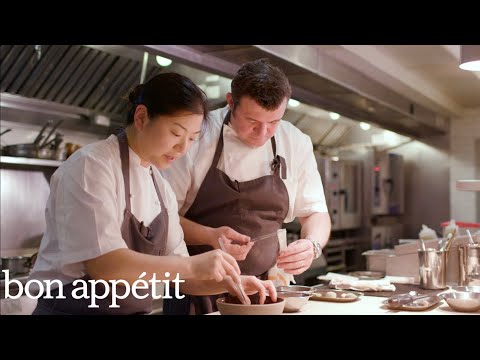
The useful way to watch Bon Appetit's 2018 Frasca short is to ignore the generic phrase "farm-to-table" for a minute.[1] The video uses it because that is a familiar American shorthand, and Frasca does in fact care about seasonal produce and same-day harvests.[1][3] But the more revealing story in the clip is regional and social at once. Frasca is trying to turn Friuli-Venezia Giulia into a Boulder neighborhood habit, not into an expensive costume drama.
Frasca's own current site makes that reading easier. The home page says the restaurant tells the story of Friuli-Venezia Giulia through the lens of Colorado, and it foregrounds warm, gracious hospitality just as strongly as cuisine and wine.[2] The menu page adds the operating proof. There is a Quattro Piatti menu at $150, a longer Friulano Menu at $230, and explicit pairing structures that keep wine inside the main experience rather than off to the side.[3] This is important because Frasca is not presenting Friuli as a museum topic. It is presenting Friuli as a live dining grammar that can scale from a shorter four-course format to a more elaborate tasting arc while staying recognizably itself.
That is why the video is worth annotating. In four minutes, it lays out almost the whole house logic. First it explains what a historical frasca was in northeastern Italy: a local place where a branch on a mailbox told passersby they could stop for family food and wine.[1] Then it broadens Friuli into an intersection of sea, foothills, mountains, Slavic contact, Austrian contact, and white-wine culture.[1] Then it shows the team translating that border-region complexity into Colorado seasonality, guest-specific service rituals, and even a traditional frico treated with fine-dining precision.[1][2][3]
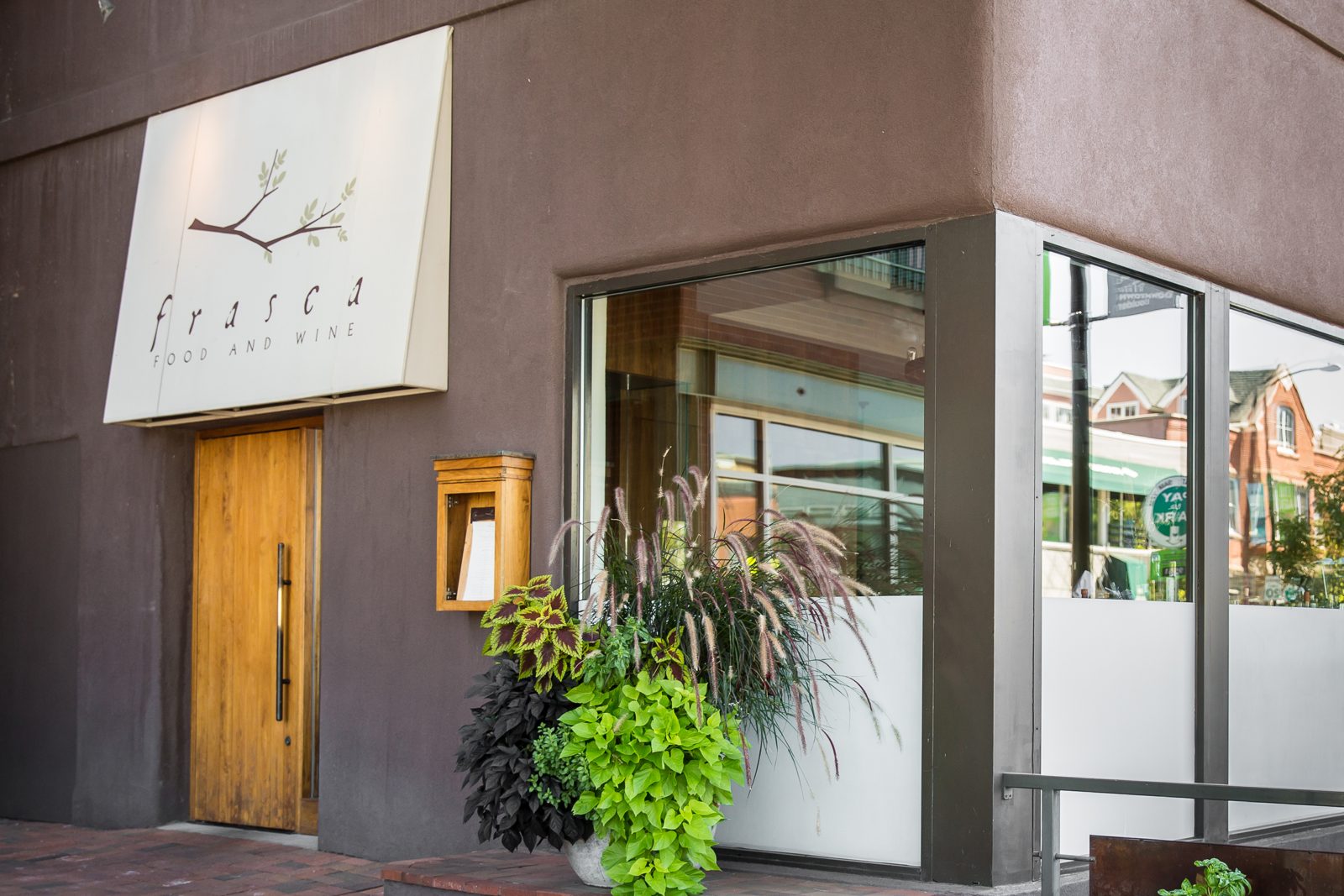
Image context: the cover uses Frasca's official exterior photograph rather than a plated close-up because the central claim here is about format.[5] Frasca matters not only for what is on the plate, but for the way a Michelin-recognized restaurant on Pearl Street keeps projecting neighborhood ease even while it runs a highly structured wine-and-tasting operation.[2][4][5]
Around 0:00 to 1:12, the video explains that Friuli is useful because it behaves like a border system, not a single-style cuisine
The opening minute gives Frasca its strongest intellectual defense.[1] Bobby Stuckey starts with the old meaning of a frasca, a roadside family place signaled by a branch, then quickly shifts to the region that inspired the restaurant.[1] His description of Friuli-Venezia Giulia is what matters: sea, inland wine country, foothills, and mountains all within a relatively tight span, plus crosscurrents from Slovenia, Austria, and older trade routes.[1] In other words, the restaurant's source material is not "Italian" in the flat, red-sauce sense. It is already mixed, already layered, already shaped by borders.
That makes Frasca much more interesting than a generic regional import. The official site says it brings Friuli to life in a uniquely Colorado setting, and the phrase can sound like branding until you put it next to the video.[2] Once you hear the region described as an intersection, the Colorado angle stops looking like dilution. It starts looking like a structurally similar move. Frasca is taking one place defined by overlap and rearticulating it in another place where local produce, Rocky Mountain seasonality, and American dining expectations all have to be negotiated in real time.[2][3]
This is also why the restaurant has endured as more than a wine-destination relic. A narrow concept can get stiff over time. A border concept stays alive because it keeps giving the kitchen and dining room permission to translate rather than merely preserve. The opening minute of the video quietly establishes that Frasca is not trying to be a perfect facsimile of Friuli. It is trying to be faithful to Friuli's way of absorbing differences and turning them into a house style.[1][2]
Around 1:25 to 2:12, the wine program acts like a first language rather than a luxury accessory
The middle of the video is where Frasca separates itself from a lot of American fine dining.[1] Stuckey says the wine team thinks Friuli first, northern Italy second, and then the rest of the world, then argues that Friuli is Italy's greatest white-wine region and a place where famous grapes sit beside more idiosyncratic local varieties.[1] That sequence is revealing because it shows the wine program functioning as worldview, not decoration.
Plenty of fine-dining restaurants have deep cellars. Frasca's distinction is that wine helps define how the whole restaurant thinks. The official home page pairs cuisine and wine from the first sentence, while the menu page keeps pairings structurally visible instead of burying them behind a sommelier script.[2][3] That matters because the guest is being taught to read Friuli through the glass as much as through the plate. A region known for white wine, mixed borders, and small shifts in terrain needs a dining room that can explain difference without turning the evening into a lecture. The video suggests that this is exactly what the room wants to do.[1]
There is a larger fine-dining point here. Many luxury restaurants still treat wine as a prestige amplifier. Frasca treats it more like narrative infrastructure. If the cuisine is about an unusually compact region where mountain, sea, and neighboring cultures all press into each other, the wine program becomes the cleanest way to make that compression legible. This is one reason the restaurant can stay grounded while serving at a very high level. Wine does not float above the meal. It keeps the meal geographically honest.[1][2][3]
Around 2:12 to 3:16, Colorado seasonality prevents the restaurant from becoming a frozen tribute act
The video's next move is just as important. Stuckey pivots from regional explanation to produce, saying the menu should reflect the season and praising food harvested in the morning and landing in the kitchen that same afternoon.[1] That line could describe many ambitious American restaurants, but at Frasca it has a special role. Seasonality is the mechanism that stops Friuli from hardening into reenactment.
The current menu page shows exactly how that works in May 2026. Alongside older regional references, you get ingredients such as white asparagus, Colorado lamb, green garlic, watercress, red beet, rhubarb, sugar snaps, and other products that clearly belong to a living local market rather than a nostalgic import project.[3] The shorter and longer menus both operate this way. They keep the restaurant attached to northeastern Italy as a flavor logic, but they let Colorado determine the actual pulse of the plate.[2][3]
This is where Frasca's "farm-to-table" reputation becomes more precise. The kitchen is not chasing localism for moral theater alone. It is using local harvest rhythm to keep a regional Italian idea breathable in Boulder. That is a stronger and harder task. A replica restaurant can become inert. A translated restaurant has to make continuous decisions about which parts of its inheritance are essential and which parts should bend with place and season. The video's produce section shows Frasca choosing motion over stiffness.[1][3]
Around 3:23 to the end, frico and pre-service ritual show why the restaurant still feels warm instead of overdetermined
The final stretch of the short provides the emotional key.[1] The team talks through a version of frico, the classic Friulian cheese-and-potato preparation, and the video cuts through a pre-service meeting where front and back of house review the incoming guests in detail.[1] Those scenes belong together. One is about a traditional dish. The other is about the social labor that keeps a fine-dining room personal. Together they explain Frasca's most durable ambition: Stuckey says the goal is to be the greatest neighborhood restaurant in the world.[1]
That line could sound like sentimental branding if the room did not support it. But the official site's repeated emphasis on gracious hospitality, and the concept of the original frasca itself, make the goal believable.[1][2] The restaurant is trying to do something difficult: hold onto Michelin-level precision, a serious wine identity, and a specific regional reference without becoming chilly. The pre-service ritual matters because it turns hospitality into a daily craft rather than an abstract virtue. The frico matters because it reminds the guest that regional cuisine is supposed to comfort before it is supposed to impress.[1][2]
This is why Frasca still reads cleanly in 2026. The house does not pretend Boulder is Friuli, and it does not pretend neighborhood warmth is the enemy of formal rigor. It keeps those things in active conversation. Borderland cuisine, white-wine intelligence, seasonal Colorado produce, and guest-specific service all pull in the same direction. The result is a restaurant whose deepest luxury is not spectacle. It is the feeling that serious taste and genuine ease can occupy the same room without one canceling the other.[1][2][3][4]
Sources
- Bon Appétit, "Frasca Food & Wine, Boulder's Italian Inspired Farm-To-Table Restaurant," YouTube video.
- Frasca Food and Wine official homepage - current positioning on Friuli-Venezia Giulia through Colorado, Michelin and James Beard recognition, and the restaurant's hospitality emphasis.
- Frasca Food and Wine, "Menus & Wine List" - current Quattro Piatti and Friulano menu structures, pricing, and seasonal dish descriptions.
- Frasca Food and Wine, "Hours & Location" - Pearl Street placement and current guest-facing location details.
- Frasca Food and Wine official exterior image asset used for the lead photograph.