Mérito could have become an easy restaurant to misread. Put a Venezuelan chef in Lima, give him a room in Barranco, place the restaurant on the global lists, and the headline almost writes itself: fusion. The word is not exactly wrong, but it is too blunt for what Juan Luis Martínez appears to be building. Mérito is more interesting when read as a house system for migration: a place where Venezuelan memory, Peruvian product, Andean and coastal ingredients, open-kitchen intimacy, and Barranco's old-house texture are made to speak in one grammar.
That matters now because Mérito is no longer a local secret or a promising side note in Lima's crowded fine-dining ecosystem. The 50 Best Discovery profile lists it at No. 26 on The World's 50 Best Restaurants 2025 and No. 4 on Latin America's 50 Best Restaurants 2025, while describing it as a cozy two-storey Barranco restaurant with an open kitchen at the center and Venezuelan dishes built from Peruvian ingredients.[2] The regional 50 Best page gives the human version of the same story: Martínez, from Caracas, opened Mérito in 2018 after time at Central, then turned the restaurant into a sophisticated meeting of Peruvian and Venezuelan flavors.[3]
The useful question is not whether Mérito has become important. The evidence says it has. The better question is why its importance feels different from the more familiar Lima story of biodiversity, altitude, and research cuisine. Mérito's proposition is narrower and warmer. It does not try to turn Peru into a full territorial map. It asks what happens when one cook's memory of another country is rebuilt with the materials, tempo, and appetite of Lima.
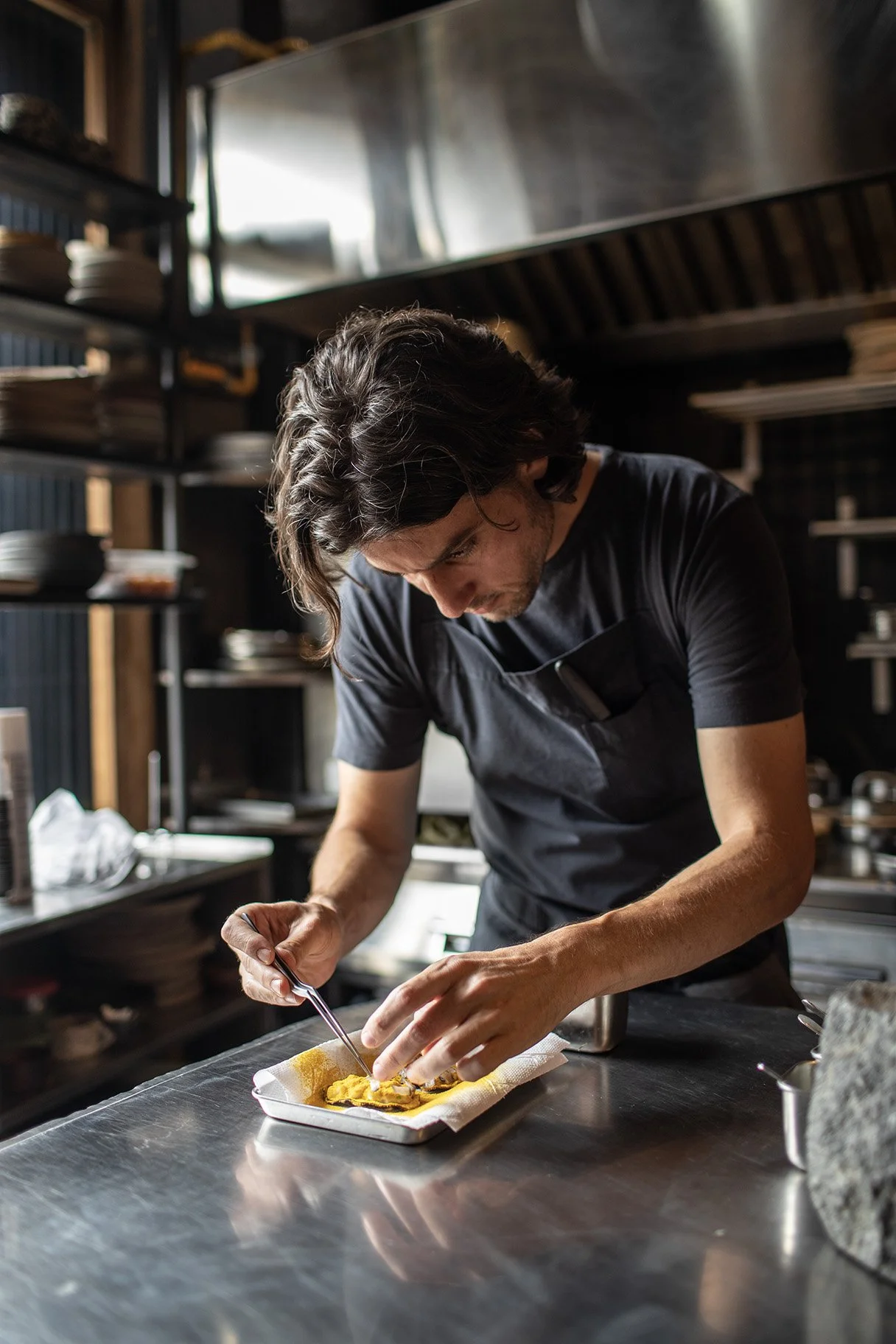
Image context: the cover uses an official Mérito kitchen photograph rather than a dining-room exterior or ranking image. The choice matters because this profile turns on the restaurant's proximity: diners are meant to feel the cooking as an active exchange, not as a sealed prestige performance.[1][6]
The House Does Work Before The Menu
The official Mérito page gives the room unusually concrete weight. It says the restaurant is built from adobe walls more than 150 years old, stone floors, and wooden tables. The first floor is described as sensory and close because the diner is inside the kitchen, interacting with cooks and seeing the step-by-step making of dishes; the second floor becomes a dining room with two connected environments.[1] That is not neutral decor copy. It explains the restaurant's social scale.
In many tasting rooms, the kitchen is visible as theatre: stainless steel, flames, and choreographed concentration. Mérito's open kitchen seems to work more like a conversation device. The guest is near enough to understand that the restaurant's strongest claim is not polished hybridity from a distance, but translation happening by hand. Arepas, roots, tropical fruit, pork belly, Andean curry, tubers, coffee, lucuma, cocona, and mashua do not become interesting because they appear on a list. They become interesting because the room makes their crossings feel deliberate.[2][3]
That is why Barranco matters. A new luxury box could have made the food look more globally generic. An old house in a coastal, arts-heavy district gives the restaurant a different emotional contract: layered, imperfect, inhabited. Infobae reports Martínez saying he wanted a place with history rather than a new building, and that Mérito's walls "speak."[5] Whether or not one takes that phrase literally, it clarifies the design instinct. Mérito wants a room that can hold memory without turning it into museum atmosphere.
Venezuela Is Not A Garnish
The strongest versions of fusion cooking usually avoid the word because they are doing something stricter. Mérito is not adding Venezuelan references to Peruvian fine dining as decorative accent. It is using Venezuelan memory as a method for reading Peruvian ingredients.
The 50 Best Discovery profile gives the sharpest dish clue: glazed pork belly "char siu" with fluffy arepas has become a repeat-customer favorite.[2] That dish sounds playful, but its structure is serious. The arepa is not nostalgia pasted onto an international pork preparation. It changes how the bite is held, how fat is carried, and how the diner reads softness, sweetness, grain, and meat together. The regional 50 Best page names other signals: Andean curry; beef with arracacha and mango; cocona with mashua and lemon verbena.[3] These are not attempts to prove that Peru and Venezuela are the same. They are attempts to let shared Latin American materials behave differently when they pass through one chef's biography.
RPP's interview account makes that biographical pressure explicit. Martínez arrived in Peru in 2014 for an internship at Central and described Lima as a place where he felt able to live, work, and express who he was.[4] The same report says Mérito was born from two gastronomic cultures, Peru and Venezuela, and names dishes such as reinterpreted arepas and Peruvian corn with Venezuelan cheese.[4] The point is not sentiment alone. It is authorship. Mérito's food has force because the migration story is not abstract empathy; it is a daily operating condition.
That condition also protects the restaurant from becoming a simplified "Lima plus Caracas" formula. Infobae quotes Martínez framing the connection more broadly, through the Andes, Amazon, sea, identity-bearing products, and nostalgia.[5] This is where Mérito becomes a Latin American restaurant rather than a binary fusion restaurant. The map is not only two flags. It is a set of routes, crops, memories, and techniques that keep crossing borders before they reach the plate.
Why The Format Feels Timely
Mérito's timing is useful because Lima's global dining image has become unusually strong and unusually easy to flatten. Central made territory and research globally legible. Maido turned Nikkei into a world-leading fine-dining language. Mayta, Kjolle, and others keep expanding the city's high-end range. In that context, Mérito's rise could be treated as one more ranking entry. That would miss the more interesting signal.
What Mérito adds is a different model of seriousness. The official page describes a changing menu built from Latin American pantry and constant reinvention.[1] The 50 Best pages emphasize open kitchen, two floors, Barranco, local regulars, Venezuelan memory, Peruvian ingredients, cocktails, and the related projects Demo and Clon.[2][3] RPP adds the team dimension, reporting that Martínez and his wife Michelle work with a team of nearly 90 people, with Michelle responsible for design and visual experience.[4] Taken together, those facts suggest a restaurant trying to scale intimacy without losing the feeling of a personal house.
The pricing and format signals are part of that. 50 Best Discovery lists the tasting menu from $75, lunch Tuesday to Saturday, and dinner Monday to Saturday.[2] Infobae reports both a tasting-menu lane and an a la carte structure, with examples ranging from grilled corn and scallops to glazed pork belly, flan, and chirimoya desserts.[5] The restaurant may evolve, and prices can change, but the public evidence points to a room that does not rely solely on a long, solemn menu as proof of seriousness. It keeps a more flexible appetite in view.
That flexibility is important. Migration cooking can turn stiff when it tries too hard to explain itself. Mérito seems strongest when it lets explanation and appetite stay close: open kitchen, old walls, bar seats, arepas, roots, fruit, cocktails, desserts, and a room compact enough for the guest to sense movement. The result is not modest in ambition, but it is deliberately less monumental than the grandest Lima tasting rooms.
The Restaurant's Real Subject
The most useful way to describe Mérito is not "Venezuelan-Peruvian fusion." It is a restaurant about how identity becomes practical. Identity here is not a mural on the wall or a paragraph on the menu. It is the decision to put the guest near the kitchen, to keep the old building's material memory visible, to let Venezuelan forms handle Peruvian ingredients, to make cocktails and desserts part of the same crossing, and to build sister projects that extend the restaurant's ideas into more casual formats.[1][3][4]
That is why Mérito feels current in 2026. Fine dining has spent years learning how to talk about place. Mérito's contribution is to make place move. Its Lima is not only Barranco, and its Venezuela is not only home country memory. Both become active ingredients: one supplies room, produce, audience, and market; the other supplies longing, format, and sensory reflex. The meal works when neither side disappears.
The rankings will bring more travelers to the door.[2][3][4] The better reason to go is smaller and more durable: Mérito shows how a restaurant can make migration legible without turning it into a speech. It does the harder thing. It cooks the crossing until it has texture.
Sources
- Mérito Restaurante, "Sobre" - official page on the 150-year-old adobe walls, stone floors, two-floor layout, open-kitchen proximity, Barranco address, hours, and the restaurant's Latin American pantry framing.
- 50 Best Discovery, "Mérito - Lima - Restaurant" - current profile covering the No. 26 global and No. 4 Latin America rankings, Central background, open kitchen, two-storey room, key dishes, bar seats, tasting-menu price, and service windows.
- Latin America's 50 Best Restaurants 2025, "Mérito" - regional profile on Juan Luis Martínez, the 2018 opening, Peruvian-Venezuelan flavor structure, tasting-menu examples, cocktails, Demo, Clon, and Barranco setting.
- Brenda García Retamal, "'Mérito' ingresó al The World's 50 Best 2025," RPP, June 22, 2025 - interview-based report on Martínez's Central path, Venezuelan roots, Peru as home, dishes, recognition, team scale, and Michelle's design role.
- Jordan Arce, "Mérito, el restaurante en Lima de un chef venezolano que entró a la lista de los 50 mejores del mundo," Infobae, June 24, 2025 - report on the Barranco house, migration frame, open kitchen, representative dishes, tasting-menu and a la carte context, and seasonal menu variation.
- Mérito Restaurante official image asset, "Soto_23.jpg" - real kitchen photograph used as the article image.