KOKS' Greenland chapter is easiest to misunderstand if it is treated as stunt geography: the famous Faroese restaurant goes farther north, diners cross a bay, the story becomes remoteness. That is the least useful reading. The sharper one is an ingredient and sourcing report. In Ilimanaq, KOKS tested whether a fine-dining language built in the Faroe Islands could be rebuilt from a different Arctic pantry without turning local culture into garnish.
The boundary matters because this is not a current booking recommendation. Visit Faroe Islands now lists KOKS with closed opening hours, and World of Greenland's current Ilimanaq Lodge restaurant page presents Restaurant Egede as the active local restaurant concept rather than a live KOKS residency.[1][2] That makes the Ilimanaq period more valuable as a completed case study. It lets the meal be judged not by scarcity hype, but by the operational question it raised: what happens when a two-star kitchen moves into a protected colonial manager's house from 1741 and has to make dinner out of what the surrounding sea, tundra, hunters, fishers, and seasons can support?[2][3]
Air Greenland's opening report gives the cleanest statement of intent. The group had agreed that KOKS would take over Restaurant Egede in Ilimanaq, a historic building run by World of Greenland, and use the destination's seafood, game, and plants as the basis for dishes that people would travel for.[3] Owner Johannes Jensen framed the move as a long investment in Greenland and in food "true to the culture far to the north," while also naming training for Greenlandic chefs and service staff as part of the project.[3] That second detail is important. A remote tasting menu becomes thinner if all the skill, language, and authority are imported for a season and then leave unchanged. KOKS' stated ambition was at least broader than that.
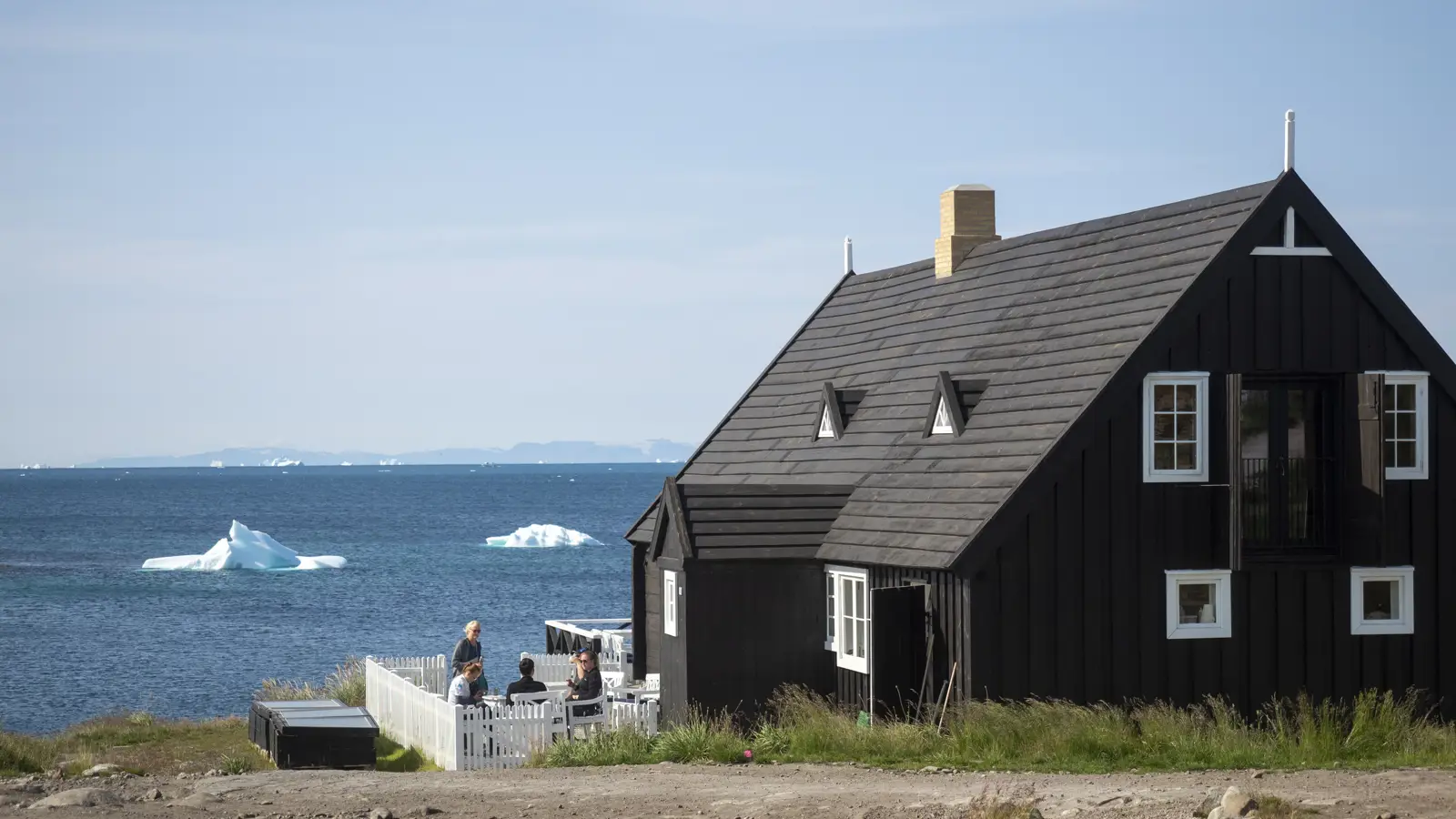
Image context: the cover image shows the Ilimanaq KOKS setting rather than a trophy plate. For this piece, the building is part of the sourcing argument. The meal depended on a protected house, local settlement logistics, and access to ingredients that do not behave like a metropolitan supply chain.[2][3][6]
The Pantry Was Not A Theme
KOKS arrived in Greenland with a recognizable house discipline. Michelin's earlier Faroe Islands profile described the restaurant's core language as seasonal Faroese produce shaped through drying, fermenting, salting, and smoking, with dishes built from scallops, dulse, blueberry, air-dried lamb, and fermented meat rather than luxury ingredients flown in for status.[4] Visit Faroe Islands says the same thing in tourism language: KOKS focuses on Faroese seasons, local produce, sustainability, and ancient practices such as drying, fermenting, salting, and smoking.[1]
The Greenland challenge was therefore not simply "find new local ingredients." It was whether those practices could remain serious when the pantry changed. Air Greenland's report names the opening menu's logic: seal blood tartlet with mussels and seaweed, snow crab in truffle seaweed dashi, and grouse with blackcurrant salsa.[3] Euronews' 2022 report adds the human and logistical frame, placing the restaurant in Ilimanaq Lodge, a settlement it described as having 53 inhabitants, reachable from Ilulissat by a boat ride across the bay.[5] Those details can sound theatrical, but they also define the supply chain. If the kitchen is going to serve seal, shellfish, birds, seaweed, berries, and fermented or preserved products in that setting, the meal has to respond to availability, weather, transport, and local knowledge rather than to a distributor's catalog.
That is why the most interesting KOKS dishes from the Ilimanaq period are not interesting because they are unusual. They are interesting because they force the restaurant to show its method. A seal blood tartlet is not just provocation. It asks whether a kitchen can carry a culturally specific protein into a tasting-menu format without sanding it into novelty. Snow crab with seaweed dashi asks a different question: can Arctic sweetness, marine salinity, and Nordic-Japanese broth logic meet without the broth becoming a borrowed prestige accent? Grouse with blackcurrant salsa is more legible to outsiders, but even there the key is season, locality, and acidity rather than a generic game course.[3]
Scarcity Was The Design Constraint
Most city tasting menus use abundance quietly. Even when they talk about seasonality, they can usually call multiple suppliers, replace one product with another, or keep a dish stable through a long service window. Ilimanaq made that kind of stability harder. Air Greenland's article says KOKS spent many hours picking grouse before service and needed substantial preparation time to make an 18-dish menu.[3] The point is not quaint labor. It is scheduling. A meal like this has to be planned backward from what can be gathered, landed, stored, prepared, and served within a short northern season.
That constraint is why the restaurant's earlier Faroe Islands grammar mattered. Drying, fermenting, salting, and smoking are not only flavor signatures. They are technologies for smoothing uneven supply.[1][4] In the Faroes, those methods connect KOKS to island foodways and weather. In Greenland, they become a way to negotiate a more extreme version of the same problem. The kitchen can make freshness vivid, but it also has to know when preservation is the point.
This is where the Ilimanaq residency becomes more than a luxury detour. It was a test of whether fine dining can make scarcity feel precise rather than deprived. The better version of that answer is not to pretend the Arctic is a limitless pantry. It is to let the meal show that limits are part of the taste: brine, iron, smoke, bitter herbs, cold-water shellfish, dark berries, dense meat, and the quiet drama of ingredients that arrive through people rather than channels.
The Building Kept The Meal Honest
World of Greenland's current Restaurant Egede page is useful because it separates the place from KOKS' temporary fame. It describes the restaurant as located in an old colonial manager's house from 1741, one of Greenland's oldest buildings, now protected, with original elements such as old planks, canvas walls, and even a sail from a whaling ship.[2] It also says the active Restaurant Egede concept is built around Greenlandic ingredients, seasonal creativity, and a relaxed link to local culture rather than gastronomic prestige.[2]
Read backward, that makes the KOKS residency look less like a takeover and more like a pressure test inside a pre-existing cultural container. A global restaurant brand entered a building that already carried missionary history, trade history, whaling memory, restoration craft, and settlement scale. The room could not plausibly be treated as a blank luxury shell. It gave the meal weight and also made the ethical stakes sharper. If a kitchen serves seal, grouse, mussels, berries, and seaweed there, it has to do more than arrange them beautifully. It has to avoid turning the place into stage dressing for outsiders.
Air Greenland's report suggests that KOKS understood at least part of that risk. Jensen spoke about strengthening historical traditions of the original culture, and the report explicitly connected the project to training Greenlandic chefs and service staff.[3] That does not prove a perfect exchange. Seasonal residencies can still concentrate prestige elsewhere. But it does show the right problem was visible: the sourcing story had to include people, not only products.
What Remained After KOKS
The strongest evidence that the Ilimanaq experiment was larger than one prestige season is the current shape of Restaurant Egede. World of Greenland now describes a kitchen drawing inspiration from the surrounding nature of Ilimanaq, serving a seasonal signature dinner and a lunch format that can be eaten in the dining area or taken into the landscape.[2] The language is explicitly less star-driven. It does not aim for gastronomic prestige; it emphasizes connection to nature, culture, and hospitality.[2]
That shift is not a downgrade in the story. It clarifies the distinction between two valid dining modes. KOKS used extreme craft to prove how forcefully the Arctic pantry could carry a world-class tasting menu. Restaurant Egede appears to be using the same place more gently, as a restaurant tied to lodge life, local setting, and seasonal ingredients without the burden of international spectacle.[2][3]
For fine dining, KOKS' Ilimanaq lesson is still alive even if the residency is over. The meal matters because it made sourcing physical. It was not enough to say "local." The kitchen had to deal with a small settlement, boat access, a protected 1741 house, short seasons, unfamiliar products, staff training, and diners who arrived with global expectations. That is a more serious test than remoteness as marketing.
The best version of the KOKS Greenland story is therefore not "the world's remote restaurant." It is narrower and better: for a few seasons, a Faroese fine-dining language had to prove that it could listen to a different Arctic larder. The interesting part is not how far diners traveled to get there. It is how little the meal could take for granted once they arrived.
Sources
- Visit Faroe Islands, "KOKS" - current tourism listing with KOKS' Faroe Islands produce philosophy, preservation methods, contact details, and closed opening-hours status.
- World of Greenland, "Restaurant Egede" - current Ilimanaq Lodge restaurant page describing the 1741 protected building, Greenlandic ingredient focus, seasonal dinner, and relaxed local-culture framing.
- Air Greenland, "Restaurant KOKS in ilimanaq open to guests," June 20, 2022 - opening report on the KOKS takeover of Restaurant Egede, local seafood/game/plant sourcing, chef training ambitions, sample dishes, price, season dates, and preparation constraints.
- The MICHELIN Guide Nordic Editorial Team, "What to Eat at Two-Michelin-Starred KOKS in the Faroe Islands" - Michelin's profile of KOKS' Faroe Islands tasting-menu grammar, local produce, and preservation techniques.
- Theo Farrant with AFP, "Would you eat this feathered bird wing dish at the world's most remote Michelin-starred restaurant?" Euronews, July 6, 2022 - report on the Greenland move, Ilimanaq Lodge setting, 30-seat format, local ingredients, and Ilulissat boat-access context.
- Air Greenland image asset, "restaurant-koks-lisa-burns-2019.jpg" - Lisa Burns photograph of Restaurant KOKS in Ilimanaq used as the article image.